115195
论文已发表
注册即可获取德孚的最新动态
IF 收录期刊
- 3.6 Breast Cancer (Dove Med Press)
- 4.3 Clin Epidemiol
- 2.6 Cancer Manag Res
- 3.2 Infect Drug Resist
- 4.1 Clin Interv Aging
- 6.1 Drug Des Dev Ther
- 4.1 Int J Chronic Obstr
- 8.7 Int J Nanomed
- 2.5 Int J Women's Health
- 3.2 Neuropsych Dis Treat
- 2.4 OncoTargets Ther
- 2.6 Patient Prefer Adher
- 2.6 Ther Clin Risk Manag
- 3.1 J Pain Res
- 3.5 Diabet Metab Synd Ob
- 4.5 Psychol Res Behav Ma
- 3.4 Nat Sci Sleep
- 2.4 Pharmgenomics Pers Med
- 2.6 Risk Manag Healthc Policy
- 4.6 J Inflamm Res
- 2.3 Int J Gen Med
- 3.9 J Hepatocell Carcinoma
- 3.3 J Asthma Allergy
- 2.5 Clin Cosmet Investig Dermatol
- 3.0 J Multidiscip Healthc

金雀异黄素在雌激素受体 β1 阳性乳腺癌细胞中有较高的抗癌活性
Authors Jiang H, Fan JJ, Cheng L, Hu P, Liu RB
Received 1 August 2018
Accepted for publication 3 October 2018
Published 14 November 2018 Volume 2018:11 Pages 8153—8163
DOI https://doi.org/10.2147/OTT.S182239
Checked for plagiarism Yes
Review by Single-blind
Peer reviewers approved by Dr Andrew Yee
Peer reviewer comments 2
Editor who approved publication: Dr Leo Jen-Liang Su
Background: Most
breast cancers are estrogen dependent and were sensitive to endocrine therapy,
and genistein (GEN) shows strong affinity with human oestrogen receptor beta
(ERβ).
Purpose: The
present study aimed to investigate the anticancer activity of GEN in breast
cancer cell lines that constitutively expressing ERβ1 in vitro and in
vivo.
Methods: MCF-7/ERβ1
and MDA-MB-231/ERβ1 cell sub-lines were established through lentiviral
infection. Then, cells were treated with increasing concentrations of GEN (10-6 mol/l,
10-5 mol/l and 10-4 mol/l)
for 48 h, and cell proliferation, cell cycle analyses were performed to
investigate different biological characteristics of ERβ1-overexpressing cell
lines. Studies in vivo were also performed to investigate the effects of
dietary GEN on MCF-7/ERβ1 and MDA-MB-231/ERβ1 cells implanted mice.
Results: Results
showed that compared to parental cells, GEN inhibited the proliferation ability
of MCF-7/ERβ1 cells to a greater extent, especially at high concentrations.
MDA-MB-231 cells were also inhibited by high doses of GEN, but the
overexpressed ERβ1 did not enhance the anti-proliferative effect on MDA-MB-231
cells. ERβ1 arrested cells in G2/M phase, and GEN arrested cells in G0/G1,
which led to a combinatorial effect on cell cycle blockade. Furthermore, ERβ1
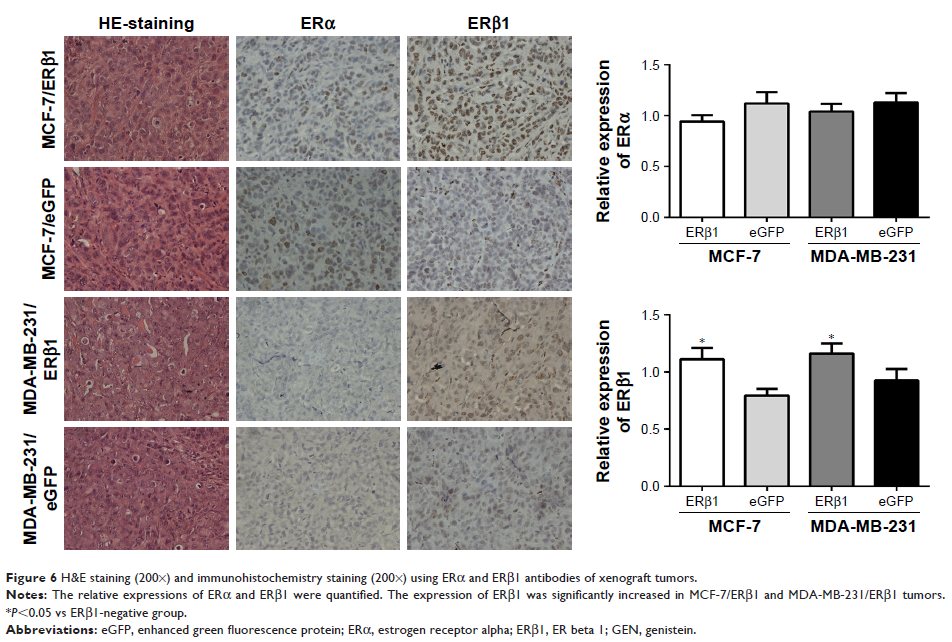
increased the anti-tumour activity of dietary GEN in MCF-7/ERβ1 subcutaneous
tumour models. Our data indicated that ERβ1 increased the anticancer efficacy
of GEN in MCF-7 cells by affecting cell cycle transition.
Conclusion: As a
result, GEN could be a potential therapeutic agent for ERβ1-positive cancer.
Keywords: breast
cancer, estrogen receptor beta 1, genistein, MCF-7 cells, MDA-MB-231 cells,
estrogen receptor alpha