115195
论文已发表
注册即可获取德孚的最新动态
IF 收录期刊
- 3.6 Breast Cancer (Dove Med Press)
- 4.3 Clin Epidemiol
- 2.6 Cancer Manag Res
- 3.2 Infect Drug Resist
- 4.1 Clin Interv Aging
- 6.1 Drug Des Dev Ther
- 4.1 Int J Chronic Obstr
- 8.7 Int J Nanomed
- 2.5 Int J Women's Health
- 3.2 Neuropsych Dis Treat
- 2.4 OncoTargets Ther
- 2.6 Patient Prefer Adher
- 2.6 Ther Clin Risk Manag
- 3.1 J Pain Res
- 3.5 Diabet Metab Synd Ob
- 4.5 Psychol Res Behav Ma
- 3.4 Nat Sci Sleep
- 2.4 Pharmgenomics Pers Med
- 2.6 Risk Manag Healthc Policy
- 4.6 J Inflamm Res
- 2.3 Int J Gen Med
- 3.9 J Hepatocell Carcinoma
- 3.3 J Asthma Allergy
- 2.5 Clin Cosmet Investig Dermatol
- 3.0 J Multidiscip Healthc

肿瘤培养的非小细胞肺癌血小板生物标志物的鉴定
Authors Sheng ML, Dong ZH, Xie YP
Received 15 June 2018
Accepted for publication 15 October 2018
Published 14 November 2018 Volume 2018:11 Pages 8143—8151
DOI https://doi.org/10.2147/OTT.S177384
Checked for plagiarism Yes
Review by Single-blind
Peer reviewers approved by Dr Amy Norman
Peer reviewer comments 2
Editor who approved publication: Dr Jianmin Xu
Background: Lung
cancer is a severe cancer with a high death rate. The 5-year survival rate for
stage III lung cancer is much lower than stage I. Early detection and
intervention of lung cancer patients can significantly increase their survival
time. However, conventional lung cancer-screening methods, such as chest
X-rays, sputum cytology, positron-emission tomography (PET), low-dose computed
tomography (CT), magnetic resonance imaging, and gene-mutation, -methylation,
and -expression biomarkers of lung tissue, are invasive, radiational, or
expensive. Liquid biopsy is non-invasive and does little harm to the body. It
can reflect early-stage dysfunctions of tumorigenesis and enable early
detection and intervention.
Methods: In this
study, we analyzed RNA-sequencing data of tumor-educated platelets (TEPs) in
402 non-small-cell lung cancer (NSCLC) patients and 231 healthy controls. A total
of 48 biomarker genes were selected with advanced minimal-redundancy,
maximal-relevance, and incremental feature-selection (IFS) methods.
Results: A support
vector-machine (SVM) classifier based on the 48 biomarker genes accurately
predicted NSCLC with leave-one-out cross-validation (LOOCV) sensitivity,
specificity, accuracy, and Matthews correlation coefficients of 0.925, 0.827,
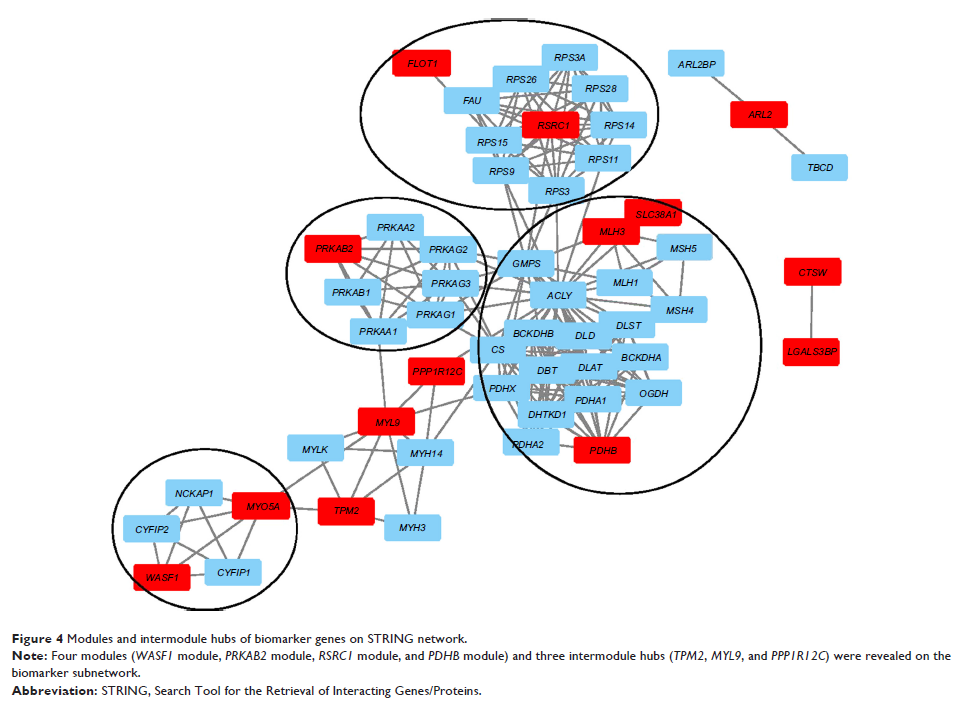
0.889, and 0.760, respectively. Network analysis of the 48 genes revealed that
the WASF1 actin
cytoskeleton module, PRKAB2 kinase module, RSRC1 ribosomal
protein module, PDHB carbohydrate-metabolism module, and three
intermodule hubs (TPM2 , MYL9 , and PPP1R12C ) may play important roles in NSCLC
tumorigenesis and progression.
Conclusion: The
48-gene TEP liquid-biopsy biomarkers will facilitate early screening of NSCLC
and prolong the survival of cancer patients.
Keywords: tumor-educated
platelet, TEP, liquid biopsy, minimal redundancy, maximal relevance, MRMR,
incremental feature selection, IFS, non-small-cell lung cancer, NSCLC