115195
论文已发表
注册即可获取德孚的最新动态
IF 收录期刊
- 3.6 Breast Cancer (Dove Med Press)
- 4.3 Clin Epidemiol
- 2.6 Cancer Manag Res
- 3.2 Infect Drug Resist
- 4.1 Clin Interv Aging
- 6.1 Drug Des Dev Ther
- 4.1 Int J Chronic Obstr
- 8.7 Int J Nanomed
- 2.5 Int J Women's Health
- 3.2 Neuropsych Dis Treat
- 2.4 OncoTargets Ther
- 2.6 Patient Prefer Adher
- 2.6 Ther Clin Risk Manag
- 3.1 J Pain Res
- 3.5 Diabet Metab Synd Ob
- 4.5 Psychol Res Behav Ma
- 3.4 Nat Sci Sleep
- 2.4 Pharmgenomics Pers Med
- 2.6 Risk Manag Healthc Policy
- 4.6 J Inflamm Res
- 2.3 Int J Gen Med
- 3.9 J Hepatocell Carcinoma
- 3.3 J Asthma Allergy
- 2.5 Clin Cosmet Investig Dermatol
- 3.0 J Multidiscip Healthc

促卵泡激素通过 NF-κB 通路抑制宫颈癌
Authors Shi X, Qiu S, Zhuang W, Wang C, Zhang S, Yuan N, Yuan F, Qiao Y
Received 7 May 2018
Accepted for publication 17 June 2018
Published 14 November 2018 Volume 2018:11 Pages 8107—8115
DOI https://doi.org/10.2147/OTT.S173339
Checked for plagiarism Yes
Review by Single-blind
Peer reviewers approved by Dr Narasimha Reddy Parine
Peer reviewer comments 2
Editor who approved publication: Dr Arseniy Yuzhalin
Background: Follicle-stimulating
hormone (FSH) has multiple biological functions. It is currently considered
that FSH can inhibit cervical cancer, and our aim was to explore the underlying
molecular mechanisms.
Materials and methods: An in
vivo experiment using nude mice injected with HeLa cells was performed. Flow
cytometry, western blotting, and real-time quantitative PCR analyses were done.
Results: Twenty
one days after injection of HeLa cells, the subcutaneous tumor mass was
significantly lower (P<0.01) in mice treated with 20 mIU/mL FSH, but did
not disappear. In vitro observations indicated that FSH might inhibit cell
proliferation and activate cell apoptosis to induce the reduction of HeLa
cells. The mRNA and protein levels of Cyclin D1, Cyclin E1, and Caspase 3
changed accordingly as expected in vivo and in vitro. Moreover, FSH inactivated
the nuclear factor-kappa B (NF-κB) pathway in subcutaneous tumors; the
NF-κB(p65) activity in HeLa cells was significantly decreased using 20 mIU/mL
FSH and was increased when FSH was administered along with lipopolysaccharide,
accompanied by the same change of cell number. Further, FSH accelerated protein
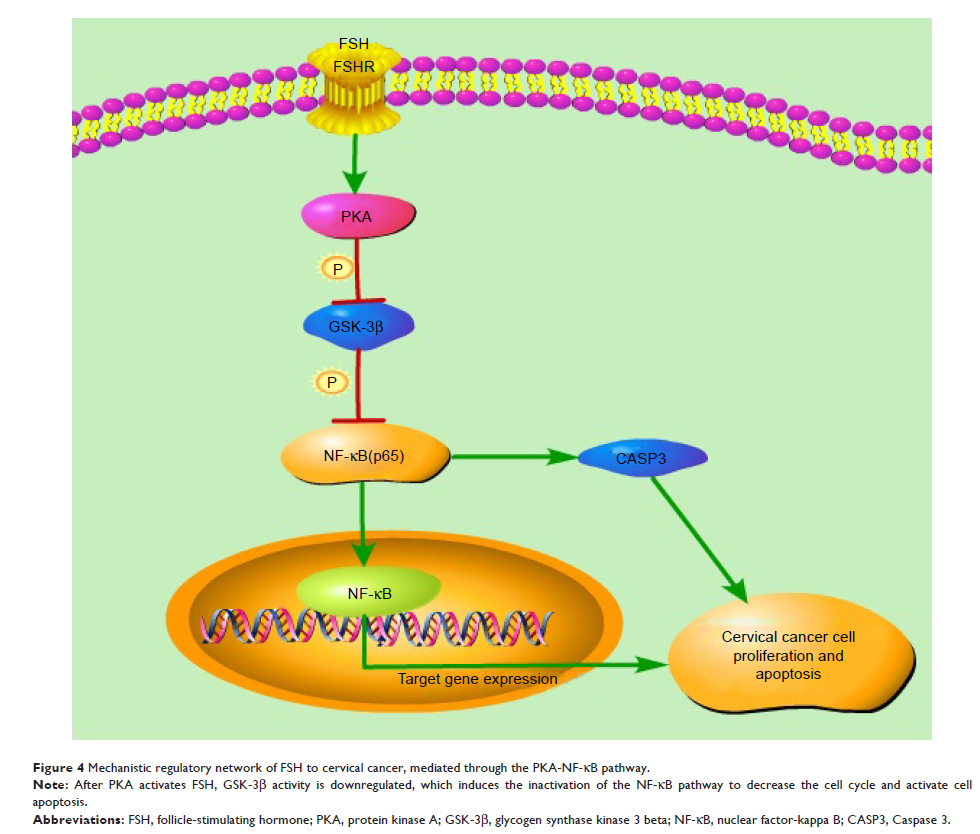
kinase A (PKA) activity, but inactivated glycogen synthase kinase 3 beta
(GSK-3β) activity. Specific inhibition of PKA and/or GSK-3β provided in vitro
evidence that directly supported the FSH-mediated inhibition of GSK-3β to
inactivate NF-κB via the promotion of PKA activity.
Conclusion: Our data
are the first description of the molecular regulatory mechanisms of
FSH-mediated inhibition of the development of cervical cancer by decreasing the
cell cycle and activating cell apoptosis via the PKA/GSK-3β/NF-κB pathway.
Keywords: FSH,
cervical cancer, cell cycle, apoptosis, PKA, NF-κB