115195
论文已发表
注册即可获取德孚的最新动态
IF 收录期刊
- 3.6 Breast Cancer (Dove Med Press)
- 4.3 Clin Epidemiol
- 2.6 Cancer Manag Res
- 3.2 Infect Drug Resist
- 4.1 Clin Interv Aging
- 6.1 Drug Des Dev Ther
- 4.1 Int J Chronic Obstr
- 8.7 Int J Nanomed
- 2.5 Int J Women's Health
- 3.2 Neuropsych Dis Treat
- 2.4 OncoTargets Ther
- 2.6 Patient Prefer Adher
- 2.6 Ther Clin Risk Manag
- 3.1 J Pain Res
- 3.5 Diabet Metab Synd Ob
- 4.5 Psychol Res Behav Ma
- 3.4 Nat Sci Sleep
- 2.4 Pharmgenomics Pers Med
- 2.6 Risk Manag Healthc Policy
- 4.6 J Inflamm Res
- 2.3 Int J Gen Med
- 3.9 J Hepatocell Carcinoma
- 3.3 J Asthma Allergy
- 2.5 Clin Cosmet Investig Dermatol
- 3.0 J Multidiscip Healthc

维生素 D3 用于结核病患者抑郁症的辅助治疗:一项短期、实验性的随机双盲对照研究
Authors Zhang L, Wang S, Zhu Y, Yang T
Received 8 August 2018
Accepted for publication 22 October 2018
Published 14 November 2018 Volume 2018:14 Pages 3103—3109
DOI https://doi.org/10.2147/NDT.S183039
Checked for plagiarism Yes
Review by Single-blind
Peer reviewers approved by Dr Amy Norman
Peer reviewer comments 2
Editor who approved publication: Dr Yu-Ping Ning
Objective: We aimed
to evaluate whether high-dose cholecalciferol has beneficial effects on
depression in pulmonary tuberculosis (PTB) patients.
Methods: This
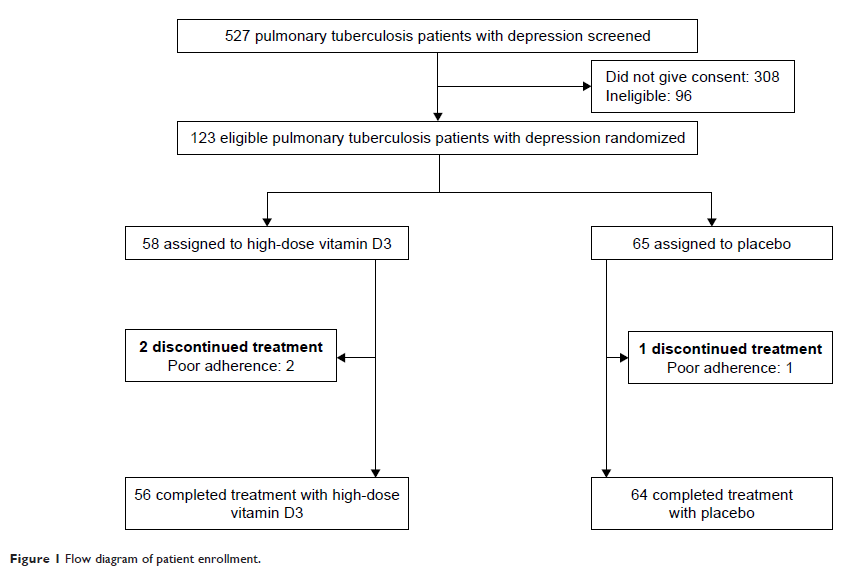
pilot, randomized, and double-blind trial enrolled 123 recurrent PTB patients
(aged ≥18 years) meeting Diagnostic and Statistical Manual of Mental Disorders-IV (DSM-IV) criteria
of major depressive disorder from four hospitals in Southeast China. Patients
were randomly assigned to 8-week oral treatment with 100,000 IU/week
cholecalciferol (Vit D group) or a matching placebo (control group). The
primary outcome was treatment response, defined as a 50% reduction in symptoms
and change in scores of the Chinese version of Beck Depression Inventory (BDI)
from baseline to 8 weeks. Relative risks of depression were estimated using
multivariable logistic regression.
Results: Finally,
120 patients were enrolled, including 56 test patients and 64 controls. After 8
weeks, the treatment response or BDI scores did not differ significantly
between groups. Multivariate logistic regression showed that BDI scores were
not significantly improved in the Vit D group after adjustment for age, time to
first negative smear, or 25-hydroxyvitamin D level.
Conclusion: The use
of high-dose Vit D3 supplementation may not be warranted for reducing
depressive symptoms in the PTB population. Nevertheless, this finding should be
validated by further large-scale studies according to different kinds of
depression or Vit D receptor polymorphism genotype.
Keywords: vitamin
D, major depressive disorders, depression, tuberculosis, Mycobacterium tuberculosis