115195
论文已发表
注册即可获取德孚的最新动态
IF 收录期刊
- 3.6 Breast Cancer (Dove Med Press)
- 4.3 Clin Epidemiol
- 2.6 Cancer Manag Res
- 3.2 Infect Drug Resist
- 4.1 Clin Interv Aging
- 6.1 Drug Des Dev Ther
- 4.1 Int J Chronic Obstr
- 8.7 Int J Nanomed
- 2.5 Int J Women's Health
- 3.2 Neuropsych Dis Treat
- 2.4 OncoTargets Ther
- 2.6 Patient Prefer Adher
- 2.6 Ther Clin Risk Manag
- 3.1 J Pain Res
- 3.5 Diabet Metab Synd Ob
- 4.5 Psychol Res Behav Ma
- 3.4 Nat Sci Sleep
- 2.4 Pharmgenomics Pers Med
- 2.6 Risk Manag Healthc Policy
- 4.6 J Inflamm Res
- 2.3 Int J Gen Med
- 3.9 J Hepatocell Carcinoma
- 3.3 J Asthma Allergy
- 2.5 Clin Cosmet Investig Dermatol
- 3.0 J Multidiscip Healthc

氧化还原响应的透明质酸功能化氧化石墨烯纳米片用于靶向递送水不溶性抗癌药物
Authors Liu J, Zhang D, Lian S, Zheng J, Li B, Li T, Jia L
Received 11 May 2018
Accepted for publication 3 July 2018
Published 14 November 2018 Volume 2018:13 Pages 7457—7472
DOI https://doi.org/10.2147/IJN.S173889
Checked for plagiarism Yes
Review by Single-blind
Peer reviewers approved by Dr Jiang Yang
Peer reviewer comments 2
Editor who approved publication: Dr Linlin Sun
Background: Gefitinib
(Gef), an important epidermal growth factor receptor (EGFR), is used to treat
lung cancer, but low water solubility and poor bioavailability severely limit
its application in cancer therapy.
Methods: In this
study, nano-graphene oxide (NGO) was decorated with hyaluronic acid (HA) by a
linker cystamine dihydrochloride containing disulfide bonds (-SS-), followed by
the incorporation of gefitinib, thus, constructing a HA-functionalized GO-based
gefitinib delivery system (NGO-SS-HA-Gef). Subsequently, studies of biological
experiments in vitro and in vivo were performed to investigate the therapeutic
effect of the system in lung cancer.
Results: The
HA-grafted GO nanosheets possessed enhanced physiological stability, admirable
biocompatibility, and no obvious side effects in mice and could act as a
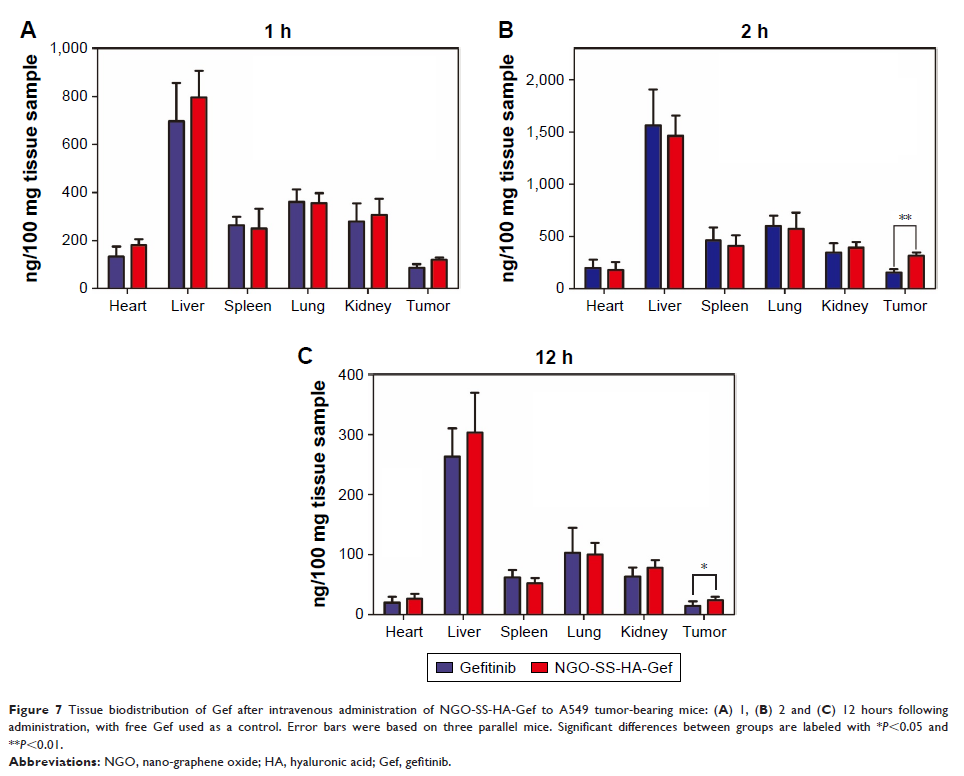
nanocarrier for the delivery of gefitinib to tumor. Cellular uptake and
intracellular cargo release assays showed that the uptake of NGO-SS-HA by A549
cells was facilitated via CD44 receptor-mediated endocytosis, and that more
drug was released from NGO-SS-HA in the presence of GSH than in the absence of
GSH. The target-specific binding of NGO-SS-HA to cancer cells with
redox-responsive cargo release significantly enhanced the abilities of
gefitinib-loaded GO nanosheets to induce cell apoptosis, suppress cell
proliferation, and inhibit tumor growth in lung cancer cell-bearing mice.
Conclusion: The results
demonstrated the potential utility of NGO-SS-HA-Gef for therapeutic
applications in the treatment of lung cancer.
Keywords: nano-graphene
oxide, gefitinib, hyaluronic acid, CD44, redox-responsive