115195
论文已发表
注册即可获取德孚的最新动态
IF 收录期刊
- 3.6 Breast Cancer (Dove Med Press)
- 4.3 Clin Epidemiol
- 2.6 Cancer Manag Res
- 3.2 Infect Drug Resist
- 4.1 Clin Interv Aging
- 6.1 Drug Des Dev Ther
- 4.1 Int J Chronic Obstr
- 8.7 Int J Nanomed
- 2.5 Int J Women's Health
- 3.2 Neuropsych Dis Treat
- 2.4 OncoTargets Ther
- 2.6 Patient Prefer Adher
- 2.6 Ther Clin Risk Manag
- 3.1 J Pain Res
- 3.5 Diabet Metab Synd Ob
- 4.5 Psychol Res Behav Ma
- 3.4 Nat Sci Sleep
- 2.4 Pharmgenomics Pers Med
- 2.6 Risk Manag Healthc Policy
- 4.6 J Inflamm Res
- 2.3 Int J Gen Med
- 3.9 J Hepatocell Carcinoma
- 3.3 J Asthma Allergy
- 2.5 Clin Cosmet Investig Dermatol
- 3.0 J Multidiscip Healthc

RIP1 和 RIP3 可在 HT22 海马神经细胞中介导由血红素诱导的细胞死亡
Authors Su X, Wang H, Lin Y, Chen F
Received 22 July 2018
Accepted for publication 27 September 2018
Published 15 November 2018 Volume 2018:14 Pages 3111—3119
DOI https://doi.org/10.2147/NDT.S181074
Checked for plagiarism Yes
Review by Single-blind
Peer reviewers approved by Dr Andrew Yee
Peer reviewer comments 2
Editor who approved publication: Dr Yu-Ping Ning
Background: Intracerebral
hemorrhage (ICH) is a devastating neurological injury associated with
significant mortality. Necroptosis is a newly identified type of programmed
necrosis initiated by the activation of tumor necrosis factor alpha. Evidences
had demonstrated the importance of necroptosis in neuronal cell death.
Necrostatin-1 is a specific inhibitor of necroptosis. The present study was
carried out to explore whether RIP1/RIP3 pathways participate in hemin induced
cell death in HT-22 hippocampal neuronal cells and investigate the potential
neuroprotection of necrostatin-1 in hemin induced cell death in HT-22.
Methods: First,
different concentrations of hemin (0, 25, 50, 100 µmol/L) were added to HT-22
cells. Propidium iodide (PI) positive cells and cell viability were measured at
24 hours after hemin treatment. Then, necrostatin-1, pan-caspase inhibitor
Benzyloxycarbonyl-Val-Ala-Asp(OMe)-fluoromethylketone (z-VAD-fmk) and reactive
oxygen species (ROS) scavenger butylated hydroxyanisole (BHA) were applied to
hemin-treated HT-22 cells. PI positive cells and cell viability were measured
at 24 hours after hemin treatment. MitoSox Red was used to indicate ROS level.
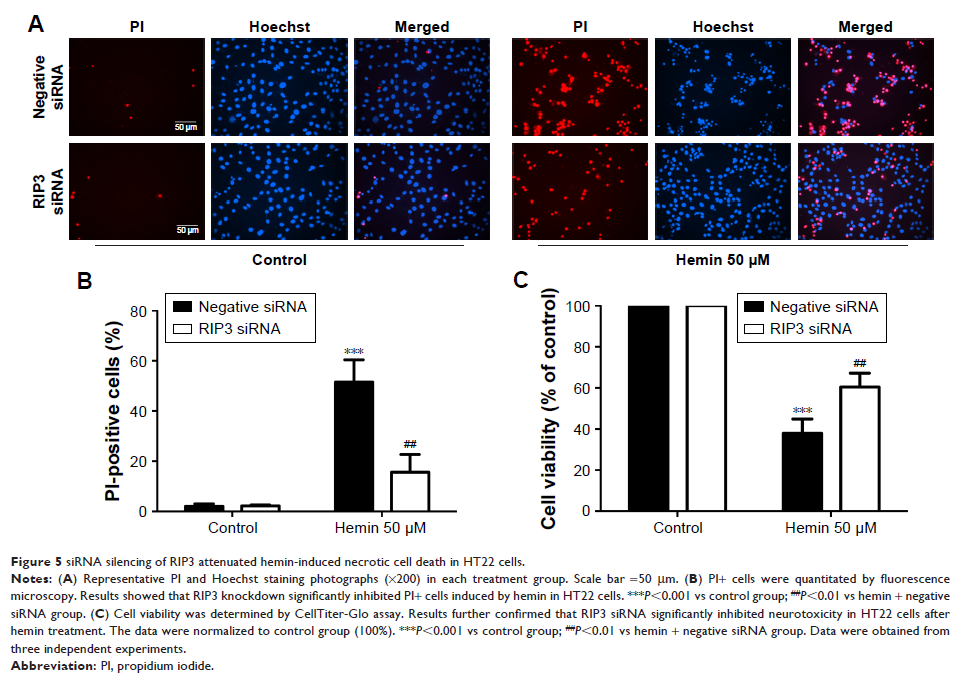
Last, the effect of RIP3 in hemin induced HT-22 cell death was explored through
RIP3 knockdown using siRNA. PI positive cells, cell viability and ROS lever
were measured at 24 h after hemin treatment.
Results: Hemin
could induce a dose dependent cell death in HT22 neural cells. RIP1 specific
inhibitor necrostatin-1 significantly inhibited cell death induced by hemin in
HT-22 cells, greatly reducing PI positive cells, dramatically improving cell
viability and decreasing ROS accumulation. BHA could significantly inhibit PI
positive cells induced by hemin in HT-22 cells. Furthermore, silencing of RIP3
using siRNA attenuated hemin induced cell death in HT-22 cells, greatly
reducing PI positive cells, dramatically improving cell viability and
decreasing ROS accumulation.
Conclusion: These
data revealed that RIP1/RIP3 might mediate hemin induced cell death in HT-22
cells, and necrostatin-1 played a neuroprotection role in hemin induced cell
death in HT-22. RIP1 and RIP3 might represent novel therapeutic targets for
ICH.
Keywords: intracerebral
hemorrhage, necroptosis, HT22, RIP1, RIP3, necrostatin-1