115195
论文已发表
注册即可获取德孚的最新动态
IF 收录期刊
- 3.6 Breast Cancer (Dove Med Press)
- 4.3 Clin Epidemiol
- 2.6 Cancer Manag Res
- 3.2 Infect Drug Resist
- 4.1 Clin Interv Aging
- 6.1 Drug Des Dev Ther
- 4.1 Int J Chronic Obstr
- 8.7 Int J Nanomed
- 2.5 Int J Women's Health
- 3.2 Neuropsych Dis Treat
- 2.4 OncoTargets Ther
- 2.6 Patient Prefer Adher
- 2.6 Ther Clin Risk Manag
- 3.1 J Pain Res
- 3.5 Diabet Metab Synd Ob
- 4.5 Psychol Res Behav Ma
- 3.4 Nat Sci Sleep
- 2.4 Pharmgenomics Pers Med
- 2.6 Risk Manag Healthc Policy
- 4.6 J Inflamm Res
- 2.3 Int J Gen Med
- 3.9 J Hepatocell Carcinoma
- 3.3 J Asthma Allergy
- 2.5 Clin Cosmet Investig Dermatol
- 3.0 J Multidiscip Healthc

杏仁核异常的功能连接性与多系统萎缩患者的抑郁症状相关
Authors Zhao B, Liu H, Li H, Shang X
Received 29 June 2018
Accepted for publication 3 October 2018
Published 15 November 2018 Volume 2018:14 Pages 3133—3142
DOI https://doi.org/10.2147/NDT.S178657
Checked for plagiarism Yes
Review by Single-blind
Peer reviewers approved by Dr Justinn Cochran
Peer reviewer comments 3
Editor who approved publication: Dr Yu-Ping Ning
Purpose: Depressive
symptoms are frequent nonmotor symptoms that occur in multiple system atrophy
(MSA) patients. However, possible changes that can present in the amygdala
(AMY) functional connectivity (FC) of the brain in MSA patients with depressive
symptoms (DMSA patients) remain largely unknown.
Materials and methods: Resting-state
functional magnetic resonance imaging scans were obtained from 29 DMSA
patients, 28 MSA patients without depression symptoms (NDMSA patients), and 34
healthy controls (HCs). FC was analyzed by defining the bilateral AMY as the
seed region. Correlation analysis was performed between the FC and clinical
scores.
Results: When
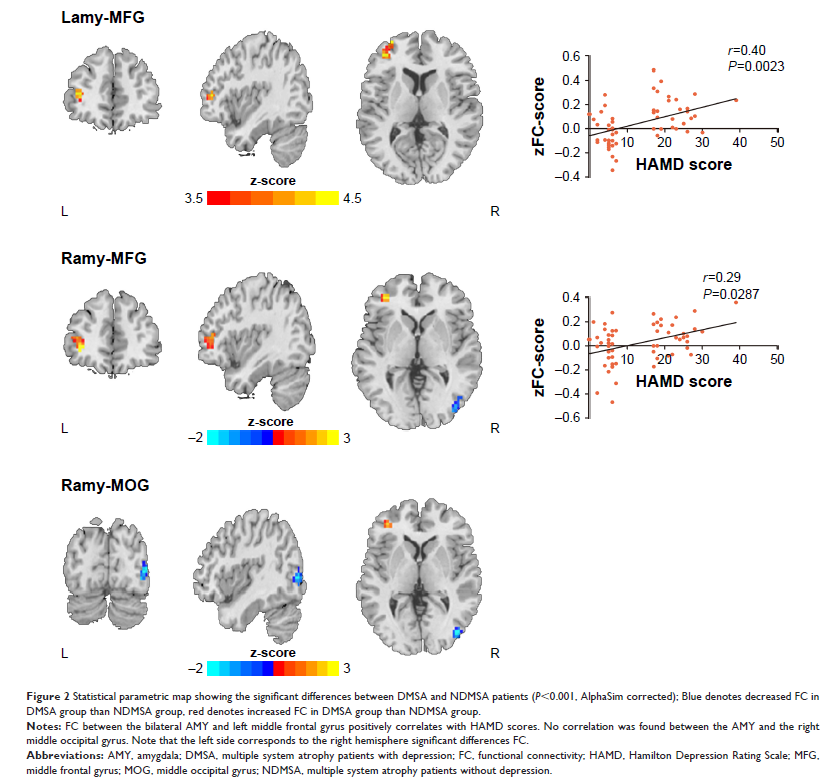
compared with NDMSA patients, DMSA patients showed increased bilateral AMY FC
in the left middle frontal gyrus (MFG) and decreased right AMY FC in the left
middle occipital gyrus. Moreover, the AMY FC values in the left middle frontal
cortex were positively correlated with the Hamilton Depression Rating Scale-17
item scores. Furthermore, relative to the HCs, DMSA patients presented
decreased bilateral AMY FC values in the visuospatial cortex, sensorimotor
networks, and limbic areas.
Conclusion: Depressive
symptoms are associated with AMY–MFG FC anomalies in MSA patients. We propose
that the middle frontal cortex may play an important role in the
neuropathophysiology of depression in MSA patients.
Keywords: multiple
system atrophy, depression, functional magnetic resonance imaging, functional
connectivity, amygdala