115195
论文已发表
注册即可获取德孚的最新动态
IF 收录期刊
- 3.6 Breast Cancer (Dove Med Press)
- 4.3 Clin Epidemiol
- 2.6 Cancer Manag Res
- 3.2 Infect Drug Resist
- 4.1 Clin Interv Aging
- 6.1 Drug Des Dev Ther
- 4.1 Int J Chronic Obstr
- 8.7 Int J Nanomed
- 2.5 Int J Women's Health
- 3.2 Neuropsych Dis Treat
- 2.4 OncoTargets Ther
- 2.6 Patient Prefer Adher
- 2.6 Ther Clin Risk Manag
- 3.1 J Pain Res
- 3.5 Diabet Metab Synd Ob
- 4.5 Psychol Res Behav Ma
- 3.4 Nat Sci Sleep
- 2.4 Pharmgenomics Pers Med
- 2.6 Risk Manag Healthc Policy
- 4.6 J Inflamm Res
- 2.3 Int J Gen Med
- 3.9 J Hepatocell Carcinoma
- 3.3 J Asthma Allergy
- 2.5 Clin Cosmet Investig Dermatol
- 3.0 J Multidiscip Healthc

与新生博尔纳病毒感染大鼠异常行为有关的 ERK/CREB/BDNF 通路的激活
Authors Li C, Xu X, Zhang X, Cheng K, Guo Y, Jie J, Guo H, He Y, Zhou C, Gui S, Zhong X, Wang H, Xie P
Received 5 June 2018
Accepted for publication 17 September 2018
Published 15 November 2018 Volume 2018:14 Pages 3121—3132
DOI https://doi.org/10.2147/NDT.S176399
Checked for plagiarism Yes
Review by Single-blind
Peer reviewers approved by Dr Cristina Weinberg
Peer reviewer comments 4
Editor who approved publication: Dr Yu-Ping Ning
Background: Neuropsychiatric
disorders are devastating illnesses worldwide; however, the potential
involvement of viruses in the pathophysiological mechanisms of psychiatric
diseases have not been clearly elucidated. Borna disease virus (BDV) is a
neurotropic, noncytopathic RNA virus.
Materials and methods: In this
study, we infected neonatal rats intracranially with BDV Hu-H1 and Strain V
within 24 hours of birth. Psychological phenotypes were assessed using
sucrose preference test, open field test, elevated plus maze test, and forced
swim test. The protein expression of ERK/CREB/BDNF pathway was assessed by
Western blotting of in vitro and in vivo samples.
Results: Hu-H1-infected
rats showed anxiety-like behavior 8 weeks postinfection while Strain V-infected
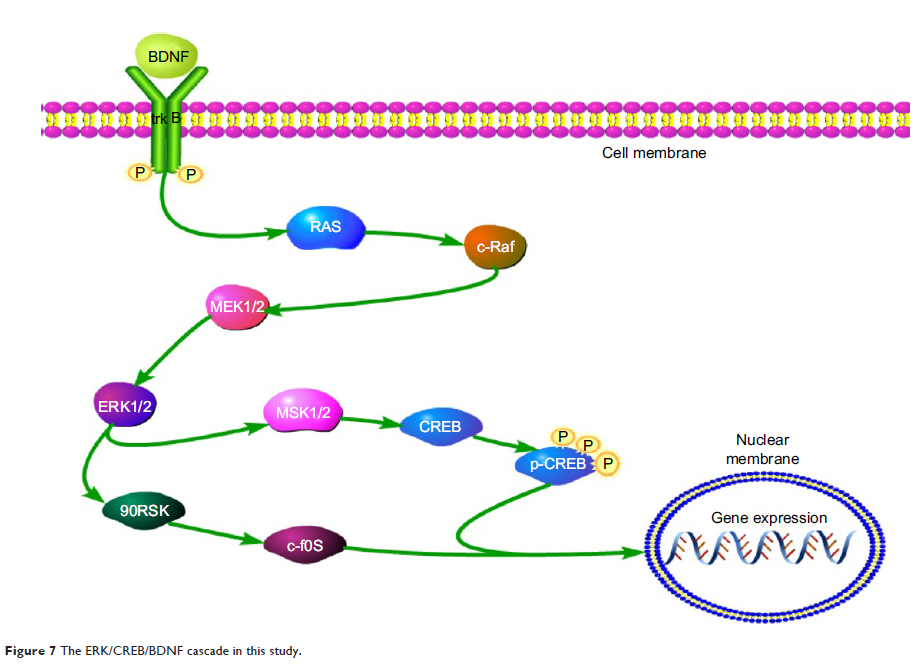
rats demonstrated a certain abnormal behavior. Phosphorylated ERK1/2 was
significantly upregulated in the hippocampi of Strain V- and Hu-H1-infected
rats compared with control rats, indicating that Raf/MEK/ERK signaling was
activated.
Conclusion: The data
suggested that infection of neonatal rats with BDV Hu-H1 and Strain V caused
behavioral abnormalities that shared common molecular pathways, providing
preliminary evidences to investigate the underlying mechanisms of psychiatric
disorders caused by BDV.
Keywords: Borna
disease virus, ERK/CREB/BDNF signaling pathway, neonatal Borna disease