115195
论文已发表
注册即可获取德孚的最新动态
IF 收录期刊
- 3.6 Breast Cancer (Dove Med Press)
- 4.3 Clin Epidemiol
- 2.6 Cancer Manag Res
- 3.2 Infect Drug Resist
- 4.1 Clin Interv Aging
- 6.1 Drug Des Dev Ther
- 4.1 Int J Chronic Obstr
- 8.7 Int J Nanomed
- 2.5 Int J Women's Health
- 3.2 Neuropsych Dis Treat
- 2.4 OncoTargets Ther
- 2.6 Patient Prefer Adher
- 2.6 Ther Clin Risk Manag
- 3.1 J Pain Res
- 3.5 Diabet Metab Synd Ob
- 4.5 Psychol Res Behav Ma
- 3.4 Nat Sci Sleep
- 2.4 Pharmgenomics Pers Med
- 2.6 Risk Manag Healthc Policy
- 4.6 J Inflamm Res
- 2.3 Int J Gen Med
- 3.9 J Hepatocell Carcinoma
- 3.3 J Asthma Allergy
- 2.5 Clin Cosmet Investig Dermatol
- 3.0 J Multidiscip Healthc

在采用主动脉扩张袖套状移植的胸腔内主动脉腔内修复术后进行B型主动脉夹层动脉重建
Authors Zhang H, Qiao T
Received 9 July 2018
Accepted for publication 4 September 2018
Published 15 November 2018 Volume 2018:13 Pages 2359—2366
DOI https://doi.org/10.2147/CIA.S179526
Checked for plagiarism Yes
Review by Single-blind
Peer reviewers approved by Dr Cristina Weinberg
Peer reviewer comments 2
Editor who approved publication: Dr Wu
Objective: This study
investigated the safety and efficiency of thoracic endovascular aortic repair
(TEVAR) plus an aortic extender cuff placement in treating Stanford Type B
aortic dissections (TBADs).
Methods: Clinical
data on 157 patients with TBADs who underwent TEVAR in two tertiary medical
centers from February 2013 to March 2018 were analyzed retrospectively. An
estimated mismatch rate >120% was the indication for placement of an aortic
extender cuff. Results in the perioperative and follow-up periods (≥3 months)
were analyzed, especially those of aortic remodeling.
Results: In total, 106
patients (67.5%) underwent standard TEVAR, and 51 (32.5%) received TEVAR plus
an aortic extender cuff placement. The primary technical success rate was 96.8%
(152/157). Perioperative adverse events included endoleak (2%, 3/157), spinal
cord ischemia (SCI) (1.3%, 2/157), and transient renal failure (0.6%, 1/157),
with no between-group differences. The median follow-up was 15 months (range
3–71 months). Ten cases of late stent complications were observed, including
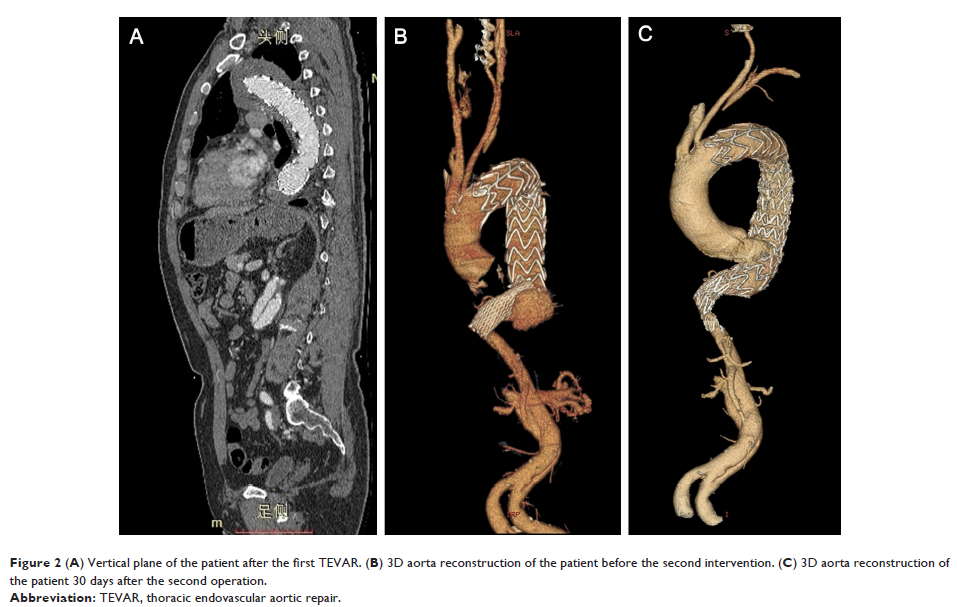
three endoleak, one upper limb ischemia, one stent distortion, and five stent
graft-induced distal re-dissection (SIDR). Patients with a cuff had less distal
re-dissection and fewer second interventions, but the differences lacked
significance. In the last follow-up, the TEVAR+Cuff group were found to have
better true lumen recovery and false lumen shrinkage, and increased complete
false lumen thrombosis in the thoracic and abdominal segments; however, no
statistical difference was evident in comparison with the TEVAR group (P >0.05).
Conclusion: TEVAR plus an
aortic extender cuff implantation improves remodeling of the dissected thoracic
aorta, thus reducing the potential of SIDR. Furthermore, the covered stent with
a length of 250 mm does not increase the rate of SCI or paraplegia. However,
these results should be confirmed in a larger series of patients with longer
follow-up.
Keywords: Type B aortic
dissection, thoracic endovascular aortic repair, aortic extender cuff, aortic remodelling