108225
论文已发表
注册即可获取德孚的最新动态
IF 收录期刊
- 3.4 Breast Cancer (Dove Med Press)
- 3.2 Clin Epidemiol
- 2.6 Cancer Manag Res
- 2.9 Infect Drug Resist
- 3.7 Clin Interv Aging
- 5.1 Drug Des Dev Ther
- 3.1 Int J Chronic Obstr
- 6.6 Int J Nanomed
- 2.6 Int J Women's Health
- 2.9 Neuropsych Dis Treat
- 2.8 OncoTargets Ther
- 2.0 Patient Prefer Adher
- 2.2 Ther Clin Risk Manag
- 2.5 J Pain Res
- 3.0 Diabet Metab Synd Ob
- 3.2 Psychol Res Behav Ma
- 3.4 Nat Sci Sleep
- 1.8 Pharmgenomics Pers Med
- 2.0 Risk Manag Healthc Policy
- 4.1 J Inflamm Res
- 2.0 Int J Gen Med
- 3.4 J Hepatocell Carcinoma
- 3.0 J Asthma Allergy
- 2.2 Clin Cosmet Investig Dermatol
- 2.4 J Multidiscip Healthc

本文已被撤回 - 白藜芦醇苷通过诱导 caspase 依赖性细胞凋亡和抑制 PI3K/Akt 通路对肾细胞癌细胞发挥抗肿瘤作用
Authors Jin YL, Xin LM, Zhou CC, Ren Y
Received 19 July 2018
Accepted for publication 12 October 2018
Published 16 November 2018 Volume 2018:11 Pages 8185—8195
DOI https://doi.org/10.2147/OTT.S180785
Checked for plagiarism Yes
Review by Single-blind
Peer reviewers approved by Dr Andrew Yee
Peer reviewer comments 3
Editor who approved publication: Dr Carlos E Vigil
肿瘤靶标和治疗究期刊的主编决定撤回此文章。
撤稿启事
Purpose: Polydatin, a
stilbenoid glucoside of a resveratrol derivative, has many biological
functions, including antitumor effects. However, the antitumor effects of
polydatin in renal cell carcinoma (RCC) have not been investigated.
Materials and methods: In the current
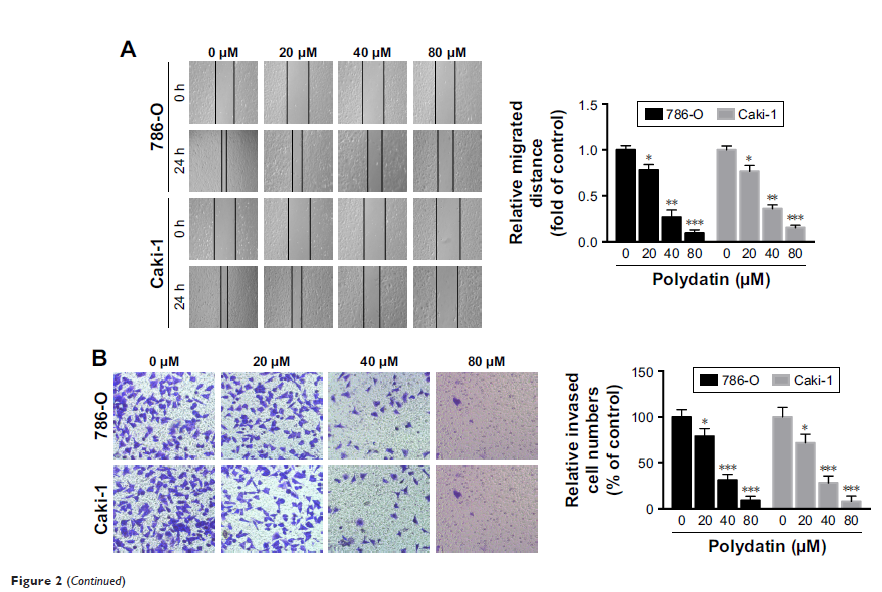
study, MTT assays, transwell invasion assays and wound healing assays were
performed to examine cell proliferation, invasion and migration. An apoptosis
nucleosome ELISA was used to measure apoptosis. Caspase activity assays were
applied to measure the activities of caspase-3/9. A Western blot assay was used
to measure the change in protein levels.
Results: Our data
demonstrated that polydatin inhibited the proliferation of RCC cells but not
normal renal epithelial cells in a time- and dose-dependent manner. Polydatin
also triggered apoptosis in a caspase-dependent manner. Moreover, polydatin
treatment also led to the downregulation of Bcl-2 and Mcl-1 and to activation
of Bax. Ectopic expression of Bcl-2 and Mcl-1 or silencing of Bax could repress
the apoptosis that was induced by polydatin. Moreover, incubation with
polydatin also suppressed the PI3K/Akt signaling pathway in RCC cells.
Conclusion: Taken together,
our data indicated that polydatin may be applied as a potent agent against RCC.
Keywords: polydatin,
renal cell carcinoma, apoptosis, PI3K, Akt