115195
论文已发表
注册即可获取德孚的最新动态
IF 收录期刊
- 3.6 Breast Cancer (Dove Med Press)
- 4.3 Clin Epidemiol
- 2.6 Cancer Manag Res
- 3.2 Infect Drug Resist
- 4.1 Clin Interv Aging
- 6.1 Drug Des Dev Ther
- 4.1 Int J Chronic Obstr
- 8.7 Int J Nanomed
- 2.5 Int J Women's Health
- 3.2 Neuropsych Dis Treat
- 2.4 OncoTargets Ther
- 2.6 Patient Prefer Adher
- 2.6 Ther Clin Risk Manag
- 3.1 J Pain Res
- 3.5 Diabet Metab Synd Ob
- 4.5 Psychol Res Behav Ma
- 3.4 Nat Sci Sleep
- 2.4 Pharmgenomics Pers Med
- 2.6 Risk Manag Healthc Policy
- 4.6 J Inflamm Res
- 2.3 Int J Gen Med
- 3.9 J Hepatocell Carcinoma
- 3.3 J Asthma Allergy
- 2.5 Clin Cosmet Investig Dermatol
- 3.0 J Multidiscip Healthc

酒精依赖者的异常前额叶 - 顶叶 - 小脑回路
Authors Liu R, Liu BX, Ma M, Kong D, Li G, Yang J, Wu X, Zheng J, Dong Y
Received 26 June 2018
Accepted for publication 29 August 2018
Published 16 November 2018 Volume 2018:14 Pages 3143—3150
DOI https://doi.org/10.2147/NDT.S178257
Checked for plagiarism Yes
Review by Single-blind
Peer reviewers approved by Dr Amy Norman
Peer reviewer comments 2
Editor who approved publication: Dr Yu-Ping Ning
Objective: To identify
whether the amplitude of low-frequency fluctuations (ALFF) analysis has the
potential to serve as a biological marker to detect alcohol-induced spontaneous
brain activities and distinguish the patients with alcohol dependence from the
healthy subjects.
Methods: We utilized the
ALFF analysis to report on the alcohol-induced spontaneous brain activities in
29 patients with alcohol dependence (9 female, 20 male) relative to 29
status-matched healthy subjects (11 female, 18 male). Receiver operating
characteristic curve was used to test the ability of the ALFF analysis in
discriminating the patients with alcohol dependence from the healthy subjects.
Pearson correlation was used to evaluate the relationships between the signal
value of those ALFF differences in brain areas and behavioral characteristics.
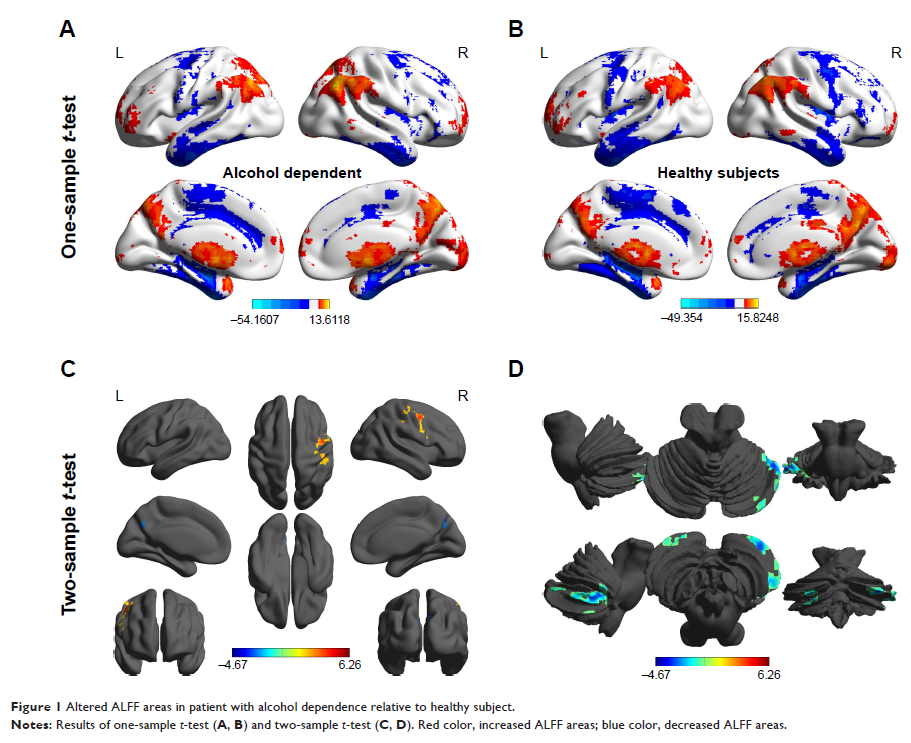
Results: Alcohol-induced
brain differences located in the right inferior parietal lobule and right
supplementary motor area with significant higher ALFF values, and in the left
precuneus and bilateral cerebellum posterior lobe with lower ALFF values. The
movement-related areas were significantly correlated with each other (P <0.05).
Receiver operating characteristic curve revealed good area under the curve
values (mean, 0.86±0.079; 0.774–0.951) of the ALFF differences in those
specific brain areas, as well as high degree of sensitivities (mean,
80.84%±14.01% or 80%±14.56%; 62.5%–100%) and specificities (mean, 83.32%±9.31%;
70.8%–95.8% or 84.16%±8%; 75%–95.8%).
Conclusion: The ALFF
analysis may serve as a biological indicator to detect the spontaneous brain
activities in patients with alcohol dependence. The
prefrontal–parietal–cerebellar circuit appears to be disturbed by long-term
alcoholism in patients with alcohol dependence.
Keywords: alcohol
dependence, amplitude of low-frequency fluctuations, receiver operating
characteristic