115195
论文已发表
注册即可获取德孚的最新动态
IF 收录期刊
- 3.6 Breast Cancer (Dove Med Press)
- 4.3 Clin Epidemiol
- 2.6 Cancer Manag Res
- 3.2 Infect Drug Resist
- 4.1 Clin Interv Aging
- 6.1 Drug Des Dev Ther
- 4.1 Int J Chronic Obstr
- 8.7 Int J Nanomed
- 2.5 Int J Women's Health
- 3.2 Neuropsych Dis Treat
- 2.4 OncoTargets Ther
- 2.6 Patient Prefer Adher
- 2.6 Ther Clin Risk Manag
- 3.1 J Pain Res
- 3.5 Diabet Metab Synd Ob
- 4.5 Psychol Res Behav Ma
- 3.4 Nat Sci Sleep
- 2.4 Pharmgenomics Pers Med
- 2.6 Risk Manag Healthc Policy
- 4.6 J Inflamm Res
- 2.3 Int J Gen Med
- 3.9 J Hepatocell Carcinoma
- 3.3 J Asthma Allergy
- 2.5 Clin Cosmet Investig Dermatol
- 3.0 J Multidiscip Healthc

将右旋美托咪啶或芬太尼加入到罗哌卡因中用于腹横肌平面阻滞:对妇科手术术后疼痛及恢复质量的效果
Authors Chen Q, Liu X, Zhong X, Yang B
Received 28 June 2018
Accepted for publication 9 October 2018
Published 16 November 2018 Volume 2018:11 Pages 2897—2903
DOI https://doi.org/10.2147/JPR.S178516
Checked for plagiarism Yes
Review by Single-blind
Peer reviewers approved by Dr Colin Mak
Peer reviewer comments 2
Editor who approved publication: Dr Michael Ueberall
Background: Transversus
abdominis plane (TAP) block is reportedly a preferable technique for reducing
postoperative pain in abdominal surgeries. The aim of this study was to compare
the analgesic efficacy and recovery quality after gynecological surgery by
adding dexmedetomidine or fentanyl into an ultrasound-guided TAP block.
Methods: We randomly
assigned 100 elective gynecological patients into four groups (TAP, TAP-DEX,
TAP-FEN, and control, n=25 in each). TAP blocks were performed postoperatively.
The control group received patient-controlled intravenous analgesia (PCIA), the
TAP group received TAP blocks with 0.375% ropivacaine, the TAP-DEX group
received 0.375% ropivacaine with dexmedetomidine 1 µg/kg, and the TAP-FEN group
received 0.375% ropivacaine with fentanyl 1 µg/kg. The primary outcomes were
the first request time for PCIA bolus and quality of postoperative recovery
assessed using the QoR-40 questionnaire 2 days after surgery. The secondary
outcomes were the visual analog scale (VAS) scores at rest across the different
time intervals, the total number of PCIA boluses required in 24 and 48 hours
postoperatively, and associated complications.
Results: The first request
time for PCIA was significantly longer in the TAP-DEX than in the TAP, TAP-FEN,
and control groups (9.86±0.77, 7.86±0.56, 8.79±0.55, and 1.56±0.65 hours,
respectively; P <0.01). The QoR-40 scores were highest in the
TAP-DEX group (P <0.05).
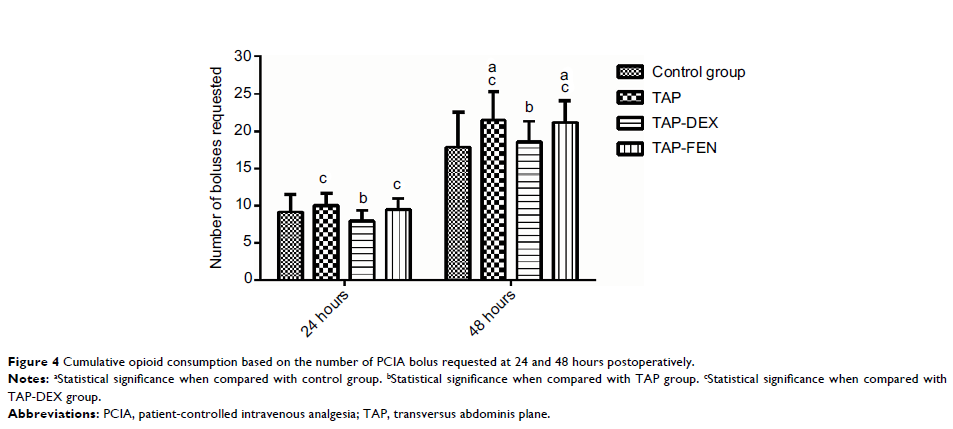
The mean PCIA bolus consumption in the first 24–48 hours was lowest in TAP-DEX
group. VAS showed significant differences between TAP-DEX and TAP-FEN groups
only at 6 hours (P <0.01).
Conclusion: The use
of dexmedetomidine as an adjuvant to TAP blocks could facilitate postoperative
analgesia and improve the quality of recovery without increasing related
complications.
Keywords: transversus
abdominis plane block, dexmedetomidine, fentanyl, pain, quality of
postoperative recovery, adjuvant