115195
论文已发表
注册即可获取德孚的最新动态
IF 收录期刊
- 3.6 Breast Cancer (Dove Med Press)
- 4.3 Clin Epidemiol
- 2.6 Cancer Manag Res
- 3.2 Infect Drug Resist
- 4.1 Clin Interv Aging
- 6.1 Drug Des Dev Ther
- 4.1 Int J Chronic Obstr
- 8.7 Int J Nanomed
- 2.5 Int J Women's Health
- 3.2 Neuropsych Dis Treat
- 2.4 OncoTargets Ther
- 2.6 Patient Prefer Adher
- 2.6 Ther Clin Risk Manag
- 3.1 J Pain Res
- 3.5 Diabet Metab Synd Ob
- 4.5 Psychol Res Behav Ma
- 3.4 Nat Sci Sleep
- 2.4 Pharmgenomics Pers Med
- 2.6 Risk Manag Healthc Policy
- 4.6 J Inflamm Res
- 2.3 Int J Gen Med
- 3.9 J Hepatocell Carcinoma
- 3.3 J Asthma Allergy
- 2.5 Clin Cosmet Investig Dermatol
- 3.0 J Multidiscip Healthc

丙戊酸可增强随意型皮瓣的存活:其中包括促进血管生成和抑制氧化应激和细胞凋亡
Authors Wu H, Ding J, Wang L, Lin J, Li S, Xiang G, Jiang L, Xu H, Gao W, Zhou K
Received 2 September 2018
Accepted for publication 24 October 2018
Published 16 November 2018 Volume 2018:12 Pages 3951—3960
DOI https://doi.org/10.2147/DDDT.S186222
Checked for plagiarism Yes
Review by Single-blind
Peer reviewers approved by Dr Colin Mak
Peer reviewer comments 2
Editor who approved publication: Dr Qiongyu Guo
Background: Random
skin flaps are commonly applied during plastic surgery, but distal flap
necrosis limits their clinical applications. Valproic acid (VPA), a histone deacetylase
inhibitor and a traditional antiepileptic agent, may promote flap survival.
Materials and methods: Sprague–Dawley
rats were randomly divided into VPA-treated and control groups. All rats
received VPA or saline by intraperitoneal injections once daily for 7 days
after the modified McFarlane flap model was established. On postoperative day
7, flap survival, laser Doppler blood flow, and water content were examined for
flap viability, hematoxylin and eosin staining (H&E), immunohistochemistry (IHC),
and Western blot analysis, and the status of angiogenesis, apoptosis, and
oxidative stress were detected in the ischemic flaps.
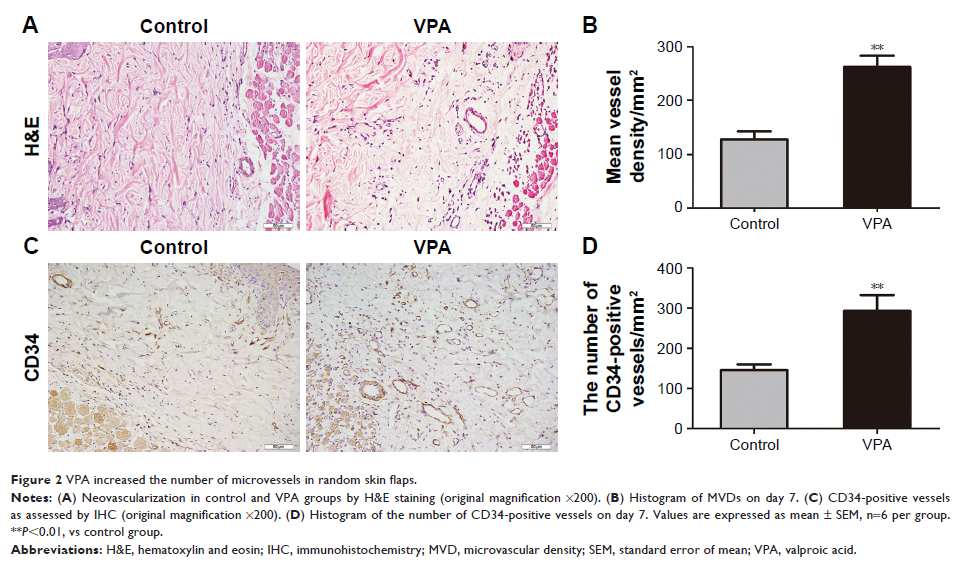
Results: VPA
increased the survival area, blood flow, and number of microvessels in skin
flaps on postoperative day 7 and reduced edema. VPA promoted angiogenesis by
enhancing vascular endothelial growth factor (VEGF) mRNA transcription and
upregulating VEGF and cadherin 5 expression, inhibited apoptosis via reduction
of caspase 3 cleavage, and relieved oxidative stress by increasing superoxide
dismutase (SOD) and glutathione (GSH) levels and reducing the malondialdehyde
(MDA) level.
Conclusion: VPA
promoted random skin flap survival by enhancing angiogenesis and inhibiting
oxidative stress and apoptosis.
Keywords: valproic
acid, random skin flap, angiogenesis, oxidative stress, apoptosis