115195
论文已发表
注册即可获取德孚的最新动态
IF 收录期刊
- 3.6 Breast Cancer (Dove Med Press)
- 4.3 Clin Epidemiol
- 2.6 Cancer Manag Res
- 3.2 Infect Drug Resist
- 4.1 Clin Interv Aging
- 6.1 Drug Des Dev Ther
- 4.1 Int J Chronic Obstr
- 8.7 Int J Nanomed
- 2.5 Int J Women's Health
- 3.2 Neuropsych Dis Treat
- 2.4 OncoTargets Ther
- 2.6 Patient Prefer Adher
- 2.6 Ther Clin Risk Manag
- 3.1 J Pain Res
- 3.5 Diabet Metab Synd Ob
- 4.5 Psychol Res Behav Ma
- 3.4 Nat Sci Sleep
- 2.4 Pharmgenomics Pers Med
- 2.6 Risk Manag Healthc Policy
- 4.6 J Inflamm Res
- 2.3 Int J Gen Med
- 3.9 J Hepatocell Carcinoma
- 3.3 J Asthma Allergy
- 2.5 Clin Cosmet Investig Dermatol
- 3.0 J Multidiscip Healthc

黄芩素在体内和体外通过抑制 PI3K/AKT 通路诱导乳腺癌细胞的凋亡和自噬
Authors Yan W, Ma X, Zhao X, Zhang S
Received 30 July 2018
Accepted for publication 27 September 2018
Published 16 November 2018 Volume 2018:12 Pages 3961—3972
DOI https://doi.org/10.2147/DDDT.S181939
Checked for plagiarism Yes
Review by Single-blind
Peer reviewers approved by Dr Andrew Yee
Peer reviewer comments 3
Editor who approved publication: Dr Anastasios Lymperopoulos
Purpose: Baicalein,
a widely used Chinese herbal medicine, has shown anticancer effects on many
types of human cancer cell lines. However, little is known about the underlying
mechanism in human breast cancer cells. In this study, we examined the
apoptotic and autophagic pathways activated following baicalein treatment in
human breast cancer cells in vitro and in vivo.
Materials and methods: In
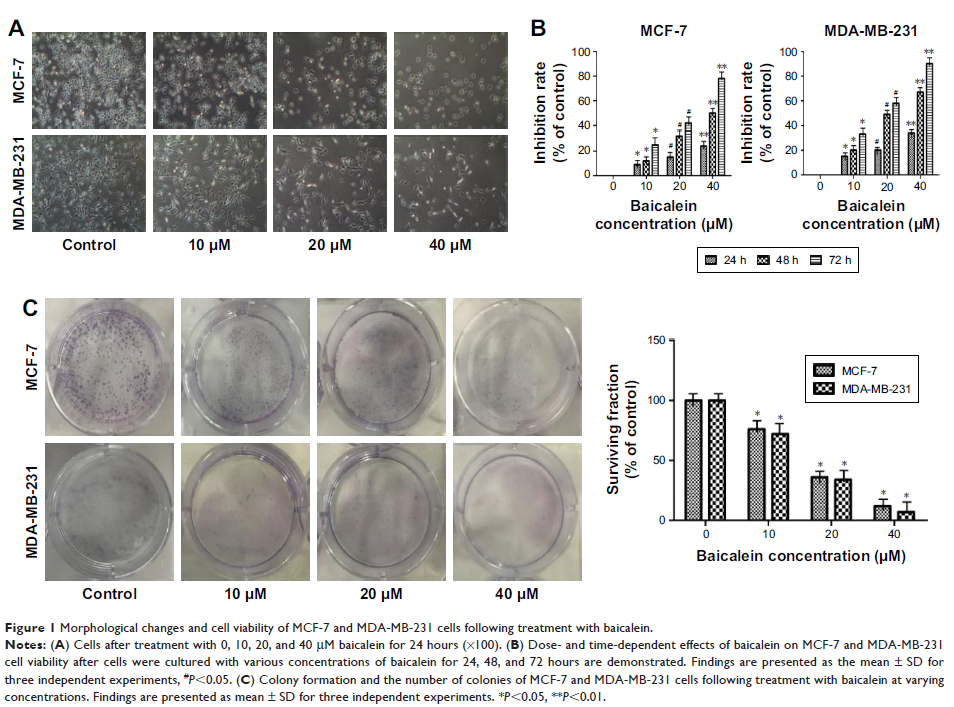
in vitro study, we used MTT and clone formation assay to confirm the
inhibitory role of baicalein on proliferation of MCF-7 and MDA-MB-231 breast
cancer cells. Apoptosis was detected employing Hoechst 33258 staining, JC-1
staining, and flow cytometry. Autophagy was monitored by acridine orange
staining and transmission electron microscopy observation. Quantitative
real-time PCR and Western blot analysis were employed to study the effects of
baicalein on PI3K/AKT signaling components of MCF-7 and MDA-MB-231 breast
cancer cells. In in vivo study, the effect of baicalein was tested with a
breast cancer cells transplantation tumor model.
Results: Our study
showed that baicalein has the potential to suppress cell proliferation, induce
apoptosis and autophagy of breast cancer cells in vitro and in vivo.
Furthermore, baicalein significantly downregulated the expression of p-AKT,
p-mTOR, NF-κB, and p-IκB while enhancing the expression of IκB in MCF-7 and
MDA-MB-231 cells. It also decreased the p-AKT/AKT and p-mTOR/mTOR ratios.
Conclusion: Our study
demonstrated that baicalein induces apoptosis and autophagy of breast cancer
cells via inhibiting the PI3K/AKT signaling pathway in vivo and vitro. Our
study revealed that baicalein may be a potential therapeutic agent for breast
cancer.
Keywords: baicalein,
breast cancer, apoptosis, autophagy, PI3K, AKT