115195
论文已发表
注册即可获取德孚的最新动态
IF 收录期刊
- 3.6 Breast Cancer (Dove Med Press)
- 4.3 Clin Epidemiol
- 2.6 Cancer Manag Res
- 3.2 Infect Drug Resist
- 4.1 Clin Interv Aging
- 6.1 Drug Des Dev Ther
- 4.1 Int J Chronic Obstr
- 8.7 Int J Nanomed
- 2.5 Int J Women's Health
- 3.2 Neuropsych Dis Treat
- 2.4 OncoTargets Ther
- 2.6 Patient Prefer Adher
- 2.6 Ther Clin Risk Manag
- 3.1 J Pain Res
- 3.5 Diabet Metab Synd Ob
- 4.5 Psychol Res Behav Ma
- 3.4 Nat Sci Sleep
- 2.4 Pharmgenomics Pers Med
- 2.6 Risk Manag Healthc Policy
- 4.6 J Inflamm Res
- 2.3 Int J Gen Med
- 3.9 J Hepatocell Carcinoma
- 3.3 J Asthma Allergy
- 2.5 Clin Cosmet Investig Dermatol
- 3.0 J Multidiscip Healthc

气管、支气管腺样囊性癌的淋巴结转移预测因子、淋巴结转移率及总淋巴结数的预后价值
Authors Wo Y, Li S, Wang Y, Lu T, Qin Y, Sun X, Jiao W
Received 31 July 2018
Accepted for publication 12 October 2018
Published 19 November 2018 Volume 2018:10 Pages 5919—5925
DOI https://doi.org/10.2147/CMAR.S182069
Checked for plagiarism Yes
Review by Single-blind
Peer reviewers approved by Dr Colin Mak
Peer reviewer comments 3
Editor who approved publication: Dr Chien-Feng Li
Purpose: To identify
potential risk factors of lymph node metastasis and to verify the prognostic
significance of the lymph node ratio (LNR) and the total number of lymph nodes
examined (NNE) in tracheobronchial adenoid cystic carcinoma (ACC) patients,
using a large population-based database.
Patients and methods: From
Surveillance, Epidemiology, and End Results database, we identified 263
patients with tracheobronchial ACC in whom complete lymph node data could be
obtained. Logistic regression analysis was performed to determine predictive
factors of nodal metastasis. X-tile software determined the optimal cut-off
points for LNR and NNE. Kaplan–Meier analyses and Cox regression models were
adopted for survival analysis.
Results: Of 263
patients, 75 (28.5%) had lymph node involvement. Tumors of bronchial origin (P <0.001) and
tumors larger than 30 mm (P <0.001) were associated with a higher likelihood
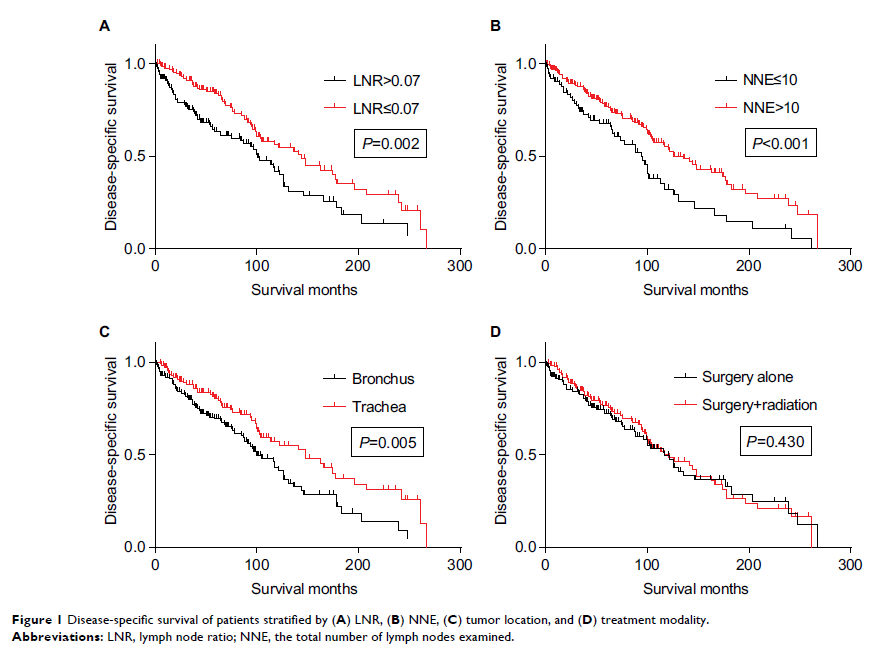
of nodal involvement. Examination of more than ten lymph nodes could avoid
understaging and resulted in improved survival; meanwhile, patients with a LNR
of 0.07 or less had favorable prognosis.
Conclusion: Patients
with tracheobronchial ACC have significant risk of lymph node metastasis.
Bronchial ACC and larger tumor size are both risk factors of lymph node
metastasis. LNR and NNE may provide a more precise prediction of survival and
could be taken into account in future clinical work.
Keywords: adenoid
cystic carcinoma, trachea, bronchus, lymph node, SEER database