115195
论文已发表
注册即可获取德孚的最新动态
IF 收录期刊
- 3.6 Breast Cancer (Dove Med Press)
- 4.3 Clin Epidemiol
- 2.6 Cancer Manag Res
- 3.2 Infect Drug Resist
- 4.1 Clin Interv Aging
- 6.1 Drug Des Dev Ther
- 4.1 Int J Chronic Obstr
- 8.7 Int J Nanomed
- 2.5 Int J Women's Health
- 3.2 Neuropsych Dis Treat
- 2.4 OncoTargets Ther
- 2.6 Patient Prefer Adher
- 2.6 Ther Clin Risk Manag
- 3.1 J Pain Res
- 3.5 Diabet Metab Synd Ob
- 4.5 Psychol Res Behav Ma
- 3.4 Nat Sci Sleep
- 2.4 Pharmgenomics Pers Med
- 2.6 Risk Manag Healthc Policy
- 4.6 J Inflamm Res
- 2.3 Int J Gen Med
- 3.9 J Hepatocell Carcinoma
- 3.3 J Asthma Allergy
- 2.5 Clin Cosmet Investig Dermatol
- 3.0 J Multidiscip Healthc

人疱疹病毒 6 型 U94/rep 可抑制胶质瘤的增殖、侵袭和血管生成
Authors Gu B, Li L, Li M, Wang J, Zhang G, Yao K, Wang S
Received 20 June 2018
Accepted for publication 27 September 2018
Published 20 November 2018 Volume 2018:10 Pages 5991—6001
DOI https://doi.org/10.2147/CMAR.S177777
Checked for plagiarism Yes
Review by Single-blind
Peer reviewers approved by Dr Colin Mak
Peer reviewer comments 2
Editor who approved publication: Professor Kenan Onel
Purpose: We previously
found the involvement of human herpesvirus 6 (HHV-6) infection in the
pathogenesis of glioma. U94/rep, encoded by HHV-6, has been identified to play
a vital role in viral gene expression and latency. Recent studies have shown
its inhibition of angiogenesis and tumorigenesis in endothelial cells and
prostate cancer cell line PC3, respectively. Here, we aimed to investigate the
role of U94/rep in the development and progression of glioma.
Patients and methods: A total
of 20 glioma tissues with positive HHV-6 infection were used for detection of
U94/rep. MTT, soft agar, propidium iodide staining, wound healing, Transwell,
and chick embryo chorioallantoic membrane assays were applied for evaluation of
glioma cells’ proliferation, colony formation, cell cycle, migration, invasion,
and angiogenesis, respectively.
Results: U94/rep
transcripts could be detected in 11 out of 20 glioma tissues with positive
HHV-6 infection. Furthermore, MTT and soft agar assays revealed that
overexpression of U94/rep inhibited glioma cell proliferation and colony
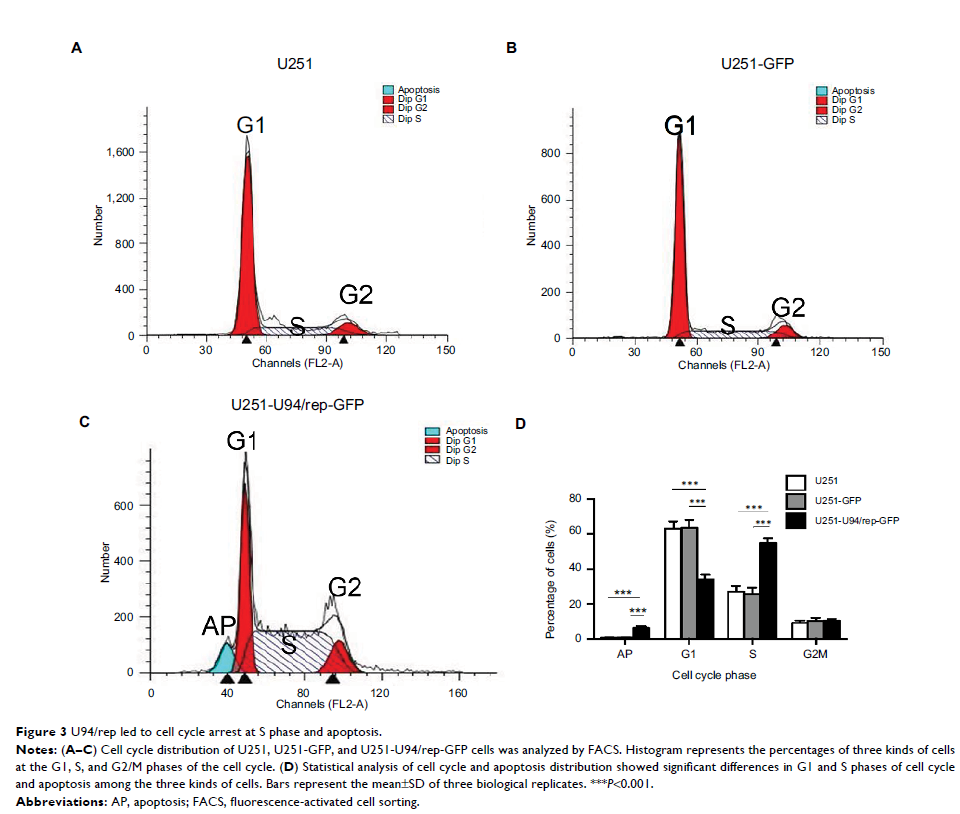
formation, which may be attributed to the cell cycle arrest at S phase induced
by U94/rep. Further analysis demonstrated that U94/rep inhibited glioma cells’
migration and invasion and ex vivo angiogenesis. Reduced expression of
proangiogenic factors, vascular endothelial growth factor and basic fibroblast
growth factor, and type IV collagenases, MMP-2 and MMP-9, was detected in cells
overexpressing U94/rep. These decreased factors may undermine glioma cell
migration, invasion, and angiogenesis.
Conclusion: Our
results demonstrated that U94/rep could inhibit malignant phenotypes of glioma
cells, indicating that it is a potential target for therapeutic intervention.
Keywords: HHV-6, U94/rep,
tumorigenesis, glioma