115195
论文已发表
注册即可获取德孚的最新动态
IF 收录期刊
- 3.6 Breast Cancer (Dove Med Press)
- 4.3 Clin Epidemiol
- 2.6 Cancer Manag Res
- 3.2 Infect Drug Resist
- 4.1 Clin Interv Aging
- 6.1 Drug Des Dev Ther
- 4.1 Int J Chronic Obstr
- 8.7 Int J Nanomed
- 2.5 Int J Women's Health
- 3.2 Neuropsych Dis Treat
- 2.4 OncoTargets Ther
- 2.6 Patient Prefer Adher
- 2.6 Ther Clin Risk Manag
- 3.1 J Pain Res
- 3.5 Diabet Metab Synd Ob
- 4.5 Psychol Res Behav Ma
- 3.4 Nat Sci Sleep
- 2.4 Pharmgenomics Pers Med
- 2.6 Risk Manag Healthc Policy
- 4.6 J Inflamm Res
- 2.3 Int J Gen Med
- 3.9 J Hepatocell Carcinoma
- 3.3 J Asthma Allergy
- 2.5 Clin Cosmet Investig Dermatol
- 3.0 J Multidiscip Healthc

EIF2B5 mRNA 的高表达及其在肝癌中的预后意义:一项基于 TCGA 和 GEO 数据库的研究
Authors Jiao Y, Fu Z, Li Y, Meng L, Liu Y
Received 27 August 2018
Accepted for publication 23 October 2018
Published 20 November 2018 Volume 2018:10 Pages 6003—6014
DOI https://doi.org/10.2147/CMAR.S185459
Checked for plagiarism Yes
Review by Single-blind
Peer reviewers approved by Dr Amy Norman
Peer reviewer comments 2
Editor who approved publication: Dr Antonella D'Anneo
Purpose: Liver
cancer is a high mortality disease with no curable treatments.
Posttranscriptional modifications play essential roles in the occurrence and
the progression of liver cancer. EIF2B5 is a subunit of EIF2B that regulates
the initiation and the rate of translation and participates in several diseases
including tumors. This study aims to elucidate the prognostic significance of
EIF2B5 in liver cancer.
Materials and methods: We used
The Cancer Genome Atlas database to analyze the expression of EIF2B5 in liver
cancer. Then we used chi-squared and Fisher exact tests to test the correlation
between clinical characteristics and EIF2B5 expression. Finally, we assessed
the role of EIF2B5 in prognosis by Kaplan–Meier curves and Cox analysis. Gene
set enrichment analysis was performed by using The Cancer Genome Atlas data
set.
Results: The
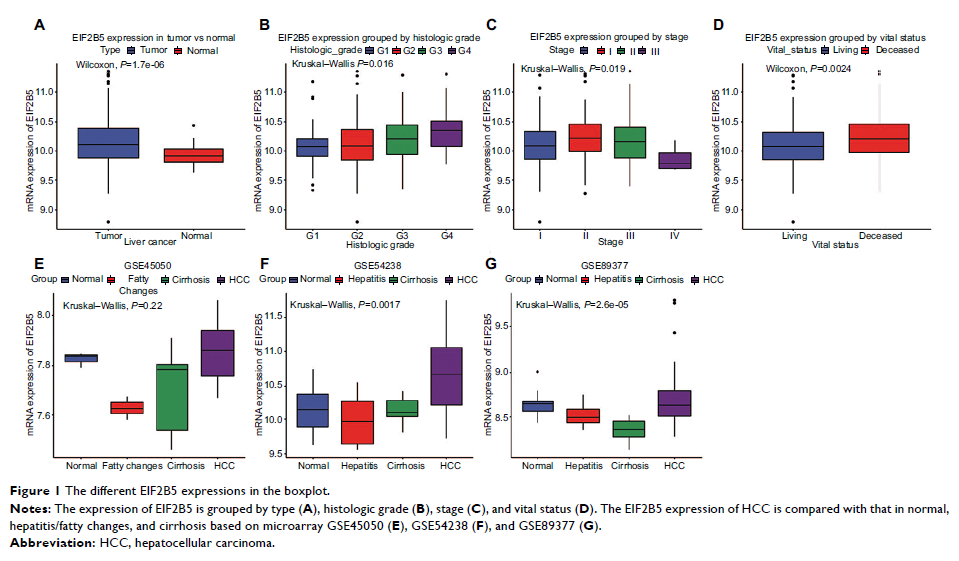
results showed that EIF2B5 was upregulated in liver cancer, and the
expression was related to histologic grade, clinical stage, and vital
status. Moreover, Kaplan–Meier curves and Cox analysis implicated that highly
expressed EIF2B5 correlated with poor prognosis, and EIF2B5 was an independent
risk factor for liver cancer. Gene set enrichment analysis showed that ATR and
BRCA pathway, cell cycle pathway, DNA repair, myc signaling pathway, and E2F
targets are differentially enriched in EIF2B5 high-expression phenotype.
Conclusion: Our results
suggest that EIF2B5 participated in cancer progression and could become a
biomarker for the prognosis of patients with liver cancer.
Keywords: liver
cancer, EIF2B5, prognosis, diagnosis