115195
论文已发表
注册即可获取德孚的最新动态
IF 收录期刊
- 3.6 Breast Cancer (Dove Med Press)
- 4.3 Clin Epidemiol
- 2.6 Cancer Manag Res
- 3.2 Infect Drug Resist
- 4.1 Clin Interv Aging
- 6.1 Drug Des Dev Ther
- 4.1 Int J Chronic Obstr
- 8.7 Int J Nanomed
- 2.5 Int J Women's Health
- 3.2 Neuropsych Dis Treat
- 2.4 OncoTargets Ther
- 2.6 Patient Prefer Adher
- 2.6 Ther Clin Risk Manag
- 3.1 J Pain Res
- 3.5 Diabet Metab Synd Ob
- 4.5 Psychol Res Behav Ma
- 3.4 Nat Sci Sleep
- 2.4 Pharmgenomics Pers Med
- 2.6 Risk Manag Healthc Policy
- 4.6 J Inflamm Res
- 2.3 Int J Gen Med
- 3.9 J Hepatocell Carcinoma
- 3.3 J Asthma Allergy
- 2.5 Clin Cosmet Investig Dermatol
- 3.0 J Multidiscip Healthc

NGF 和 VEGF 在骨折组织中的表达与创伤性脑损伤患者锁骨骨折的加速愈合密切相关
Authors Zhang R, Liang Y, Wei S
Received 2 August 2018
Accepted for publication 11 October 2018
Published 21 November 2018 Volume 2018:14 Pages 2315—2322
DOI https://doi.org/10.2147/TCRM.S182325
Checked for plagiarism Yes
Review by Single-blind
Peer reviewers approved by Dr Andrew Yee
Peer reviewer comments 2
Editor who approved publication: Professor Deyun Wang
Background: Angiogenesis
and bone formation are vital for fracture healing. Nerve growth factor (NGF)
not only promotes neuronal survival but also enhances the proliferation and
differentiation of osteoblasts. Vascular endothelial growth factor (VEGF) plays
an important role in angiogenesis. However, the potential correlation of NGF
and VEGF levels with fracture healing in patients with traumatic brain injury
(TBI) remains unclear.
Methods: This study
enrolled 22 patients with clavicle fracture and concomitant TBI (CFT group) and
25 patients with clavicle fracture alone (CF group). Serum NGF levels were
measured with ELISA. The expressions of NGF, VEGF, and CD31 in callus tissues
were measured with immunohistochemistry.
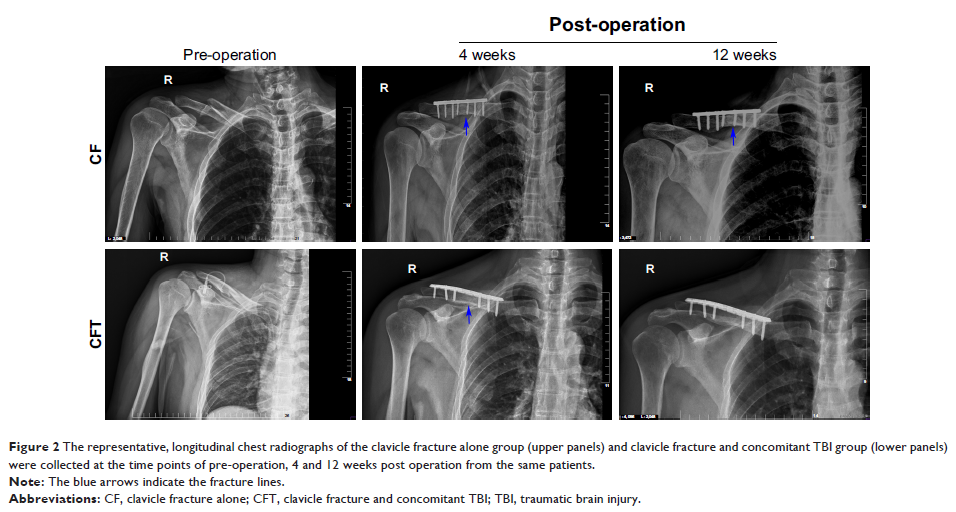
Results: The
fracture healing time in CFT group (82.22±13.61 days) was significantly shorter
than that in CF group (127±25.05 days; P <0.001). The expression of CD31, marker of blood
vessels, in callus tissues of CFT group was higher compared with that of CF
group. Serum NGF levels and the expression of NGF in callus tissues of CFT
group were higher than those in CF group (P <0.01). The expressions of CD31, NGF, and VEGF are
correlated with shorter fracture healing time.
Conclusion: The
formation of blood vessels was increased in CFT group compared with CF group.
NGF and VEGF levels were higher in CFT group than in CF group and correlated
with shorter fracture healing time. Accelerated fracture healing in patients
with TBI may be due to NGF- and VEGF-mediated angiogenesis at the fracture site.
Keywords: traumatic
brain injury, fracture healing, clavicle fracture, NGF, VEGF, angiogenesis