115195
论文已发表
注册即可获取德孚的最新动态
IF 收录期刊
- 3.6 Breast Cancer (Dove Med Press)
- 4.3 Clin Epidemiol
- 2.6 Cancer Manag Res
- 3.2 Infect Drug Resist
- 4.1 Clin Interv Aging
- 6.1 Drug Des Dev Ther
- 4.1 Int J Chronic Obstr
- 8.7 Int J Nanomed
- 2.5 Int J Women's Health
- 3.2 Neuropsych Dis Treat
- 2.4 OncoTargets Ther
- 2.6 Patient Prefer Adher
- 2.6 Ther Clin Risk Manag
- 3.1 J Pain Res
- 3.5 Diabet Metab Synd Ob
- 4.5 Psychol Res Behav Ma
- 3.4 Nat Sci Sleep
- 2.4 Pharmgenomics Pers Med
- 2.6 Risk Manag Healthc Policy
- 4.6 J Inflamm Res
- 2.3 Int J Gen Med
- 3.9 J Hepatocell Carcinoma
- 3.3 J Asthma Allergy
- 2.5 Clin Cosmet Investig Dermatol
- 3.0 J Multidiscip Healthc

血清中 HIF-1α 和 IL-19 水平与 COPD 疾病进展的相关性:一项回顾性研究
Authors Rong B, Liu Y, Li M, Fu T, Gao W, Liu H
Received 12 June 2018
Accepted for publication 15 August 2018
Published 21 November 2018 Volume 2018:13 Pages 3791—3803
DOI https://doi.org/10.2147/COPD.S177034
Checked for plagiarism Yes
Review by Single-blind
Peer reviewers approved by Dr Colin Mak
Peer reviewer comments 2
Editor who approved publication: Professor Chunxue Bai
Background: The aim of this
study was to disclose the correlation between the serum levels of
hypoxia-inducible factor 1 alpha (HIF-1α) and IL-19 and stable COPD.
Methods: The serum
levels of HIF-1α and IL-19 were tested by ELISA. The relationships between
their levels and clinical parameters of stable COPD patients were analyzed by
linear regression methods.
Results: Patients with
stable COPD showed higher serum levels of HIF-1α and IL-19 compared with
healthy control group (P <0.001), and serum levels of HIF-1α and IL-19 had
a positive linear correlation (P <0.05). In stable COPD patients, increased serum
levels of HIF-1α and IL-19 were positively correlated with the GOLD grading (P <0.005),
modified British Medical Research Council (mMRC) score (P <0.05), and
medical history (P <0.05) but negatively related to the pulmonary
function (P <0.05).
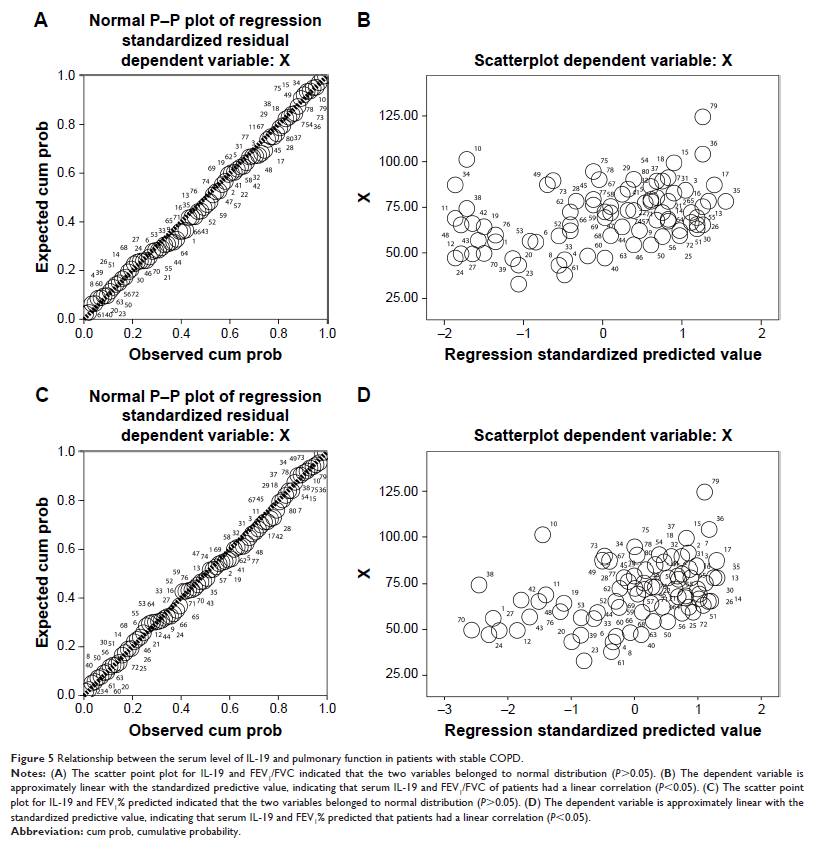
The serum level of HIF-1α (P <0.05) was affected by the patient’s FEV1/FVC
value and COPD grading, and the serum level of IL-19 was associated with the
mMRC scores and the serum level of HIF-1α (P <0.05).
Conclusion: Increased
serum levels of HIF-1α and IL-19 correlated with the disease progression of
COPD, suggesting that they can be used as indicators to help us understand the
COPD.
Keywords: chronic
obstructive pulmonary disease, COPD, hypoxia-inducible factor 1 alpha,
interleukin-19, serum, pulmonary function