115195
论文已发表
注册即可获取德孚的最新动态
IF 收录期刊
- 3.6 Breast Cancer (Dove Med Press)
- 4.3 Clin Epidemiol
- 2.6 Cancer Manag Res
- 3.2 Infect Drug Resist
- 4.1 Clin Interv Aging
- 6.1 Drug Des Dev Ther
- 4.1 Int J Chronic Obstr
- 8.7 Int J Nanomed
- 2.5 Int J Women's Health
- 3.2 Neuropsych Dis Treat
- 2.4 OncoTargets Ther
- 2.6 Patient Prefer Adher
- 2.6 Ther Clin Risk Manag
- 3.1 J Pain Res
- 3.5 Diabet Metab Synd Ob
- 4.5 Psychol Res Behav Ma
- 3.4 Nat Sci Sleep
- 2.4 Pharmgenomics Pers Med
- 2.6 Risk Manag Healthc Policy
- 4.6 J Inflamm Res
- 2.3 Int J Gen Med
- 3.9 J Hepatocell Carcinoma
- 3.3 J Asthma Allergy
- 2.5 Clin Cosmet Investig Dermatol
- 3.0 J Multidiscip Healthc

miRNA 在骨骼肌衰老中的作用
Authors Zheng Y, Kong J, Li Q, Wang Y, Li J
Received 24 March 2018
Accepted for publication 10 September 2018
Published 22 November 2018 Volume 2018:13 Pages 2407—2419
DOI https://doi.org/10.2147/CIA.S169202
Checked for plagiarism Yes
Review by Single-blind
Peer reviewers approved by Dr Amy Norman
Peer reviewer comments 3
Editor who approved publication: Dr Wu
Purpose: The aim
of this study was to explore the role of miRNAs in the process of skeletal
muscle aging.
Materials and methods: We analyzed the
miRNA microarray datasets from 19 young and 17 old skeletal muscle samples by
bioinformatic analysis. Differentially expressed miRNAs were identified,
followed by function and pathway enrichment analysis. The expression of miRNAs
were validated by real-time quantitative PCR (RT-qPCR) analysis.
Results: A total of 23
miRNAs were found to be differentially expressed in old muscle samples based on
two platforms. Gene targets of upregulated miRNAs were significantly enriched
in the oxytocin signaling pathway, AMP-activated protein kinase (AMPK)
signaling pathway, and Notch signaling pathway. The target genes of
downregulated miRNAs were significantly related to gap junction, salivary
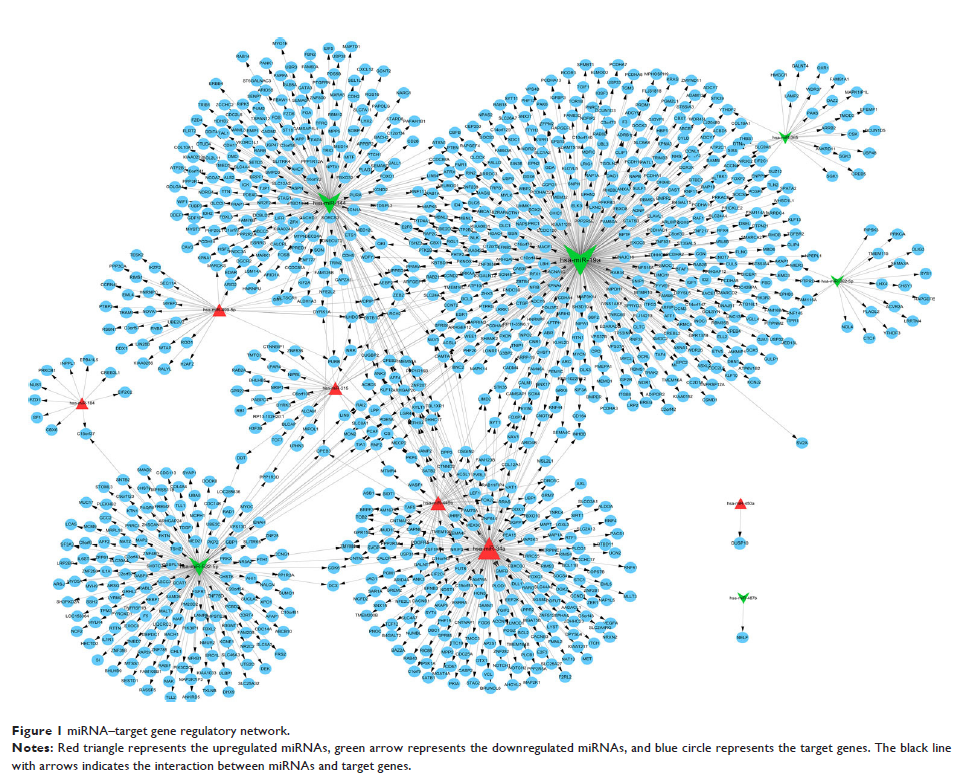
secretion, and estrogen signaling pathway. has-miR-19a and hsa-miR-34a were
significant nodes in the miRNA regulatory network. has-miR-19a was closely
related to the AMPK signaling pathway. hsa-miR-34a was closely related to
cellular senescence and mitogen-activated protein kinase (MAPK) signaling
pathway. PCR analysis showed that the expression of has-miR-34a-5p and
has-miR-449b-5p was significantly higher in the patient group than in the
control group, while no significant difference was observed in the expression
of has-miR-19a-3p and has-miR-144-3p between the two groups. Furthermore, the
expression of key target genes involved in cellular senescence (sirtuin 1
[SITRI]), MAPK signaling pathway (vascular endothelial growth factor A [VEGFA]),
and AMPK signaling pathway (protein kinase AMP-activated catalytic subunit
alpha 1 [PRKAA1] and 6-phosphofructo-2-kinase/fructose-2,6-biphosphatase 3
[PFKFB3]) were significantly increased in patients with sarcopenia.
Conclusion: has-miR-19a and
hsa-miR-34a may play regulatory roles in the aging process of skeletal muscles
and may be candidate targets to prevent muscle aging. Further experimental
validations are warranted.
Keywords: skeletal muscle
aging, differentially expressed miRNA, pathway, miRNA regulatory network