115195
论文已发表
注册即可获取德孚的最新动态
IF 收录期刊
- 3.6 Breast Cancer (Dove Med Press)
- 4.3 Clin Epidemiol
- 2.6 Cancer Manag Res
- 3.2 Infect Drug Resist
- 4.1 Clin Interv Aging
- 6.1 Drug Des Dev Ther
- 4.1 Int J Chronic Obstr
- 8.7 Int J Nanomed
- 2.5 Int J Women's Health
- 3.2 Neuropsych Dis Treat
- 2.4 OncoTargets Ther
- 2.6 Patient Prefer Adher
- 2.6 Ther Clin Risk Manag
- 3.1 J Pain Res
- 3.5 Diabet Metab Synd Ob
- 4.5 Psychol Res Behav Ma
- 3.4 Nat Sci Sleep
- 2.4 Pharmgenomics Pers Med
- 2.6 Risk Manag Healthc Policy
- 4.6 J Inflamm Res
- 2.3 Int J Gen Med
- 3.9 J Hepatocell Carcinoma
- 3.3 J Asthma Allergy
- 2.5 Clin Cosmet Investig Dermatol
- 3.0 J Multidiscip Healthc

ESCO2 通过以转录方式抑制结直肠癌中的 MMP2 来遏制肿瘤转移
Authors Guo XB, Huang B, Pan YH, Su SG, Li Y
Received 24 July 2018
Accepted for publication 15 October 2018
Published 22 November 2018 Volume 2018:10 Pages 6157—6166
DOI https://doi.org/10.2147/CMAR.S181265
Checked for plagiarism Yes
Review by Single-blind
Peer reviewers approved by Dr Colin Mak
Peer reviewer comments 2
Editor who approved publication: Dr Beicheng Sun
Background: Establishment
of cohesion 1 homolog 2 (ESCO2) plays important roles in the regulation of
cohesion and genomic stability and has been implicated in human cancers. Yet,
its clinical significance and biological function in colorectal cancer (CRC)
are unknown.
Methods: The expression
of ESCO2 was examined by quantitative real-time PCR, Western blot, and
immunohistochemistry. The role of ESCO2 in the tumor metastasis of CRC and the
related mechanisms were investigated using in vitro and in vivo models.
Results: In this study,
we show that low expression of ESCO2 in CRC was closely correlated with
lymphatic and distant metastasis. Patients with low ESCO2 expression
experienced shorter overall survival and disease-free survival in two
independent cohorts containing a total of 587 CRC cases. ESCO2 overexpression
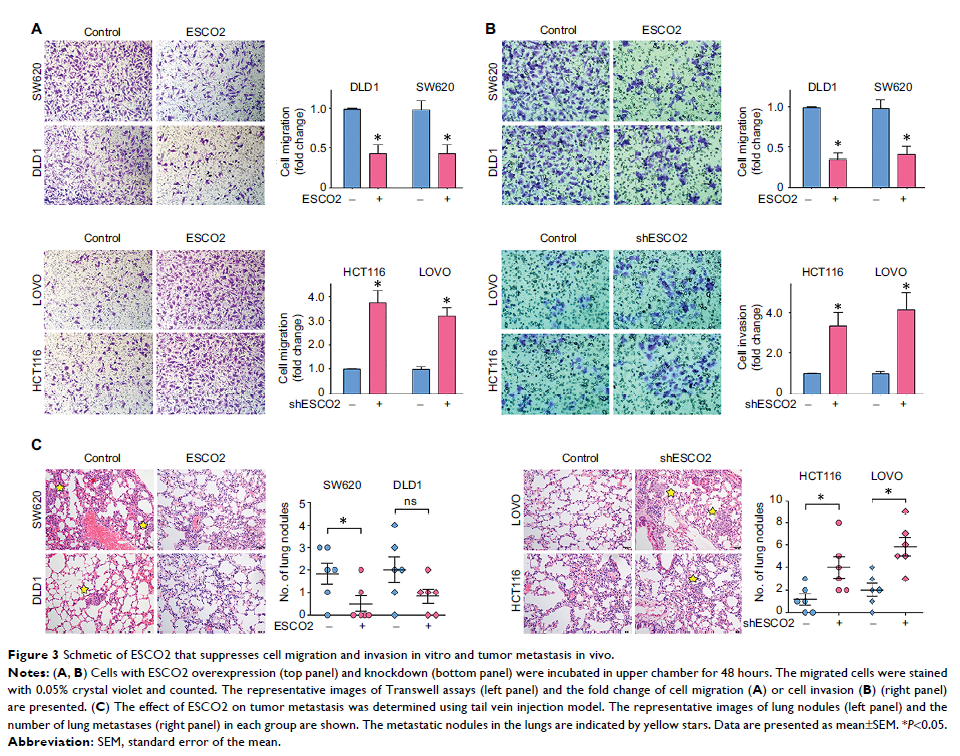
suppressed, whereas ESCO2 knockdown promoted cell migration in vitro and tumor
metastasis in vivo via modulation of epithelial–mesenchymal transition (EMT)
process. Mechanistically, ESCO2 inhibited the transcriptional activity of MMP2
promoter to downregulate its expression. Reexpression of MMP2 partially
attenuated the ESCO2-mediated malignant phenotypes.
Conclusion: Collectively,
our data suggest that ESCO2 serves as a potential prognostic factor and exerts
antimetastatic activity in CRC.
Keywords: ESCO2,
MMP2, EMT, metastasis, colorectal cancer