115195
论文已发表
注册即可获取德孚的最新动态
IF 收录期刊
- 3.6 Breast Cancer (Dove Med Press)
- 4.3 Clin Epidemiol
- 2.6 Cancer Manag Res
- 3.2 Infect Drug Resist
- 4.1 Clin Interv Aging
- 6.1 Drug Des Dev Ther
- 4.1 Int J Chronic Obstr
- 8.7 Int J Nanomed
- 2.5 Int J Women's Health
- 3.2 Neuropsych Dis Treat
- 2.4 OncoTargets Ther
- 2.6 Patient Prefer Adher
- 2.6 Ther Clin Risk Manag
- 3.1 J Pain Res
- 3.5 Diabet Metab Synd Ob
- 4.5 Psychol Res Behav Ma
- 3.4 Nat Sci Sleep
- 2.4 Pharmgenomics Pers Med
- 2.6 Risk Manag Healthc Policy
- 4.6 J Inflamm Res
- 2.3 Int J Gen Med
- 3.9 J Hepatocell Carcinoma
- 3.3 J Asthma Allergy
- 2.5 Clin Cosmet Investig Dermatol
- 3.0 J Multidiscip Healthc

School performance in children with infantile hydrocephalus: a nationwide cohort study
Authors Schmidt LB, Corn G, Wohlfahrt J, Melbye M, Munch TN
Received 30 June 2018
Accepted for publication 7 September 2018
Published 22 November 2018 Volume 2018:10 Pages 1721—1731
DOI https://doi.org/10.2147/CLEP.S178757
Checked for plagiarism Yes
Review by Single-blind
Peer reviewers approved by Dr Cristina Weinberg
Peer reviewer comments 3
Editor who approved publication: Professor Henrik Toft Sørensen
Purpose: Little is known
about the prognosis for school performance among children with all-cause
infantile hydrocephalus (IHC). Using detailed educational data, we investigated
the school performance for IHC patients compared to other children in Denmark.
Patients and methods: We
conducted a population-based cohort study of all live-born children in Denmark
(1977–2015) based on data from the Danish national health registers and the
Danish educational register. The cumulative chance of completing school at age
18 years was estimated using the Aalen–Johansen estimator. The relative risks
presented as ORs for not completing school, obtaining grades, or obtaining a
grade point average below the national mean value were estimated using a
logistic regression model.
Results: The
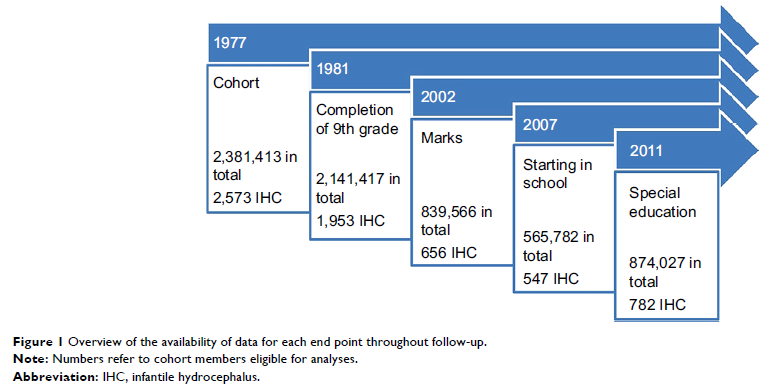
cohort included 2,381,413 children, and of these, 2,573 were diagnosed with
IHC. A total of 86% of IHC children completed compulsory school compared to 96%
among other children; only 62% of IHC children who completed school received
marks vs 96% among other children. Mediation analyses indicated that one-third
of these poorer performances in IHC children could be attributable to their
higher prevalence of epilepsy, spasticity, visual disturbances, autism, and
attention-deficit hyperactivity disorder. Completion rates were similar for
isolated and non-isolated hydrocephalus, and did not vary by age at diagnosis
or number of surgeries. Of the children with isolated IHC, 73% obtained grades
vs 58% of the children with non-isolated IHC. Poorer school performance in IHC
children was also observed when considering age at school start, grade point
average, and completion of further education.
Conclusion: The poorer
school performance among IHC children is particularly reflected by the larger
proportion not obtaining grades compared to other children. However, the
performance of the IHC children obtaining grades is comparable to that of other
children.
Keywords: pediatric
hydrocephalus, long-term outcome, prognosis, school performance