115195
论文已发表
注册即可获取德孚的最新动态
IF 收录期刊
- 3.6 Breast Cancer (Dove Med Press)
- 4.3 Clin Epidemiol
- 2.6 Cancer Manag Res
- 3.2 Infect Drug Resist
- 4.1 Clin Interv Aging
- 6.1 Drug Des Dev Ther
- 4.1 Int J Chronic Obstr
- 8.7 Int J Nanomed
- 2.5 Int J Women's Health
- 3.2 Neuropsych Dis Treat
- 2.4 OncoTargets Ther
- 2.6 Patient Prefer Adher
- 2.6 Ther Clin Risk Manag
- 3.1 J Pain Res
- 3.5 Diabet Metab Synd Ob
- 4.5 Psychol Res Behav Ma
- 3.4 Nat Sci Sleep
- 2.4 Pharmgenomics Pers Med
- 2.6 Risk Manag Healthc Policy
- 4.6 J Inflamm Res
- 2.3 Int J Gen Med
- 3.9 J Hepatocell Carcinoma
- 3.3 J Asthma Allergy
- 2.5 Clin Cosmet Investig Dermatol
- 3.0 J Multidiscip Healthc

Hypertension and transcatheter aortic valve replacement: parallel or series?
Authors Tiwari N, Madan N
Received 16 June 2018
Accepted for publication 24 October 2018
Published 23 November 2018 Volume 2018:11 Pages 81—91
DOI https://doi.org/10.2147/IBPC.S177258
Checked for plagiarism Yes
Review by Single-blind
Peer reviewers approved by Dr Andrew Yee
Peer reviewer comments 4
Editor who approved publication: Professor Turgay Celik
Abstract: Aortic stenosis
(AS) is the most common valvular heart disease in the elderly and it causes
significant morbidity and mortality. Hypertension is also highly prevalent in
elderly patients with AS, and AS patients with hypertension have worse
outcomes. Accurate assessment of AS severity and understanding its relationship
with arterial compliance has become increasingly important as the options for
valve management, particularly transcatheter interventions, have grown. The
parameters used for quantifying stenosis severity have traditionally mainly
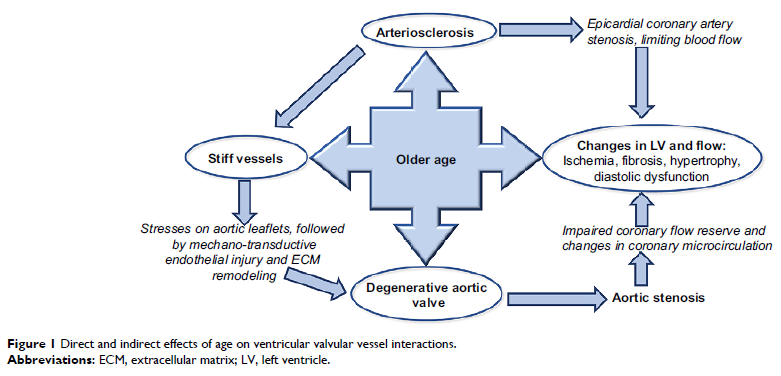
focused on the valve itself. However, AS is now recognized as a systemic
disease involving aging ventricles and stiff arteries rather than one limited
solely to the valve. Over the last decade, valvuloarterial impedance, a measure
of global ventricular load, has contributed to our understanding of the
pathophysiology and course of AS in heterogeneous patients, even when
segregated by symptoms and severity. This review summarizes our growing
understanding of the interplay between ventricle, valve, and vessel, with a
particular emphasis on downstream vascular changes after transcatheter aortic
valve replacement and the role of valvuloarterial impedance in predicting left
ventricular changes and prognosis in patients with various transvalvular flow
patterns.
Keywords: aortic
stenosis, transcatheter aortic valve replacement, global ventricular load,
ventriculoarterial coupling, arterial compliance, valvuloarterial impedance