115195
论文已发表
注册即可获取德孚的最新动态
IF 收录期刊
- 3.6 Breast Cancer (Dove Med Press)
- 4.3 Clin Epidemiol
- 2.6 Cancer Manag Res
- 3.2 Infect Drug Resist
- 4.1 Clin Interv Aging
- 6.1 Drug Des Dev Ther
- 4.1 Int J Chronic Obstr
- 8.7 Int J Nanomed
- 2.5 Int J Women's Health
- 3.2 Neuropsych Dis Treat
- 2.4 OncoTargets Ther
- 2.6 Patient Prefer Adher
- 2.6 Ther Clin Risk Manag
- 3.1 J Pain Res
- 3.5 Diabet Metab Synd Ob
- 4.5 Psychol Res Behav Ma
- 3.4 Nat Sci Sleep
- 2.4 Pharmgenomics Pers Med
- 2.6 Risk Manag Healthc Policy
- 4.6 J Inflamm Res
- 2.3 Int J Gen Med
- 3.9 J Hepatocell Carcinoma
- 3.3 J Asthma Allergy
- 2.5 Clin Cosmet Investig Dermatol
- 3.0 J Multidiscip Healthc

HIPK3 在中国非小细胞肺癌患者中的表达水平及预后价值
Authors Liu Y, Qian L, Yang J, Huang H, Feng J, Li X, Bian T, Ke H, Liu J, Zhang J
Received 28 February 2018
Accepted for publication 2 September 2018
Published 25 October 2018 Volume 2018:11 Pages 7459—7469
DOI https://doi.org/10.2147/OTT.S166878
Checked for plagiarism Yes
Review by Single-blind
Peer reviewers approved by Dr Colin Mak
Peer reviewer comments 2
Editor who approved publication: Dr Jianmin Xu
Background: Lung cancer is one of the most common malignancies in the world and is at the forefront of causes of all cancer deaths. Identification of new prognostic predictors or therapeutic targets might improve a patient’s survival rate.
Purpose: The Homeodomain interacting protein kinases (HIPKs) function as modulators of cellular stress responses and regulate cell differentiation, proliferation and apoptosis, but the function of HIPK3 is remain unknown.
Patients and methods: We used quantitative real-time polymerase chain reaction (qRT-PCR) and Western blotting methods to detective the expression of HIPK3. A total of 206 samples were obtained from patients and Immunochemical evaluation to determine HIPK3 protein expression. HIPK3 protein levels in in non-small cell lung cancer (NSCLC) were correlated with the clinical characteristics of patients and their 5-year survival rate. In addition, HIPK3 knockdown by specific RNAi promoted cell proliferation, migration, and invasion in A549 and HCC827 cancer cell lines.
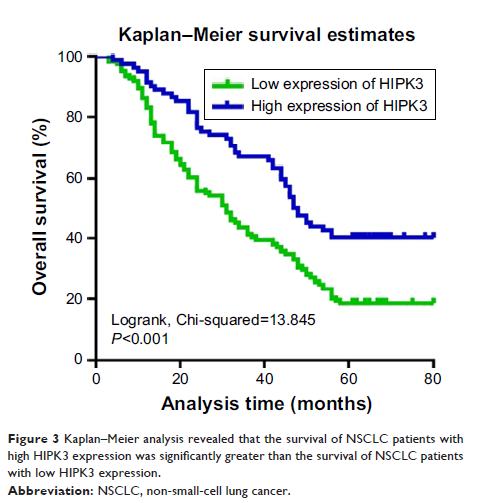
Results: The quantitative real-time polymerase chain reaction (qRT-PCR) and Western blotting methods to demonstrate that HIPK3 expression was significantly down-regulated in non-small cell lung cancer (NSCLC) tissues compared with that in normal lung tissues. At the same time, the results of immunohistochemistry assays showed that low expression of HIPK3 was significantly associated with pathology grade; tumor, node, and metastases (TNM) stage; lymph node metastasis; Ki-67 expression; and the 5-year survival rate in NSCLC patients. Univariate analysis revealed that HIPK3 expression, Ki-67 expression, tumor diameter, TNM stage, and age were significantly associated with a poor prognosis. The multivariable analysis illustrated that HIPK3, tumor diameter, TNM, Ki-67 expression, and age had effects on the overall survival of NSCLC patients independently. Kaplan-Meier survival curves revealed that NSCLC patients with a lower HIPK3 expression had a poorer prognosis. In addition, in vivo results also confirmed that HIPK3 over-expression could inhibit tumor growth.
Conclusion: Our findings confirmed that low expression of HIPK3 in NSCLC tissues was significantly correlated with poor survival rates after curative resection. HIPK3 could potentially be used as a valuable biomarker in the prognosis of the survival of NSCLC patients.
Keywords: HIPK3, non-small-cell lung cancer, immunohistochemistry, tumor suppressor gene, prognosis, biomarker