115195
论文已发表
注册即可获取德孚的最新动态
IF 收录期刊
- 3.6 Breast Cancer (Dove Med Press)
- 4.3 Clin Epidemiol
- 2.6 Cancer Manag Res
- 3.2 Infect Drug Resist
- 4.1 Clin Interv Aging
- 6.1 Drug Des Dev Ther
- 4.1 Int J Chronic Obstr
- 8.7 Int J Nanomed
- 2.5 Int J Women's Health
- 3.2 Neuropsych Dis Treat
- 2.4 OncoTargets Ther
- 2.6 Patient Prefer Adher
- 2.6 Ther Clin Risk Manag
- 3.1 J Pain Res
- 3.5 Diabet Metab Synd Ob
- 4.5 Psychol Res Behav Ma
- 3.4 Nat Sci Sleep
- 2.4 Pharmgenomics Pers Med
- 2.6 Risk Manag Healthc Policy
- 4.6 J Inflamm Res
- 2.3 Int J Gen Med
- 3.9 J Hepatocell Carcinoma
- 3.3 J Asthma Allergy
- 2.5 Clin Cosmet Investig Dermatol
- 3.0 J Multidiscip Healthc

较高的自分泌运动因子/葡萄糖-6-磷酸异构酶表达与胃癌的发生和预后较差相关
Authors Ma YT, Xing XF, Dong B, Cheng XJ, Guo T, Du H, Wen XZ, Ji JF
Received 16 June 2018
Accepted for publication 6 August 2018
Published 25 October 2018 Volume 2018:10 Pages 4969—4980
DOI https://doi.org/10.2147/CMAR.S177441
Checked for plagiarism Yes
Review by Single-blind
Peer reviewers approved by Dr Colin Mak
Peer reviewer comments 3
Editor who approved publication: Dr Antonella D'Anneo
Background: Glucose-6-phosphate isomerase (GPI) is a glycolytic-related enzyme that interconverts glucose-6-phosphate and fructose-6-phosphate in the cytoplasm. This protein is also secreted into the extracellular matrix by cancer cells and is, therefore, also called autocrine motility factor (AMF).
Methods: To clarify the roles of AMF/GPI in gastric cancer (GC), we collected 335 GC tissues and the corresponding adjacent noncancerous tissues, performed immunohistochemical studies, and analyzed the relationship between AMF/GPI expression and the patients’ clinicopathologic features.
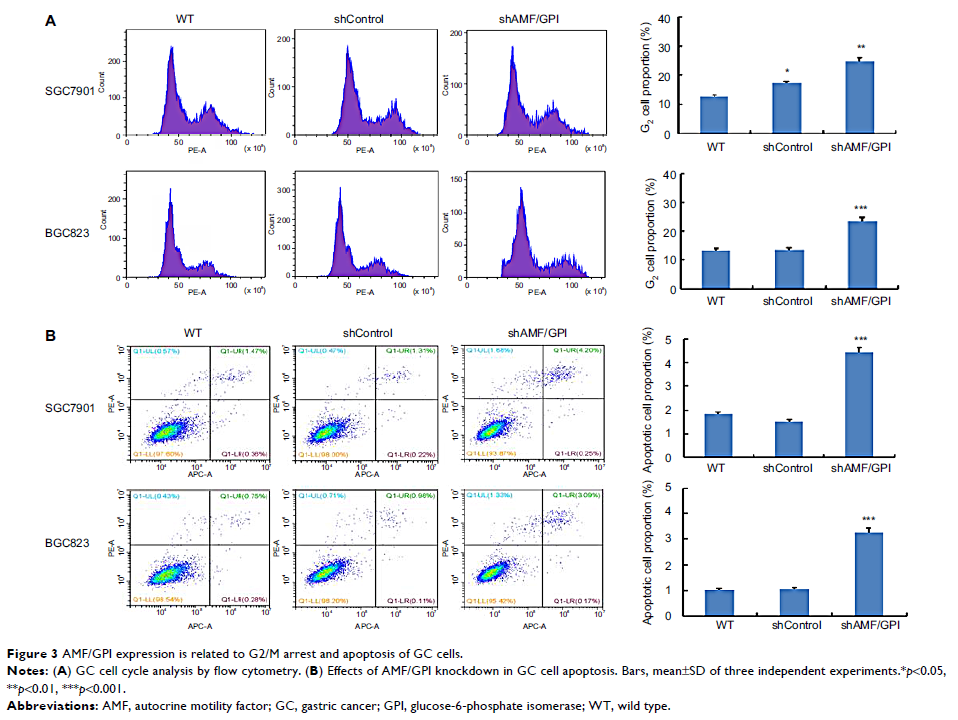
Results: AMF/GPI expression was found to be significantly higher in the GC group than in the corresponding noncancerous tissue group (P <0.001). Additionally, AMF/GPI expression positively associated with a higher TNM stage and poorer prognosis in patients. Through Kaplan–Meier analysis and according to the Oncomine database, we found that AMF/GPI was overexpressed in GC tissues compared to normal mucosa, and the patients with higher AMF/GPI expression had poorer outcomes. We used AMF/GPI-silenced GC cell lines to observe how changes in AMP/GPI affect cellular phenotypes. AMF/GPI knockdown suppressed proliferation, migration, invasion, and glycolysis, and induced apoptosis in GC cells.
Conclusion: These findings suggest that AMF/GPI overexpression is involved in carcinogenesis and promotes the aggressive phenotypes of GC cells.
Keywords: gastric cancer, glucose-6-phosphate isomerase, autocrine motility factor, tumorigenesis, prognosis, metabolism