115195
论文已发表
注册即可获取德孚的最新动态
IF 收录期刊
- 3.6 Breast Cancer (Dove Med Press)
- 4.3 Clin Epidemiol
- 2.6 Cancer Manag Res
- 3.2 Infect Drug Resist
- 4.1 Clin Interv Aging
- 6.1 Drug Des Dev Ther
- 4.1 Int J Chronic Obstr
- 8.7 Int J Nanomed
- 2.5 Int J Women's Health
- 3.2 Neuropsych Dis Treat
- 2.4 OncoTargets Ther
- 2.6 Patient Prefer Adher
- 2.6 Ther Clin Risk Manag
- 3.1 J Pain Res
- 3.5 Diabet Metab Synd Ob
- 4.5 Psychol Res Behav Ma
- 3.4 Nat Sci Sleep
- 2.4 Pharmgenomics Pers Med
- 2.6 Risk Manag Healthc Policy
- 4.6 J Inflamm Res
- 2.3 Int J Gen Med
- 3.9 J Hepatocell Carcinoma
- 3.3 J Asthma Allergy
- 2.5 Clin Cosmet Investig Dermatol
- 3.0 J Multidiscip Healthc

被动手指练习对老年痴呆症患者握力和正常的日常活动的影响:一项为期 12 月的随机对照试验
Authors Liu BB, Chen XP, Li Y, Liu H, Guo SS, Yu P
Received 20 May 2018
Accepted for publication 4 September 2018
Published 26 October 2018 Volume 2018:13 Pages 2169—2177
DOI https://doi.org/10.2147/CIA.S174756
Checked for plagiarism Yes
Review by Single-blind
Peer reviewers approved by Dr Colin Mak
Peer reviewer comments 2
Editor who approved publication: Dr Wu
Background: Dementia adds burden to society. As it is not curable, physical exercise activities are optimal to improve the physical strength and quality-of-life of people with dementia.
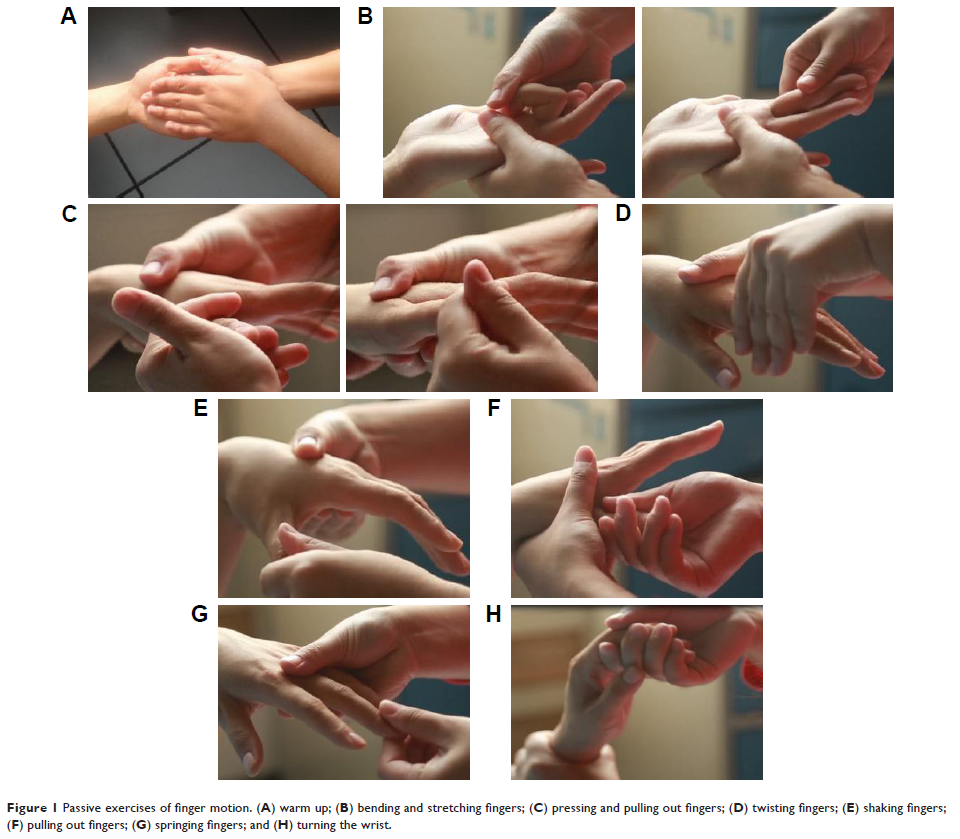
Aim: Design, implementation, and examination of a set of passive finger exercises and their effects on improving grip strength and activities of daily living (ADL) for older people with dementia.
Methods: Forty older people with dementia were recruited and randomly allocated into an experimental group and a control group, each with 20 people. The control group received routine nursing care. In addition to this, the experimental group received 25-minutes of passive finger exercises every day for 12 weeks. The health outcomes measured were grip strength and ADL, before and after the intervention. Grip strength was assessed by electrical hand muscle dynamometer. ADL were assessed with Barthel index.
Results: Although there was no effect on grip strength, passive finger exercises led to significant improvements in urinary control, defecation function, and overall ADL in comparison with the control group.
Implications for practice: Passive finger exercises can be integrated into physical exercise programs for older people with dementia to improve their urinary control, defecation function, and ADL.
Keywords: physical exercise, passive finger exercise, grip strength, urinary control, defecation, activities of daily living, ADL, dementia