115195
论文已发表
注册即可获取德孚的最新动态
IF 收录期刊
- 3.6 Breast Cancer (Dove Med Press)
- 4.3 Clin Epidemiol
- 2.6 Cancer Manag Res
- 3.2 Infect Drug Resist
- 4.1 Clin Interv Aging
- 6.1 Drug Des Dev Ther
- 4.1 Int J Chronic Obstr
- 8.7 Int J Nanomed
- 2.5 Int J Women's Health
- 3.2 Neuropsych Dis Treat
- 2.4 OncoTargets Ther
- 2.6 Patient Prefer Adher
- 2.6 Ther Clin Risk Manag
- 3.1 J Pain Res
- 3.5 Diabet Metab Synd Ob
- 4.5 Psychol Res Behav Ma
- 3.4 Nat Sci Sleep
- 2.4 Pharmgenomics Pers Med
- 2.6 Risk Manag Healthc Policy
- 4.6 J Inflamm Res
- 2.3 Int J Gen Med
- 3.9 J Hepatocell Carcinoma
- 3.3 J Asthma Allergy
- 2.5 Clin Cosmet Investig Dermatol
- 3.0 J Multidiscip Healthc

lncRNA PANDAR 的过度表达预示着急性髓性白血病的不良预后
Authors Yang L, Zhou JD, Zhang TJ, Ma JC, Xiao GF, Chen Q, Deng ZQ, Lin J, Qian J, Yao DM
Received 15 July 2018
Accepted for publication 11 September 2018
Published 29 October 2018 Volume 2018:10 Pages 4999—5007
DOI https://doi.org/10.2147/CMAR.S180150
Checked for plagiarism Yes
Review by Single-blind
Peer reviewers approved by Dr Andrew Yee
Peer reviewer comments 2
Editor who approved publication: Dr Luzhe Sun
Background and purpose: Abundant studies have shown that lncRNA PANDAR plays an oncogenic role in human solid tumors. Although abnormal expression of PANDAR has been well investigated in solid tumors, it was rarely studied in hematologic diseases. Hence, the aim of this study was to determine the PANDAR expression level and its clinical significance in patients with acute myeloid leukemia (AML).
Materials and methods: For detecting the expression level of PANDAR in 119 AML patients and 26 controls, real-time quantitative PCR was used in this study. The prognostic values were evaluated by using Kaplan–Meier analysis, Cox regression analyses, and logistic regression analysis.
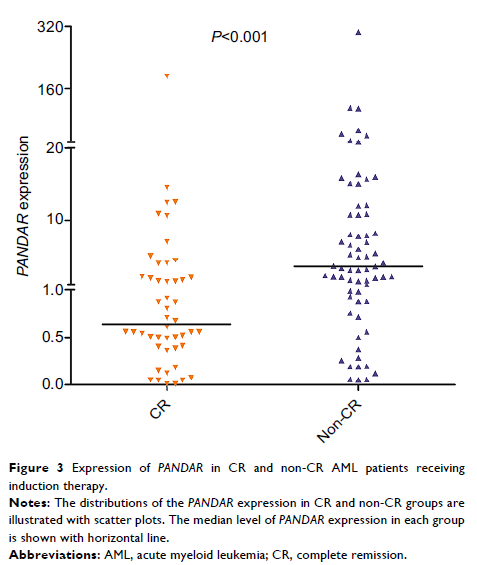
Results: PANDAR was significantly overexpressed in AML and might be a promising biomarker which could distinguish AML from normal samples (P <0.001). Patients with high expression of PANDAR (PANDAR high) were older and showed higher bone marrow blasts than patients in PANDAR low group (P =0.029 and 0.032, respectively). Significant differences between these groups were also detected regarding risk group and karyotype finding (P =0.009 and 0.041, respectively). Importantly, PANDAR high patients presented a significant lower complete remission rate compared to PANDAR lowpatients (P <0.001). Furthermore, Kaplan–Meier analysis showed that PANDAR high patients had shorter overall survival compared to PANDAR low patients observing the whole AML cohort, and also in the non-M3 group of patients (P <0.001 and P =0.005, respectively). Multivariate analysis of Cox and logistic regression analysis confirmed that high PANDAR expression was an independent unfavorable risk factor for overall survival and complete remission in both observed patient groups.
Conclusion: These results revealed that PANDAR was overexpressed in AML, and that higher PANDAR expression was associated with poor clinical outcome. Our study therefore suggests that PANDAR expression is a promising biomarker for prognostic prediction for AML.
Keywords: long noncoding RNA, PANDAR expression, acute myeloid leukemia, complete remission, overall survival