115195
论文已发表
注册即可获取德孚的最新动态
IF 收录期刊
- 3.6 Breast Cancer (Dove Med Press)
- 4.3 Clin Epidemiol
- 2.6 Cancer Manag Res
- 3.2 Infect Drug Resist
- 4.1 Clin Interv Aging
- 6.1 Drug Des Dev Ther
- 4.1 Int J Chronic Obstr
- 8.7 Int J Nanomed
- 2.5 Int J Women's Health
- 3.2 Neuropsych Dis Treat
- 2.4 OncoTargets Ther
- 2.6 Patient Prefer Adher
- 2.6 Ther Clin Risk Manag
- 3.1 J Pain Res
- 3.5 Diabet Metab Synd Ob
- 4.5 Psychol Res Behav Ma
- 3.4 Nat Sci Sleep
- 2.4 Pharmgenomics Pers Med
- 2.6 Risk Manag Healthc Policy
- 4.6 J Inflamm Res
- 2.3 Int J Gen Med
- 3.9 J Hepatocell Carcinoma
- 3.3 J Asthma Allergy
- 2.5 Clin Cosmet Investig Dermatol
- 3.0 J Multidiscip Healthc

与神经内分泌肿瘤非手术治疗相关的胃肠道事件的系统评价和荟萃分析
Authors Wu Q, Chen B, Yan G, Yang Z, Xiong L, He J
Received 25 July 2018
Accepted for publication 5 October 2018
Published 31 October 2018 Volume 2018:11 Pages 7655—7668
DOI https://doi.org/10.2147/OTT.S181335
Checked for plagiarism Yes
Review by Single-blind
Peer reviewers approved by Dr Andrew Yee
Peer reviewer comments 5
Editor who approved publication: Dr Sanjeev Srivastava
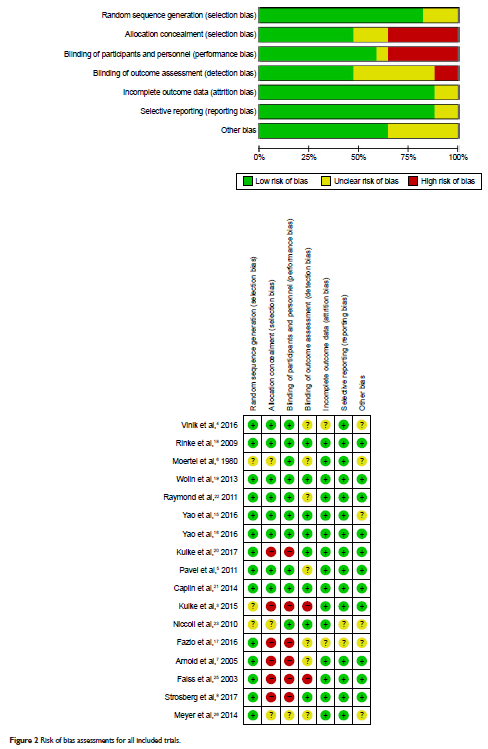
Abstract: The risk of gastrointestinal (GI) events induced by nonoperative therapies in patients with neuroendocrine tumors (NETs) is unclear. Nonoperative therapies include somatostatin analogs, molecular targeted agents, cytotoxic chemotherapy, interferon-α, and peptide receptor radionuclide therapy. We undertook an up-to-date meta-analysis to determine the incidence and relative risks (RRs) of GI events in NET patients treated with these therapies. MEDLINE, EMBASE, the Cochrane Central Register of Controlled Trials, and ClinicalTrials.gov were searched to identify relevant trials. Eligible trials were selected according to the PRISMA statement. Summary incidence, RR, and 95% CIs were calculated using random- and fixed-effects models. We included 2,890 patients from 17 randomized controlled trials in this meta-analysis. The experimental treatments led to increased incidence and risks of GI events compared to the control treatments (P <0.05). Diarrhea was the most common GI event. The experimental treatments were associated with increased risks of high-grade nausea (RR 2.36; 95% CI 1.05–5.25; P <0.01) and vomiting (RR 1.89; 95% CI 1.04–3.44; P <0.05). In regard to specific therapy regimens, everolimus led to increased risks of diarrhea (RR 2.97; 95% CI 1.83–4.83; P <0.05), vomiting (RR 2.19; 95% CI 1.38–3.48; P <0.05), and anorexia (RR 3.20; 95% CI 1.69–6.06; P <0.05), whereas VEGFR inhibitors led to increased risk of diarrhea (RR 2.12; 95% CI 1.39–3.25; P <0.05). Additionally, GI NETs led to higher risk of GI events than pancreatic NETs. Thus, nonoperative therapies are associated with increased risks of GI events in NET patients, and rigorous management is warranted to minimize the adverse impact on treatment outcomes and to improve quality of life.
Keywords: chemotherapy, somatostatin analogs, everolimus, neuroendocrine tumors, meta-analysis, gastrointestinal events