115195
论文已发表
注册即可获取德孚的最新动态
IF 收录期刊
- 3.6 Breast Cancer (Dove Med Press)
- 4.3 Clin Epidemiol
- 2.6 Cancer Manag Res
- 3.2 Infect Drug Resist
- 4.1 Clin Interv Aging
- 6.1 Drug Des Dev Ther
- 4.1 Int J Chronic Obstr
- 8.7 Int J Nanomed
- 2.5 Int J Women's Health
- 3.2 Neuropsych Dis Treat
- 2.4 OncoTargets Ther
- 2.6 Patient Prefer Adher
- 2.6 Ther Clin Risk Manag
- 3.1 J Pain Res
- 3.5 Diabet Metab Synd Ob
- 4.5 Psychol Res Behav Ma
- 3.4 Nat Sci Sleep
- 2.4 Pharmgenomics Pers Med
- 2.6 Risk Manag Healthc Policy
- 4.6 J Inflamm Res
- 2.3 Int J Gen Med
- 3.9 J Hepatocell Carcinoma
- 3.3 J Asthma Allergy
- 2.5 Clin Cosmet Investig Dermatol
- 3.0 J Multidiscip Healthc

Janus Fe3O4-TiO2 纳米粒子对 Sprague Dawley 大鼠静脉注射的生物安全性评估
Authors Su H, Song X, Li J, Iqbal MZ, Fiati Kenston SS, Li Z, Wu A, Ding M, Zhao J
Received 10 March 2018
Accepted for publication 10 July 2018
Published 31 October 2018 Volume 2018:13 Pages 6987—7001
DOI https://doi.org/10.2147/IJN.S167851
Checked for plagiarism Yes
Review by Single-blind
Peer reviewers approved by Dr Alexander Kharlamov
Peer reviewer comments 4
Editor who approved publication: Dr Lei Yang
Introduction: Newly synthesized Janus-structured Fe3O4-TiO2 nanoparticles (NPs) appear to be a promising candidate for the diagnosis and therapy of cancer. Although the toxicity of individual Fe3O4or TiO2 NPs has been studied extensively, the toxicity of Janus Fe3O4-TiO2 NPs is not clear.
Methods: In this study, the biosafety of both Janus Fe3O4-TiO2 NPs (20–25 nm) and the maternal material TiO2 NPs (7–10 nm) were evaluated in Sprague Dawley rats after one intravenous injection into the tail vein. Healthy rats were randomly divided into one control group and six experimental groups. Thirty days after treatment, rats were killed, then blood and tissue samples were collected for hematological, biochemical, element-content, histopathological, and Western blot analysis.
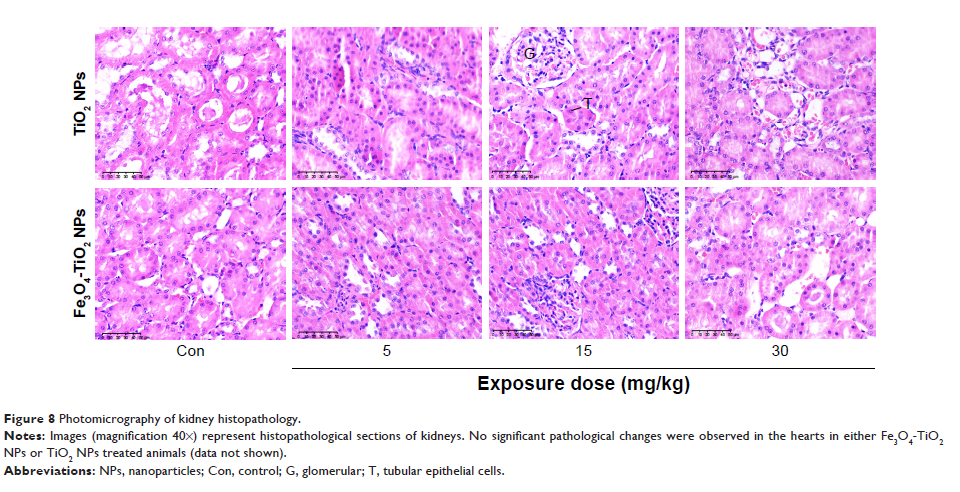
Results: The results show that only a slight Ti element accumulation in the heart, spleen, and liver could be found in the Janus Fe3O4-TiO2 NP groups (P >0.05 compared with control). However, significant Ti element accumulation in the spleen, lungs, and liver was found in the TiO2 NP-treated rats. Both Fe3O4-TiO2 NPs and TiO2 NPs could induce certain histopathological abnormalities. Western blot analysis showed that both NPs could induce certain apoptotic or inflammatory-related molecular protein upregulation in rat livers. A certain degree of alterations in liver function and electrolyte and lipid parameters was also observed in rats treated with both materials. However, compared to Janus structure Fe3O4-TiO2 NP-treated groups, TiO2 NPs at 30 mg/kg showed more severe adverse effects.
Conclusion: Our results showed that under a low dose (5 mg/kg), both NP types had no significant toxicity in rats. Janus NPs certainly seem less toxic than TiO2 NPs in rats at 30 mg/kg. To ensure safe use of these newly developed Janus NPs in cancer diagnosis and therapy, further animal studies are needed to evaluate long-term bioeffects.
Keywords: Fe3O4-TiO2 NPs, Janus structure NPs, TiO2 NPs, accumulation, inductively coupled plasma mass spectrometry, ICP-MS, biodistribution, nanomedicinef179465