115195
论文已发表
注册即可获取德孚的最新动态
IF 收录期刊
- 3.6 Breast Cancer (Dove Med Press)
- 4.3 Clin Epidemiol
- 2.6 Cancer Manag Res
- 3.2 Infect Drug Resist
- 4.1 Clin Interv Aging
- 6.1 Drug Des Dev Ther
- 4.1 Int J Chronic Obstr
- 8.7 Int J Nanomed
- 2.5 Int J Women's Health
- 3.2 Neuropsych Dis Treat
- 2.4 OncoTargets Ther
- 2.6 Patient Prefer Adher
- 2.6 Ther Clin Risk Manag
- 3.1 J Pain Res
- 3.5 Diabet Metab Synd Ob
- 4.5 Psychol Res Behav Ma
- 3.4 Nat Sci Sleep
- 2.4 Pharmgenomics Pers Med
- 2.6 Risk Manag Healthc Policy
- 4.6 J Inflamm Res
- 2.3 Int J Gen Med
- 3.9 J Hepatocell Carcinoma
- 3.3 J Asthma Allergy
- 2.5 Clin Cosmet Investig Dermatol
- 3.0 J Multidiscip Healthc

重复经颅磁刺激联合阿托西汀治疗注意缺陷多动障碍(ADHD)的临床疗效
Authors Cao P, Xing J, Cao Y, Cheng Q, Sun X, Kang Q, Dai L, Zhou X, Song Z
Received 4 August 2018
Accepted for publication 27 October 2018
Published 26 November 2018 Volume 2018:14 Pages 3231—3240
DOI https://doi.org/10.2147/NDT.S182527
Checked for plagiarism Yes
Review by Single-blind
Peer reviewers approved by Dr Colin Mak
Peer reviewer comments 2
Editor who approved publication: Dr Yu-Ping Ning
Objective: To explore
the effect of repetitive transcranial magnetic stimulation (rTMS) combined with
atomoxetine (ATX) in the treatment of attention-deficit hyperactivity disorder
(ADHD).
Methods: Sixty-four
patients with newly diagnosed ADHD were enrolled from January 2016 to October
2017 from Psychological Centre for Adolescents and Children at 102th Hospital
of People’s Liberation Army of China. These patients were randomly assigned to
three groups according to treatment method: the rTMS group, the ATX group, and
the rTMS+ ATX group. Before treatment and 6 weeks after treatment, clinical
symptoms and executive functions of ADHD patients were evaluated with the
Swanson, Nolan, and Pelham, Version IV (SNAP-IV) Questionnaire, continuous
performance test, three subtests (arithmetic, digit span, and coding) of
Wechsler Intelligence Scale for Children, as well as Iowa Gambling Tasks (IGT).
The effects of treatment were compared among three groups.
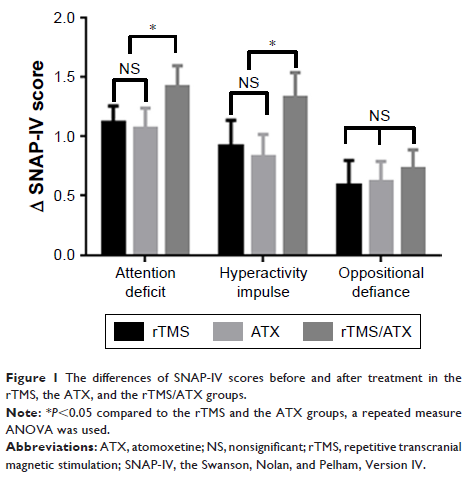
Results: After 6
weeks of treatment, the scores of all factors in the SNAP-IV questionnaire were
lower than those before treatment in the three groups; the scores of three
subtests of Wechsler Intelligence Scale for Children, continuous performance
test, and IGT were also significantly higher than those before treatment. The
rTMS+ ATX group had a better improvement in attention deficits and
hyperactivity impulse on the SNAP-IV questionnaire compared with the other
groups, and also had a higher efficacy on cold and hot executive functions such
as arithmetic, forward numbers, coding, and IGT. In addition, the ATX group
performed better than the rTMS group in coding and IGT.
Conclusion: rTMS,
ATX, and the combination therapy are effective in improving core symptoms and
executive function in patients with ADHD. The combined treatment has significant
therapeutic advantages over the single treatment groups. Compared with rTMS,
the drug therapy has a better improvement in coding and IGT.
Keywords: attention-deficit
hyperactivity disorder, repetitive transcranial magnetic stimulation, atomoxetine,
executive function