115195
论文已发表
注册即可获取德孚的最新动态
IF 收录期刊
- 3.6 Breast Cancer (Dove Med Press)
- 4.3 Clin Epidemiol
- 2.6 Cancer Manag Res
- 3.2 Infect Drug Resist
- 4.1 Clin Interv Aging
- 6.1 Drug Des Dev Ther
- 4.1 Int J Chronic Obstr
- 8.7 Int J Nanomed
- 2.5 Int J Women's Health
- 3.2 Neuropsych Dis Treat
- 2.4 OncoTargets Ther
- 2.6 Patient Prefer Adher
- 2.6 Ther Clin Risk Manag
- 3.1 J Pain Res
- 3.5 Diabet Metab Synd Ob
- 4.5 Psychol Res Behav Ma
- 3.4 Nat Sci Sleep
- 2.4 Pharmgenomics Pers Med
- 2.6 Risk Manag Healthc Policy
- 4.6 J Inflamm Res
- 2.3 Int J Gen Med
- 3.9 J Hepatocell Carcinoma
- 3.3 J Asthma Allergy
- 2.5 Clin Cosmet Investig Dermatol
- 3.0 J Multidiscip Healthc

APC 高甲基化是否是膀胱癌的诊断生物标志物?一个荟萃分析
Authors Han W, Wang Y, Fan J, Wang C
Received 19 June 2018
Accepted for publication 20 August 2018
Published 27 November 2018 Volume 2018:11 Pages 8359—8369
DOI https://doi.org/10.2147/OTT.S177601
Checked for plagiarism Yes
Review by Single-blind
Peer reviewers approved by Dr Amy Norman
Peer reviewer comments 3
Editor who approved publication: Dr Faris Farassati
Objective: Numerous
studies have been performed to investigate the association between APC promoter
hypermethylation and bladder cancer risk. Nevertheless, the conclusion was
uncertain due to small sample size, different ethnicities, and tumor subtype.
Hence, to accurately assess the effect of APC promoter
hypermethylation on the risk of bladder cancer, we performed the meta-analysis.
Materials and methods: We
retrieved the relevant literatures from electronic databases such as PubMed,
Web of Science, Wanfang, Vapp, and CNKI (Chinese National Knowledge
Infrastructure). 95% CI and OR were calculated to evaluate the associations
of APC promoter
hypermethylation with risk and clinical features of bladder cancer.
Heterogeneity among studies was assessed with Q test
and I 2 statistic.
In addition, the diagnostic sensitivity, specificity, and area under the curve
(AUC) value of APC hypermethylation for bladder cancer were calculated.
Results: In total,
14 articles with 531 controls and 1,293 cases were included to assess the
associations of APC promoter hypermethylation with the risk and
clinical characteristics of bladder cancer. The significant association
between APC promoter
hypermethylation and bladder cancer risk was detected (OR =17.01, CI
=7.40–39.07). Furthermore, the results revealed that APC promoter
hypermethylation was significantly correlated with the grade of bladder tumor
(pTNM stage: OR =1.84, CI =0.87–3.93; grade: OR =4.11, CI =1.62–10.43).
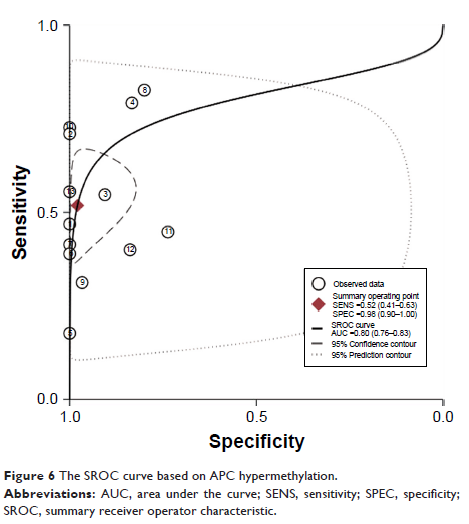
According to the results of diagnostic evaluation, the diagnostic sensitivity,
specificity, and AUC value of APC hypermethylation for bladder cancer risk were
0.52 (95% CI =0.41–0.63), 0.98 (95% CI =0.90–1.00), and 0.80 (95% CI
=0.76–0.83), respectively.
Conclusion: This
meta-analysis revealed that APC promoter hypermethylation was a risk factor
for bladder cancer risk. In addition, APC promoter hypermethylation was significantly
associated with the grade of bladder cancer. APC hypermethylation might be a
useful biomarker for the clinical diagnosis of bladder cancer.
Keywords: APC , promoter hypermethylation, bladder carcinoma,
meta-analysis