115195
论文已发表
注册即可获取德孚的最新动态
IF 收录期刊
- 3.6 Breast Cancer (Dove Med Press)
- 4.3 Clin Epidemiol
- 2.6 Cancer Manag Res
- 3.2 Infect Drug Resist
- 4.1 Clin Interv Aging
- 6.1 Drug Des Dev Ther
- 4.1 Int J Chronic Obstr
- 8.7 Int J Nanomed
- 2.5 Int J Women's Health
- 3.2 Neuropsych Dis Treat
- 2.4 OncoTargets Ther
- 2.6 Patient Prefer Adher
- 2.6 Ther Clin Risk Manag
- 3.1 J Pain Res
- 3.5 Diabet Metab Synd Ob
- 4.5 Psychol Res Behav Ma
- 3.4 Nat Sci Sleep
- 2.4 Pharmgenomics Pers Med
- 2.6 Risk Manag Healthc Policy
- 4.6 J Inflamm Res
- 2.3 Int J Gen Med
- 3.9 J Hepatocell Carcinoma
- 3.3 J Asthma Allergy
- 2.5 Clin Cosmet Investig Dermatol
- 3.0 J Multidiscip Healthc

对于经过先前的内分泌治疗已取得进展的激素受体阳性晚期乳腺癌,使用氟维司群加靶向药物与单独使用氟维司群治疗的比较:荟萃分析
Authors Xu L, Yan N, Li Z, Luo L, Wu X, Liu Q, Xu Y, Cao Y
Received 26 February 2018
Accepted for publication 18 July 2018
Published 27 November 2018 Volume 2018:11 Pages 8389—8398
DOI https://doi.org/10.2147/OTT.S166653
Checked for plagiarism Yes
Review by Single-blind
Peer reviewers approved by Dr Amy Norman
Peer reviewer comments 2
Editor who approved publication: Dr William Cho
Abstract: Fulvestrant is
recommended for the hormone receptor-positive metastatic breast cancer (MBC)
patients progressed during or after prior endocrine therapy. Notably, recent
evidence has also demonstrated that adding a targeted agent to fulvestrant
conferred a significantly clinical benefit in these patients. Since these
results were inconsistent among the studies, this meta-analysis herein was
conducted to compare the efficacy and toxicities of the fulvestrant-based
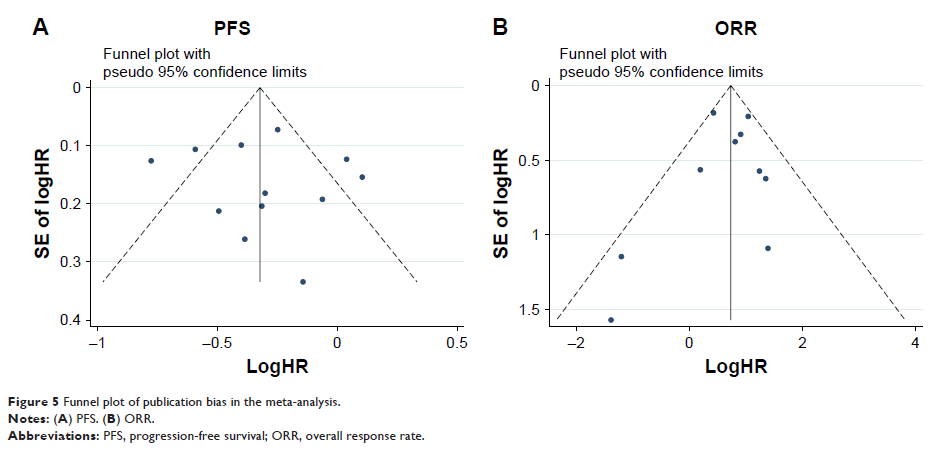
combination therapy with fulvestrant monotherapy. Thus, a systemic research was
performed in PubMed, Embase, and Cochrane library to identify relevant Phase II
or Phase III randomized controlled trials. The progression-free survival (PFS),
overall response rate (ORR), and toxicities were evaluated. And HR, risk ratio
(RR), and their 95% CIs were employed to complete the pooled analyses. In
total, 13 studies with 3,910-hour positive MBC patients progressed on prior
endocrine therapy were included in our meta-analysis. Improvements of
doublet-agents group were proven in terms of PFS (HR 0.73, 95% CI
=0.63–0.86, P =0.000) and ORR (RR 2.07, 95% CI =1.67–2.58, P =0.000). And the
further subgroup analysis also demonstrated that fulvestrant in combination
with a cyclin-dependent kinase (CDK4/6) inhibitor or a PI3K/mTOR inhibitor was
associated with a superior efficacy (RR 2.72, 95% CI =1.93–3.83, P =0.000 and RR
1.60, 95% CI =1.15–2.23, P =0.005, respectively). However, the efficacy was
comparable between the other combination strategies and fulvestrant alone. With
respect to the adverse effects, adding a targeted agent to fulvestrant also
produced more frequent grade 3/4 toxicities (RR 3.86, 95% CI =2.66–5.61, P =0.000). Taken
together, combination of fulvestrant with a targeted agent, especially
inhibitors targeting CDK4/6 or PI3K/mTOR pathway, may open a new avenue for
more effective therapies in relapse or metastatic hormone receptor-positive
breast cancer after prior aromatase inhibitors or tamoxifen treatment. In
addition, identifying reliable biomarkers to delineate which subgroup of patients
will specially benefit from fulvestrant-based combination therapy is warranted.
Keywords: fulvestrant,
breast cancer, combination therapy, endocrine resistance