115195
论文已发表
注册即可获取德孚的最新动态
IF 收录期刊
- 3.6 Breast Cancer (Dove Med Press)
- 4.3 Clin Epidemiol
- 2.6 Cancer Manag Res
- 3.2 Infect Drug Resist
- 4.1 Clin Interv Aging
- 6.1 Drug Des Dev Ther
- 4.1 Int J Chronic Obstr
- 8.7 Int J Nanomed
- 2.5 Int J Women's Health
- 3.2 Neuropsych Dis Treat
- 2.4 OncoTargets Ther
- 2.6 Patient Prefer Adher
- 2.6 Ther Clin Risk Manag
- 3.1 J Pain Res
- 3.5 Diabet Metab Synd Ob
- 4.5 Psychol Res Behav Ma
- 3.4 Nat Sci Sleep
- 2.4 Pharmgenomics Pers Med
- 2.6 Risk Manag Healthc Policy
- 4.6 J Inflamm Res
- 2.3 Int J Gen Med
- 3.9 J Hepatocell Carcinoma
- 3.3 J Asthma Allergy
- 2.5 Clin Cosmet Investig Dermatol
- 3.0 J Multidiscip Healthc

Spectrum of bactericidal action of amylmetacresol/2,4-dichlorobenzyl alcohol lozenges against oropharyngeal organisms implicated in pharyngitis
Authors Matthews D, Atkinson R, Shephard A
Received 18 August 2018
Accepted for publication 25 October 2018
Published 28 November 2018 Volume 2018:11 Pages 451—456
DOI https://doi.org/10.2147/IJGM.S184406
Checked for plagiarism Yes
Review by Single-blind
Peer reviewers approved by Dr Amy Norman
Peer reviewer comments 2
Editor who approved publication: Dr Scott Fraser
Purpose: Pharyngitis
is commonly caused by a self-limiting upper respiratory tract infection (URTI)
and symptoms typically include sore throat. Antibiotics are often
inappropriately used for the treatment of pharyngitis, which can contribute to
antimicrobial resistance, therefore non-antibiotic treatments which have broad
antiseptic effects may be more appropriate. Amylmetacresol (AMC) and
2,4-dichlorobenzyl alcohol (DCBA) are present in some antiseptic lozenges and
have established benefits in providing symptomatic relief and some in vitro
antiviral action.
Methods: Seven
bacterial species associated with pharyngitis, namely Streptococcus pyogenes , Fusobacterium necrophorum , Streptococcus dysgalactiae subspecies equisimilis , Moraxella catarrhalis , Haemophilus influenza , Arcanobacterium haemolyticum and Staphylococcus aureus ,
were exposed to an AMC/DCBA lozenge dissolved in artificial saliva. In vitro
bactericidal activity was measured as a log reduction in colony-forming units
(CFUs).
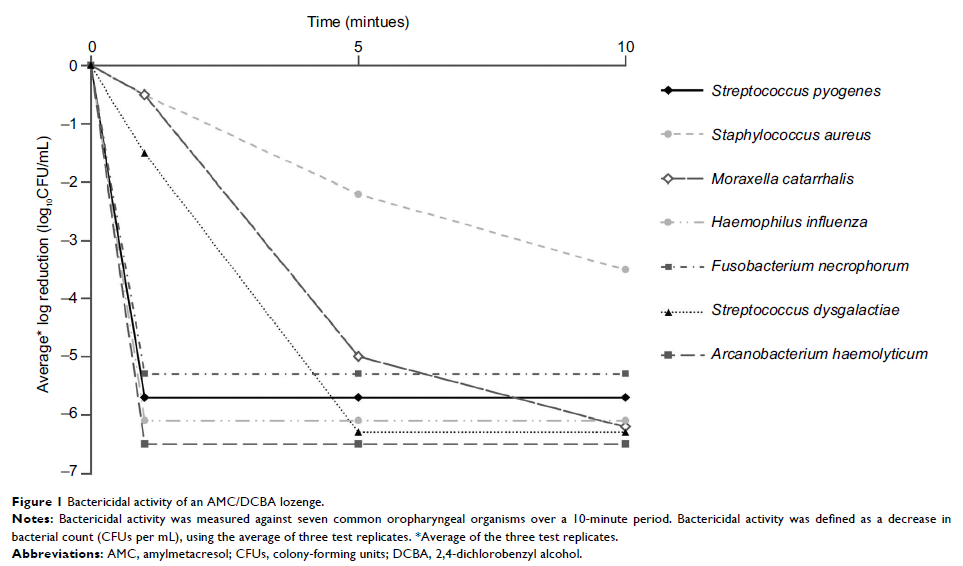
Results: Bactericidal
activity was recorded against all organisms after 1 minute. Greater than 3 log10 reductions in
CFUs were observed at 1 minute for S. pyogenes (log10 reduction
CFU/mL ± SD, 5.7±0.1), H. influenza (6.1±0.1), A. haemolyticum (6.5±0.0)
and F.
necrophorum (6.5±0.0), at 5 minutes for S. dysgalactiae (6.3±0.0)
and M.
catarrhalis (5.0±0.9) and at 10 minutes for S. aureus (3.5±0.1).
Conclusion: An
AMC/DCBA lozenge demonstrated a greater than 99.9% reduction in CFUs against
all tested species within 10 minutes, which is consistent with the time a
lozenge remains in the mouth. Patients with uncomplicated bacterial pharyngitis
may benefit from the antibacterial action of antiseptic AMC/DCBA lozenges.
Furthermore, AMC/DCBA lozenges may be more relevant and appropriate than
antibiotics for pharyngitis associated with a self-limiting viral URTI.
Keywords: pharyngitis,
bacterial infections, antibacterial agents, Streptococcus, sore throat