115195
论文已发表
注册即可获取德孚的最新动态
IF 收录期刊
- 3.6 Breast Cancer (Dove Med Press)
- 4.3 Clin Epidemiol
- 2.6 Cancer Manag Res
- 3.2 Infect Drug Resist
- 4.1 Clin Interv Aging
- 6.1 Drug Des Dev Ther
- 4.1 Int J Chronic Obstr
- 8.7 Int J Nanomed
- 2.5 Int J Women's Health
- 3.2 Neuropsych Dis Treat
- 2.4 OncoTargets Ther
- 2.6 Patient Prefer Adher
- 2.6 Ther Clin Risk Manag
- 3.1 J Pain Res
- 3.5 Diabet Metab Synd Ob
- 4.5 Psychol Res Behav Ma
- 3.4 Nat Sci Sleep
- 2.4 Pharmgenomics Pers Med
- 2.6 Risk Manag Healthc Policy
- 4.6 J Inflamm Res
- 2.3 Int J Gen Med
- 3.9 J Hepatocell Carcinoma
- 3.3 J Asthma Allergy
- 2.5 Clin Cosmet Investig Dermatol
- 3.0 J Multidiscip Healthc

凡德他尼 (ZD6474) 通过 mTOR–HIF-1 alpha–VEGF 信号轴在乳腺癌细胞中诱导抗血管生成
Authors Li L, Yu J, Jiao S, Wang W, Zhang F, Sun S
Received 28 May 2018
Accepted for publication 21 October 2018
Published 29 November 2018 Volume 2018:11 Pages 8543—8553
DOI https://doi.org/10.2147/OTT.S175578
Checked for plagiarism Yes
Review by Single-blind
Peer reviewers approved by Dr Amy Norman
Peer reviewer comments 5
Editor who approved publication: Dr Jianmin Xu
Objective: Vandetanib,
also known as ZD6474, has recently been proved to be a clinical drug for cancer
by targeting vascular endothelial growth factor receptor 2 (VEGFR2), EGFR, and
RET tyrosine kinases. We hypothesized that vandetanib will be a drug candidate for
breast cancer treatment by targeting angiogenesis.
Materials and methods: Vandetanib was
used to treat different breast cancer cell lines, and its effect on growth,
apoptosis, and cell cycle was studied by MTT assay and flow cytometry. VEGF
level in culture medium was measured by ELISA. Gene expression of mechanistic
target of rapamycin (mTOR), hypoxia-inducible factor (HIF)-1 alpha, and VEGF at
mRNA and protein level were analyzed by quantitative real-time-PCR and Western
blot. The cellular behavior variations were investigated by using wound healing
assay, transwell invasion assay, and tubular formation assay as well as
experiments in vivo.
Result: We found that
vandetanib can inhibit breast cancer cell line growth via apoptosis and cell
cycle regulation. VEGF secretion decreases upon treatment. Vandetanib can
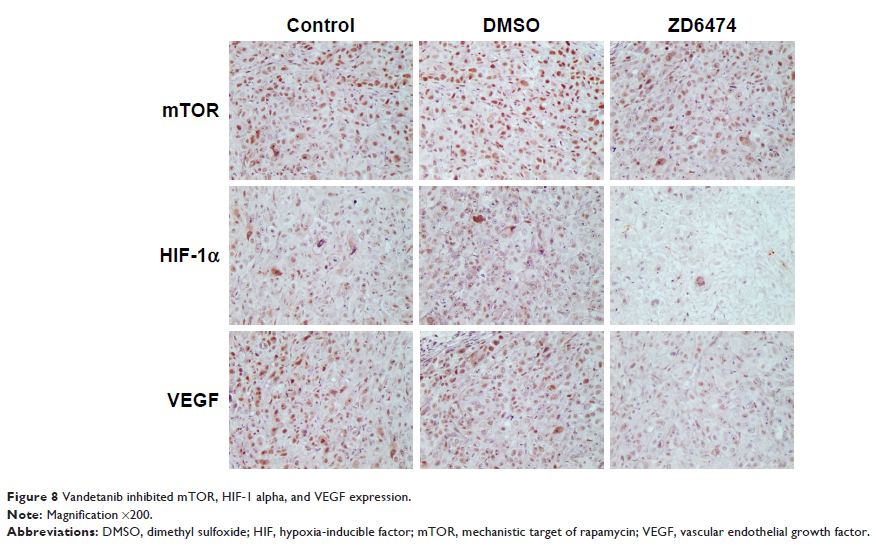
reduce both mRNA and protein level of mTOR, HIF-1 alpha, and VEGF. Angiogenesis
assays showed that vandetanib can inhibit wound healing, invasion, and tubular
formation in culture. Furthermore, vandetanib inhibited the growth of breast
tumor in vivo.
Conclusion: In short,
our study showed that vandetanib can control angiogenesis of breast cancer in
culture via mTOR, HIF-1 alpha, and VEGF signaling pathway.
Keywords: vandetanib,
HIF-1 alpha, mTOR, VEGF, breast cancer