115195
论文已发表
注册即可获取德孚的最新动态
IF 收录期刊
- 3.6 Breast Cancer (Dove Med Press)
- 4.3 Clin Epidemiol
- 2.6 Cancer Manag Res
- 3.2 Infect Drug Resist
- 4.1 Clin Interv Aging
- 6.1 Drug Des Dev Ther
- 4.1 Int J Chronic Obstr
- 8.7 Int J Nanomed
- 2.5 Int J Women's Health
- 3.2 Neuropsych Dis Treat
- 2.4 OncoTargets Ther
- 2.6 Patient Prefer Adher
- 2.6 Ther Clin Risk Manag
- 3.1 J Pain Res
- 3.5 Diabet Metab Synd Ob
- 4.5 Psychol Res Behav Ma
- 3.4 Nat Sci Sleep
- 2.4 Pharmgenomics Pers Med
- 2.6 Risk Manag Healthc Policy
- 4.6 J Inflamm Res
- 2.3 Int J Gen Med
- 3.9 J Hepatocell Carcinoma
- 3.3 J Asthma Allergy
- 2.5 Clin Cosmet Investig Dermatol
- 3.0 J Multidiscip Healthc

放射治疗可改善广泛期小细胞肺癌患者的生存率:监测、流行病学和最终结果数据库的倾向评分匹配分析
Authors Zhang R, Li P, Li Q, Qiao Y, Xu T, Ruan P, Song Q, Fu Z
Received 21 May 2018
Accepted for publication 21 September 2018
Published 29 November 2018 Volume 2018:10 Pages 6525—6535
DOI https://doi.org/10.2147/CMAR.S174801
Checked for plagiarism Yes
Review by Single-blind
Peer reviewers approved by Dr Andrew Yee
Peer reviewer comments 3
Editor who approved publication: Professor Nakshatri
Background: The
survival advantage of radiotherapy for patients with extensive-disease small-cell
lung cancer (ED-SCLC) has not been adequately evaluated.
Methods: We
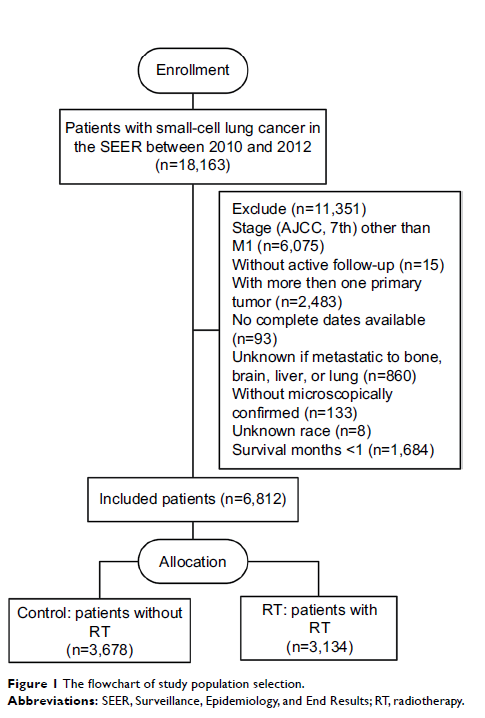
analyzed stage IV SCLC patients enrolled from the Surveillance, Epidemiology,
and End Results (SEER) registry through January 2010 and December 2012.
Propensity score analysis with 1:1 matching was performed to ensure
well-balanced characteristics of all comparison groups. Kaplan–Meier and Cox
proportional hazardous model were used to evaluate the overall survival (OS),
cancer-specific survival (CSS), and corresponding 95% CI.
Results: Overall,
for all metastatic ED-SCLC, receiving radiotherapy was associated with both
improved OS and CSS. Radiotherapy for thoracic lesion and any metastatic sites
could significantly improve the OS and CSS, except for brain metastasis. For
M1a-SCLC patient, radiotherapy, most likely to the primary site, significantly
improved the survival (P <0.001). Furthermore, for those ED-SCLC patients
with ≥ 2 metastatic sites, that is, polymetastatic ED-SCLC patients, radiation
also significantly improved the median OS from 6.0 to 8.0 months (P =0.015) and the
median CSS from 7.0 to 8.0 months (P =0.020).
Conclusion: The large SEER
results support that radiotherapy in addition to chemotherapy might improve the
survival of patients with metastatic ED-SCLC.
Keywords: small-cell
lung cancer, radiotherapy, extensive disease, metastasis, propensity score
match