115195
论文已发表
注册即可获取德孚的最新动态
IF 收录期刊
- 3.6 Breast Cancer (Dove Med Press)
- 4.3 Clin Epidemiol
- 2.6 Cancer Manag Res
- 3.2 Infect Drug Resist
- 4.1 Clin Interv Aging
- 6.1 Drug Des Dev Ther
- 4.1 Int J Chronic Obstr
- 8.7 Int J Nanomed
- 2.5 Int J Women's Health
- 3.2 Neuropsych Dis Treat
- 2.4 OncoTargets Ther
- 2.6 Patient Prefer Adher
- 2.6 Ther Clin Risk Manag
- 3.1 J Pain Res
- 3.5 Diabet Metab Synd Ob
- 4.5 Psychol Res Behav Ma
- 3.4 Nat Sci Sleep
- 2.4 Pharmgenomics Pers Med
- 2.6 Risk Manag Healthc Policy
- 4.6 J Inflamm Res
- 2.3 Int J Gen Med
- 3.9 J Hepatocell Carcinoma
- 3.3 J Asthma Allergy
- 2.5 Clin Cosmet Investig Dermatol
- 3.0 J Multidiscip Healthc

功能性二氢卟酚金纳米棒能够通过光热/光动力疗法治疗乳腺癌
Authors Liu L, Xie HJ, Mu LM, Liu R, Su ZB, Cui YN, Xie Y, Lu WL
Received 9 September 2018
Accepted for publication 6 November 2018
Published 29 November 2018 Volume 2018:13 Pages 8119—8135
DOI https://doi.org/10.2147/IJN.S186974
Checked for plagiarism Yes
Review by Single-blind
Peer reviewers approved by Dr Cristina Weinberg
Peer reviewer comments 4
Editor who approved publication: Dr Linlin Sun
Background: The
existing chemo/radiotherapy fail to eliminate cancer cells due to the
restriction of either drug resistance or radio tolerance. The predicament urges
researchers to continuously explore alternative strategy for achieving a potent
curative effect.
Methods: Functional
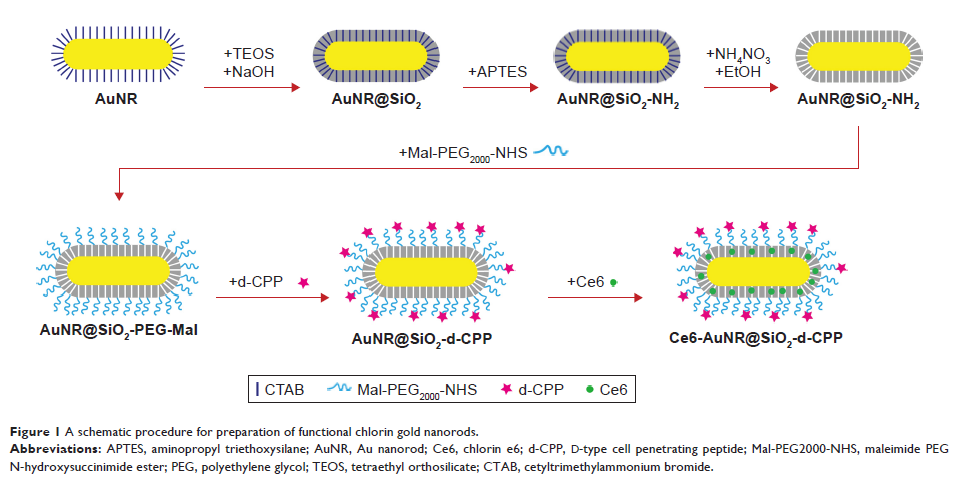
chlorin gold nanorods (Ce6-AuNR@SiO2-d-CPP) were
fabricated aiming at treating breast cancer by photothermal/photodynamic
therapy (PTT/PDT). The nanostructure was developed by synthesizing Au nanorods
as the photothermal conversion material, and by coating the pegylated
mesoporous SiO2 as the shell for entrapping
photosensitizer Ce6 and for linking the D-type cell penetrating peptide
(d-CPP). The function of Ce6-AuNR@SiO2-d-CPP was
verified on human breast cancer MCF-7 cells and MCF-7 cells xenografts in nude
mice.
Results: Under combinational
treatment of PTT and PDT, Ce6-AuNR@SiO2-d-CPP
demonstrated a strong cytotoxicity and apoptosis inducing effects in breast
cancer cells in vitro, and a robust treatment efficacy in breast cancer-bearing
nude mice. The uptake mechanism involved the energy-consuming caveolin-mediated
endocytosis, and Ce6-AuNR@SiO2-d-CPP in PTT/PDT mode could induce apoptosis
by multiple pathways in breast cancer cells.
Conclusion: Ce6-AuNR@SiO2-d-CPP
demonstrated a robust efficacy in the treatment of breast cancer by
photothermal/photodynamic therapy. Therefore, the present study could offer a
new promising strategy to treat the refractory breast cancer.
Keywords: functional
chlorin gold nanorods, cell penetrating peptide, PTT/PDT, cellular uptake,
cytotoxicity, apoptosis