115195
论文已发表
注册即可获取德孚的最新动态
IF 收录期刊
- 3.6 Breast Cancer (Dove Med Press)
- 4.3 Clin Epidemiol
- 2.6 Cancer Manag Res
- 3.2 Infect Drug Resist
- 4.1 Clin Interv Aging
- 6.1 Drug Des Dev Ther
- 4.1 Int J Chronic Obstr
- 8.7 Int J Nanomed
- 2.5 Int J Women's Health
- 3.2 Neuropsych Dis Treat
- 2.4 OncoTargets Ther
- 2.6 Patient Prefer Adher
- 2.6 Ther Clin Risk Manag
- 3.1 J Pain Res
- 3.5 Diabet Metab Synd Ob
- 4.5 Psychol Res Behav Ma
- 3.4 Nat Sci Sleep
- 2.4 Pharmgenomics Pers Med
- 2.6 Risk Manag Healthc Policy
- 4.6 J Inflamm Res
- 2.3 Int J Gen Med
- 3.9 J Hepatocell Carcinoma
- 3.3 J Asthma Allergy
- 2.5 Clin Cosmet Investig Dermatol
- 3.0 J Multidiscip Healthc

聚多巴胺诱导的羟基磷灰石涂层促进羟基磷灰石/聚酰胺 66 植入成骨:体外和体内评估
Authors Xu Y, Li H, Wu J, Yang Q, Jiang D, Qiao B
Received 23 July 2018
Accepted for publication 22 October 2018
Published 30 November 2018 Volume 2018:13 Pages 8179—8193
DOI https://doi.org/10.2147/IJN.S181137
Checked for plagiarism Yes
Review by Single-blind
Peer reviewers approved by Dr Farooq Shiekh
Peer reviewer comments 5
Editor who approved publication: Dr Linlin Sun
Background: Hydroxyapatite/polyamide
66 (HA/P66) has been clinically used for several years owing to its good
biocompatibility and bioactivity. However, it has been found that the
osseointegration process of the HA/P66 implant takes a large amount of time
because of the small amount of HA on its surface.
Methods: To
increase the amount of HA and aid faster osseointegration, we prepared a HA coating
using a biomimetic process assisted by polydopamine (PDA) on the HA/P66
substrate. The surface properties of the substrate modified by PDA and HA were
characterized, and the capacity of biomaterials for osteogenic induction was
investigated both in vitro and in vivo.
Results: The HA
coating was successfully prepared on the HA/P66 substrate and verified by X-ray
photoelectron spectroscopy (XPS), scanning electron microscopy (SEM), and X-ray
diffraction (XRD). The HA coating remained firmly attached to the underlying
PDA-HA/P66 substrate even after strong ultrasound treatment for 1 h, and the
calcium and phosphorus of the HA coating was continuously released in vitro in
a slow manner. The formation of the HA coating on the PDA film greatly
increased the hydrophilicity and surface roughness of HA/P66. In cell-based
experiments, as compared with the HA/P66 substrate, the HA coating formation on
the PDA film could facilitate the functions of C3H10T1/2 cells, including cell
adhesion, proliferation, spreading, alkaline phosphatase activity, calcium
nodule formation, and expression of osteogenic differentiation-related
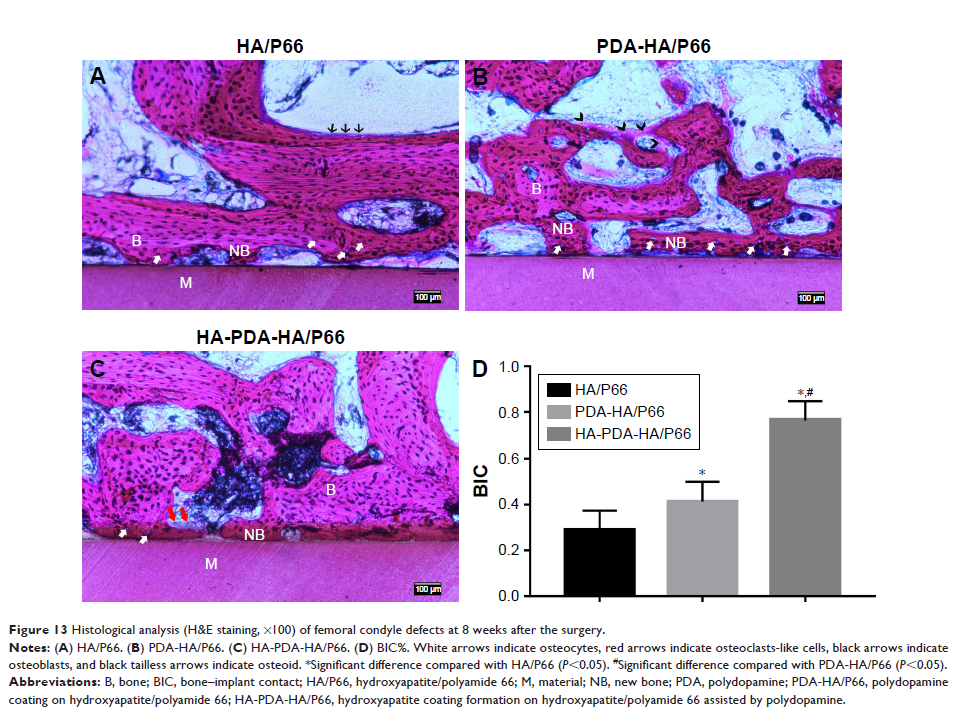
proteins. In addition, the HA/P66 scaffolds modified with PDA and HA coatings
were implanted in rabbit femoral condyles. At 8 weeks after surgery,
micro-computed tomography scanning (micro-CT) and hematoxylin–eosin (HE)
staining revealed that more new bones were formed around the HA/P66 scaffold
that was modified with a PDA-assisted HA coating.
Conclusion: These results
indicate that the preparation of a PDA-assisted HA coating by using a
biomimetic process significantly improves the capacity of biomaterials for
osteogenic induction.
Keywords: hydroxyapatite,
polydopamine, hydroxyapatite/polyamide 66, surface modification, osteogenic
induction