115195
论文已发表
注册即可获取德孚的最新动态
IF 收录期刊
- 3.6 Breast Cancer (Dove Med Press)
- 4.3 Clin Epidemiol
- 2.6 Cancer Manag Res
- 3.2 Infect Drug Resist
- 4.1 Clin Interv Aging
- 6.1 Drug Des Dev Ther
- 4.1 Int J Chronic Obstr
- 8.7 Int J Nanomed
- 2.5 Int J Women's Health
- 3.2 Neuropsych Dis Treat
- 2.4 OncoTargets Ther
- 2.6 Patient Prefer Adher
- 2.6 Ther Clin Risk Manag
- 3.1 J Pain Res
- 3.5 Diabet Metab Synd Ob
- 4.5 Psychol Res Behav Ma
- 3.4 Nat Sci Sleep
- 2.4 Pharmgenomics Pers Med
- 2.6 Risk Manag Healthc Policy
- 4.6 J Inflamm Res
- 2.3 Int J Gen Med
- 3.9 J Hepatocell Carcinoma
- 3.3 J Asthma Allergy
- 2.5 Clin Cosmet Investig Dermatol
- 3.0 J Multidiscip Healthc

厚壁菌门可能与重度抑郁症患者的肠道微生物群有关
Authors Huang YC, Shi X, Li ZY, Shen Y, Shi XX, Wang LY, Li GF, Yuan Y, Wang JX, Zhang YC, Zhao L, Zhang M, Kang Y, Liang Y
Received 21 September 2018
Accepted for publication 4 November 2018
Published 3 December 2018 Volume 2018:14 Pages 3329—3337
DOI https://doi.org/10.2147/NDT.S188340
Checked for plagiarism Yes
Review by Single-blind
Peer reviewers approved by Dr Amy Norman
Peer reviewer comments 2
Editor who approved publication: Dr Yu-Ping Ning
Background: Gut
microbiota can affect human behavior and mood in many ways. Several studies
have shown that patients with depression were also accompanied with gut
microbiota disorder, in which Firmicutes are related to the protective function
of intestinal barrier. In this study, we explore the changes and effects of
Firmicutes in the patients with major depressive disorder (MDD).
Method: We
recruited 54 subjects, including 27 patients with MDD. Fecal samples were
collected for identification by 16S rRNA sequencing and bioinformatics
analysis.
Results: The study shows
that the alpha diversity indices of MDD patients are lower than those of the
healthy controls. Firmicutes is the most significantly decreased phylum in the
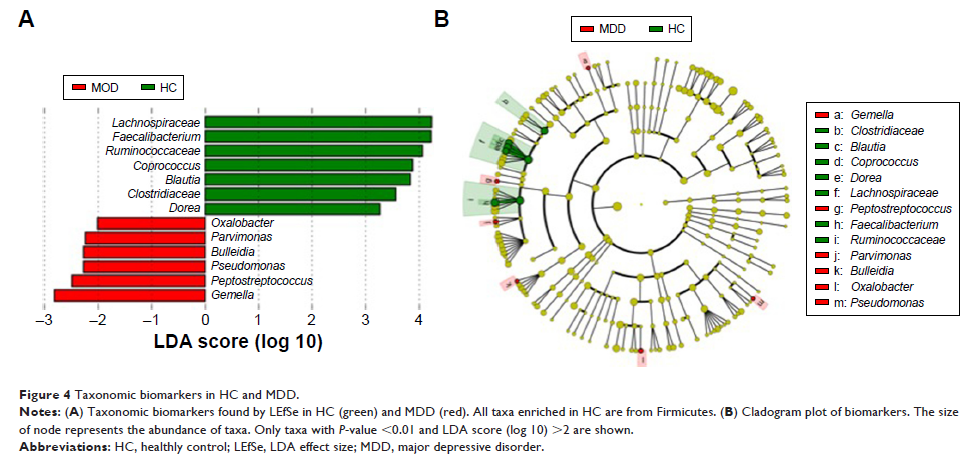
MDD samples. There are totally 13 taxonomic biomarkers with P -value <0.01
from Firmicutes. There are differences in 17 KEGG pathways between the two
groups.
Conclusion: This study
found that there is a significant disorder of gut microbiota in the patients
with depression, in which the Firmicutes decreased significantly. Defects of
the Firmicutes may lead to the depression in short-chain fatty acids, which
could account for the physiological basis of low-level inflammation of
depression.
Limitations: This is a
cross-sectional study and the sample size is comparatively small. Though
several diet-related factors were controlled in the study, there is no
quantified assessment of it.
Keywords: gut
microbiota, brain–gut axis, depression, Firmicutes, short-chain fatty acids