115195
论文已发表
注册即可获取德孚的最新动态
IF 收录期刊
- 3.6 Breast Cancer (Dove Med Press)
- 4.3 Clin Epidemiol
- 2.6 Cancer Manag Res
- 3.2 Infect Drug Resist
- 4.1 Clin Interv Aging
- 6.1 Drug Des Dev Ther
- 4.1 Int J Chronic Obstr
- 8.7 Int J Nanomed
- 2.5 Int J Women's Health
- 3.2 Neuropsych Dis Treat
- 2.4 OncoTargets Ther
- 2.6 Patient Prefer Adher
- 2.6 Ther Clin Risk Manag
- 3.1 J Pain Res
- 3.5 Diabet Metab Synd Ob
- 4.5 Psychol Res Behav Ma
- 3.4 Nat Sci Sleep
- 2.4 Pharmgenomics Pers Med
- 2.6 Risk Manag Healthc Policy
- 4.6 J Inflamm Res
- 2.3 Int J Gen Med
- 3.9 J Hepatocell Carcinoma
- 3.3 J Asthma Allergy
- 2.5 Clin Cosmet Investig Dermatol
- 3.0 J Multidiscip Healthc

MPEG-PLA 包封氯喹和多柔比星以增强卵巢癌中溶酶体的抗癌作用
Authors Shao M, Zhu WT, Lv XP, Yang QK, Liu X, Xie Y, Tang P, Sun L
Received 16 May 2018
Accepted for publication 1 October 2018
Published 3 December 2018 Volume 2018:13 Pages 8231—8245
DOI https://doi.org/10.2147/IJN.S174300
Checked for plagiarism Yes
Review by Single-blind
Peer reviewers approved by Dr Govarthanan Muthusamy
Peer reviewer comments 5
Editor who approved publication: Dr Lei Yang
Purpose: As the
deadliest gynecological malignancy, ovarian cancer ranks as a major cause of
disease-related deaths to women worldwide and is treated with transurethral
resection or systemic chemotherapy. However, traditional chemotherapeutic drug
in antitumor therapy has shown unavoidable limitations, such as poor curative
effects, systemic toxicity and development of drug resistance, leading to
failure of tumor inhibition and recurrence. This study aims to explore an
innovative method to enhance the clinical efficiency of ovarian cancer.
Materials and methods: Using MTT assay, the cell viability was detected under
different culture systems. Western blot was used to examine the expression of
P-gp in doxorubicin-resistant and wild-type A2780/SKOV3 cells. We used confocal
to examine the drug concentration under different culture conditions. Also,
flow cytometry was used to detect the drug absorption at the determined time
points under different culture systems. Using nude mice model, we evaluated the
killing efficacy of chemotherapeutic drugs with or without nanoparticle
encapsulation. ELISA was used to examine the levels of creatinine, alanine
aminotransferase and aspartate aminotransferase in plasma.
Results: We
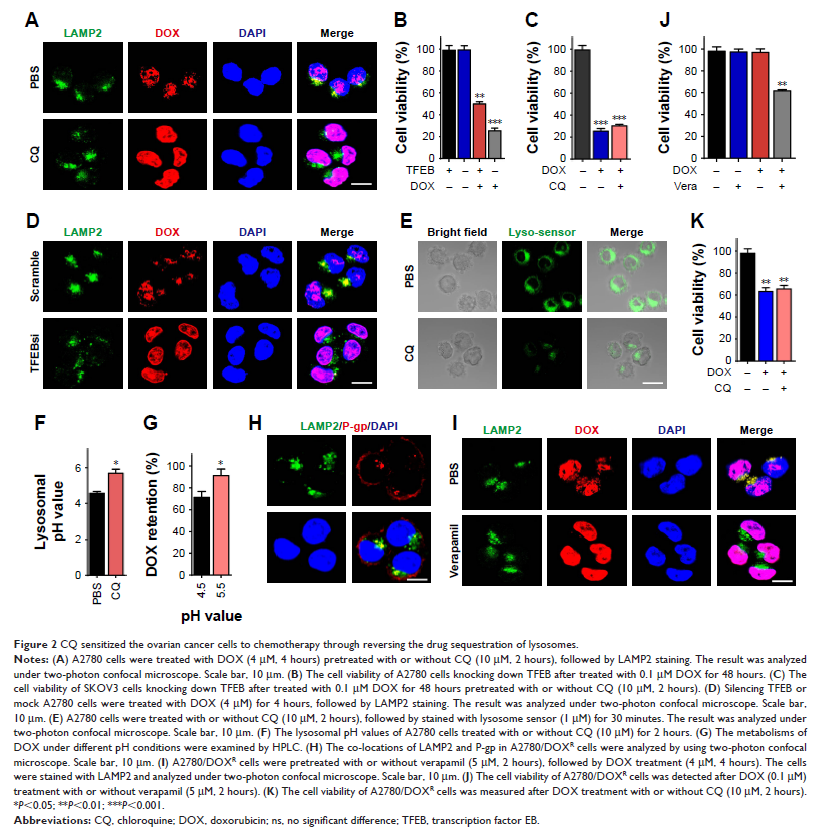
found that pretreatment of chloroquine (CQ) as chemosensitizer markedly
enhanced the anticancer effects in ovarian cancer. We also provided evidence
that CQ efficiently increase the pH value of lysosomes in tumor cells, leading
to the reverse of drug sequestration induced by lysosomes. To further improve
the pharmacokinetics profiles and avoid the systemic toxicity caused by
chemotherapeutic agents, we encapsulated CQ and chemotherapeutic drugs by
polymeric nanoparticles methoxy poly(ethylene glycol)-poly(L-lactic acid).
Codelivery of CQ and chemotherapeutic agents by nanocarrier revealed enhanced
anticancer effects compared with the free drug delivery by tail vein injection.
More importantly, accumulated drugs, prolonged drug circulation and reduced
organic damages were observed in nanoparticles delivery.
Conclusion: Codelivery of CQ and chemotherapeutic drugs by methoxy poly(ethylene
glycol)-poly(L-lactic acid) could significantly improve the anticancer effects
and might have important potency in clinical applications for ovarian cancer
therapy.
Keywords: ovarian
cancer, chloroquine, cisplatin, MPEG-PLA, nanoparticles