115195
论文已发表
注册即可获取德孚的最新动态
IF 收录期刊
- 3.6 Breast Cancer (Dove Med Press)
- 4.3 Clin Epidemiol
- 2.6 Cancer Manag Res
- 3.2 Infect Drug Resist
- 4.1 Clin Interv Aging
- 6.1 Drug Des Dev Ther
- 4.1 Int J Chronic Obstr
- 8.7 Int J Nanomed
- 2.5 Int J Women's Health
- 3.2 Neuropsych Dis Treat
- 2.4 OncoTargets Ther
- 2.6 Patient Prefer Adher
- 2.6 Ther Clin Risk Manag
- 3.1 J Pain Res
- 3.5 Diabet Metab Synd Ob
- 4.5 Psychol Res Behav Ma
- 3.4 Nat Sci Sleep
- 2.4 Pharmgenomics Pers Med
- 2.6 Risk Manag Healthc Policy
- 4.6 J Inflamm Res
- 2.3 Int J Gen Med
- 3.9 J Hepatocell Carcinoma
- 3.3 J Asthma Allergy
- 2.5 Clin Cosmet Investig Dermatol
- 3.0 J Multidiscip Healthc

Geographic variation in hospital costs, payments, and length of stay for opioid-related hospital visits in the USA
Authors Mallow PJ, Belk KW, Topmiller M, Strassels SA
Received 21 August 2018
Accepted for publication 24 October 2018
Published 4 December 2018 Volume 2018:11 Pages 3079—3088
DOI https://doi.org/10.2147/JPR.S184724
Checked for plagiarism Yes
Review by Single-blind
Peer reviewers approved by Dr Amy Norman
Peer reviewer comments 2
Editor who approved publication: Dr Michael Schatman
Purpose: Despite
the rise in opioid-related hospitalizations, there has been little research
regarding opioid-related healthcare utilization. The objective of this study
was to estimate the mean adjusted hospital costs, payments, and length of stay
(LOS) for opioid-related visits for the nation and each of the nine US census
regions.
Methods: An
observational study of retrospective claims data from the Vizient health system
database was conducted. Eligible visits had a principal diagnosis of opioid use
or dependence defined by ICD, ninth and tenth revision (ICD-9/10), and occurred
between January 2014 and June 2017. Separate regression models for inpatient
and outpatient visits were generated to estimate the adjusted costs, payments,
and LOS for opioid-related visits.
Results: A total of
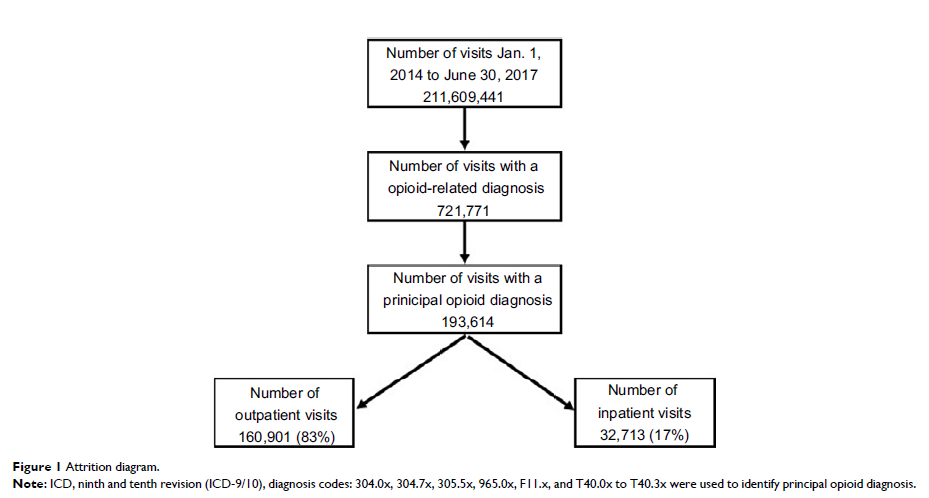
193,614 (32,713 inpatient and 160,901 outpatient) visits met the inclusion
criteria. The overall adjusted mean cost, payment, and LOS for an inpatient
opioid-related visit were $4,383 (range between regions: $2,894–$5,835), $6,689
(range between regions: $4,038–$9,001), and 4.35 days (range between regions:
3.8–5.7 days), respectively. The overall adjusted mean cost and payment for an
outpatient opioid-related visit were $533 (range between regions: $395–$802)
and $374 (range between regions: $187–$574), respectively. Opioid-related hospital
costs, payments, and LOS varied across the US. Data on the regional variation
and national averages are necessary for hospitals to benchmark their services
and more effectively manage this population.
Conclusion: Future
research should examine intraregion utilization to understand the effect of
prices and level of services.
Keywords: opioid
use disorder, healthcare utilization, geographic variation, administrative
claims