115195
论文已发表
注册即可获取德孚的最新动态
IF 收录期刊
- 3.6 Breast Cancer (Dove Med Press)
- 4.3 Clin Epidemiol
- 2.6 Cancer Manag Res
- 3.2 Infect Drug Resist
- 4.1 Clin Interv Aging
- 6.1 Drug Des Dev Ther
- 4.1 Int J Chronic Obstr
- 8.7 Int J Nanomed
- 2.5 Int J Women's Health
- 3.2 Neuropsych Dis Treat
- 2.4 OncoTargets Ther
- 2.6 Patient Prefer Adher
- 2.6 Ther Clin Risk Manag
- 3.1 J Pain Res
- 3.5 Diabet Metab Synd Ob
- 4.5 Psychol Res Behav Ma
- 3.4 Nat Sci Sleep
- 2.4 Pharmgenomics Pers Med
- 2.6 Risk Manag Healthc Policy
- 4.6 J Inflamm Res
- 2.3 Int J Gen Med
- 3.9 J Hepatocell Carcinoma
- 3.3 J Asthma Allergy
- 2.5 Clin Cosmet Investig Dermatol
- 3.0 J Multidiscip Healthc

精神分裂症患者的认知功能障碍与阴性症状,以及他们来自单一和多元家庭的一级亲属
Authors Zhang Z, Zhang R, Qin P, Tan L
Received 9 July 2018
Accepted for publication 15 October 2018
Published 5 December 2018 Volume 2018:14 Pages 3339—3348
DOI https://doi.org/10.2147/NDT.S179534
Checked for plagiarism Yes
Review by Single-blind
Peer reviewers approved by Dr Andrew Yee
Peer reviewer comments 4
Editor who approved publication: Dr Yu-Ping Ning
Purpose: This
study aimed to investigate cognitive functioning, negative symptoms, and the
relationships in schizophrenia (SP) pedigrees and to explore the effect of
genetic loading on those endophenotypes.
Patients and methods: Forty-four
patients with SP, 81 first-degree non-psychotic relatives of patients from
simplex and multiplex families, 14 matched control probands, and 29
first-degree relatives of the patients from communities were assessed by the vocabulary
subtest (VS) of Wechsler Adult Intelligence Scale, memory span subtests of the
Multiple Memory Assessment Scale (MMAS), Wisconsin Card Sorting Test (WCST),
Continuous Performance Test (CPT), and Negative Scale of Positive and Negative
Syndrome Scale.
Results: Compared with
controls, patients with SP and their relatives had worse performances in WCST
and CPT, and more serious negative symptoms. Patients from multiple families
performed poorly on most tests while patients from simplex families had impairments
only on the parameters of CPT and WSCT as compared to control probands.
Patients from multiple families differed significantly from the patients from
simplex families in the digit span and word span of MMAS. After controlling for
education, in comparison with relatives of control probands, relatives from
multiple families showed impairments in VS, multiple domains of CPT, whereas
relatives from simplex families had lower scores on the VS and more total cards
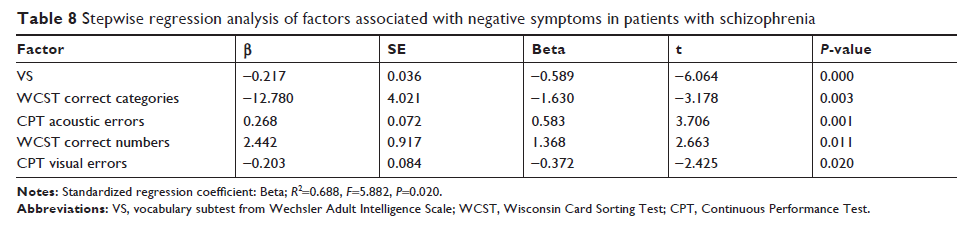
and random errors in WSCT. The performances of most tests were linked to
negative symptoms in patients with SP. For patients with SP, VS, correct
numbers and categories in the WCST, and visual and acoustic errors in the CPT
predicted 68.8% of the variability in negative symptoms.
Conclusion: Our
findings support that cognitive deficits and negative symptoms may be markers
of hereditary susceptibility of SP and aggravate as the degree of genetic load
increases. There are certain relationships between cognitive deficits and
negative symptoms in patients with SP.
Keywords: schizophrenia,
first-degree relatives, cognitive function, negative symptoms, genetic load