115195
论文已发表
注册即可获取德孚的最新动态
IF 收录期刊
- 3.6 Breast Cancer (Dove Med Press)
- 4.3 Clin Epidemiol
- 2.6 Cancer Manag Res
- 3.2 Infect Drug Resist
- 4.1 Clin Interv Aging
- 6.1 Drug Des Dev Ther
- 4.1 Int J Chronic Obstr
- 8.7 Int J Nanomed
- 2.5 Int J Women's Health
- 3.2 Neuropsych Dis Treat
- 2.4 OncoTargets Ther
- 2.6 Patient Prefer Adher
- 2.6 Ther Clin Risk Manag
- 3.1 J Pain Res
- 3.5 Diabet Metab Synd Ob
- 4.5 Psychol Res Behav Ma
- 3.4 Nat Sci Sleep
- 2.4 Pharmgenomics Pers Med
- 2.6 Risk Manag Healthc Policy
- 4.6 J Inflamm Res
- 2.3 Int J Gen Med
- 3.9 J Hepatocell Carcinoma
- 3.3 J Asthma Allergy
- 2.5 Clin Cosmet Investig Dermatol
- 3.0 J Multidiscip Healthc

miR-1 通过靶向 EVI-1 抑制乳腺癌干细胞的增殖
Authors Wu L, Wang T, He D, Li X, Jiang Y
Received 26 September 2018
Accepted for publication 3 November 2018
Published 6 December 2018 Volume 2018:11 Pages 8773—8781
DOI https://doi.org/10.2147/OTT.S188836
Checked for plagiarism Yes
Review by Single-blind
Peer reviewers approved by Dr Andrew Yee
Peer reviewer comments 3
Editor who approved publication: Dr Sanjeev Srivastava
Purpose: Breast
cancer stem cells (BCSCs) have been regarded as the key factor for treatment
failure in breast cancer. The abnormal expression of miRNAs plays a significant
role in different tumor types. However, the role of miR-1 in breast cancer remains
poorly understood. The purpose of this study was to evaluate the effects of
miR-1 on the proliferation and apoptosis of BCSCs.
Materials and methods: CD44+/CD24-/low/epithelial-specific
antigen+ BCSCs were isolated by flow cytometry.
Real-time PCR and Western blotting were used to determine the expression of
miRNAs, mRNAs, and epithelial–mesenchymal transition (EMT)-related genes. Cell
proliferation and apoptosis were measured using the Cell Counting Kit-8 assay
and Annexin V-fluorescein isothiocyanate flow cytometry, respectively.
Luciferase reporter assay was used to verify whether miR-1 targeted ecotropic
virus integration-1 (EVI-1). The role of miR-1 in breast cancer in vivo was
evaluated using BCSCs xenograft mouse models.
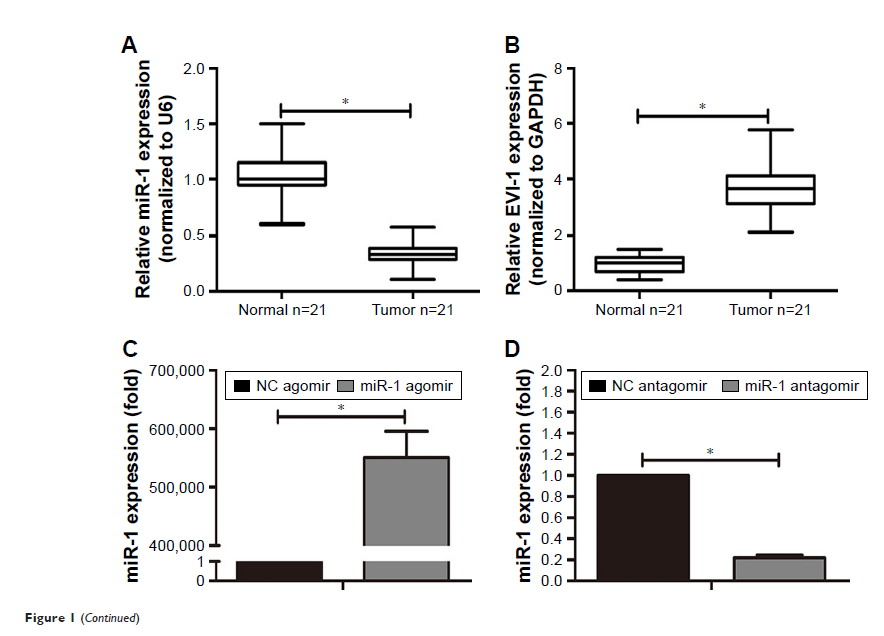
Results: In this
study, we demonstrated that miR-1 was significantly downregulated in breast
cancer tissues compared to the adjacent non-tumor tissues. The luciferase
reporter assay verified that EVI-1 was a direct target of miR-1, and
upregulation of miR-1 negatively correlated with the expression of EVI-1 in
BCSCs at both the transcriptional and posttranslational levels. Furthermore,
overexpression of miR-1 inhibited BCSCs proliferation and promoted apoptosis,
which was reversed by the overexpression of EVI-1. In addition, we demonstrated
that aberrant expression of miR-1 could regulate EMT-related genes in BCSCs.
Finally, immunohistochemical staining demonstrated that EVI-1 expression was
decreased in BCSCs tumors following intratumoral miR-1 agomir treatment
compared to the control group.
Conclusion: miR-1 can
negatively regulate the expression of EVI-1 and, thus, affect BCSCs
proliferation, apoptosis, and EMT-related markers. Taken together, these
findings demonstrate that miR-1 could be employed as a therapeutic strategy in the
treatment of breast cancer.
Keywords: breast
cancer, miR-1, proliferation, apoptosis, EVI-1