115195
论文已发表
注册即可获取德孚的最新动态
IF 收录期刊
- 3.6 Breast Cancer (Dove Med Press)
- 4.3 Clin Epidemiol
- 2.6 Cancer Manag Res
- 3.2 Infect Drug Resist
- 4.1 Clin Interv Aging
- 6.1 Drug Des Dev Ther
- 4.1 Int J Chronic Obstr
- 8.7 Int J Nanomed
- 2.5 Int J Women's Health
- 3.2 Neuropsych Dis Treat
- 2.4 OncoTargets Ther
- 2.6 Patient Prefer Adher
- 2.6 Ther Clin Risk Manag
- 3.1 J Pain Res
- 3.5 Diabet Metab Synd Ob
- 4.5 Psychol Res Behav Ma
- 3.4 Nat Sci Sleep
- 2.4 Pharmgenomics Pers Med
- 2.6 Risk Manag Healthc Policy
- 4.6 J Inflamm Res
- 2.3 Int J Gen Med
- 3.9 J Hepatocell Carcinoma
- 3.3 J Asthma Allergy
- 2.5 Clin Cosmet Investig Dermatol
- 3.0 J Multidiscip Healthc

CD300A 的过表达通过下调 Wnt/β-连环蛋白通路抑制 NSCLC 的进展
Authors Tang Z, Cai H, Wang R, Cui Y
Received 28 August 2018
Accepted for publication 12 November 2018
Published 7 December 2018 Volume 2018:11 Pages 8875—8883
DOI https://doi.org/10.2147/OTT.S185521
Checked for plagiarism Yes
Review by Single-blind
Peer reviewers approved by Dr Amy Norman
Peer reviewer comments 2
Editor who approved publication: Dr Federico Perche
Background: CD300A, a
type I transmembrane glycoprotein receptor, plays an important role in immune
response. Recent studies have reported that CD300A is involved in the
development of hematological malignancies.
Purpose: The
objective of this study was to investigate the role of CD300A in the
progression of non-small-cell lung cancer (NSCLC) and explore the associated
mechanism.
Materials and methods: Gene
Expression Profiling Interactive Analysis (GEPIA) was used to analyze the
expression of CD300A in NSCLC and its prognostic value. NSCLC cell lines A549
and H1650 were transfected with siRNA-CD300A or pcDNA3.1-CD300A vector to down-
or up-regulate the expression of CD300A. Cell Counting Kit 8, colony formation
and Transwell assays were used to assess the effects of CD300A on cell
proliferation and migration capacities. Flow cytometry was performed to examine
rate of apoptosis, and the protein levels of associated proteins was detected
using Western blot assay.
Results: From
GEPIA analysis, we observed that expression of CD300A mRNA was downregulated in
NSCLC and positively correlated with the overall survival of NSCLC patients.
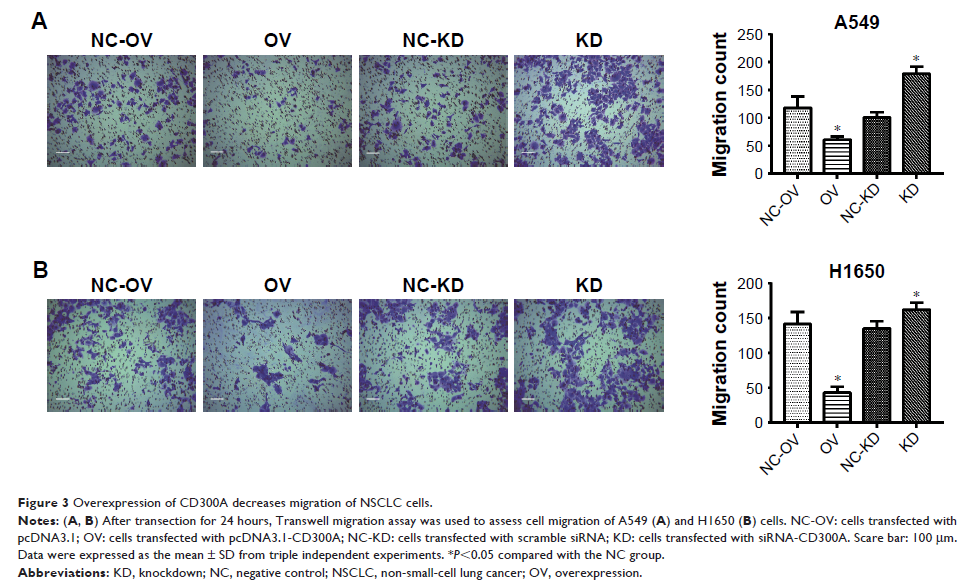
Overexpression of CD300A significantly suppressed cell growth and migration
capacities of A549 and H1650 cells and induced cell apoptosis via regulating
apoptosis-related proteins. Moreover, decreasing level of CD300A promoted cell
growth and migration and blocked apoptosis of NSCLC cells. Furthermore,
upregulation of CD300A led to significant decrease in expression level of Wnt3
and β-catenin, the pivotal components in Wnt/β-catenin signaling pathway, and
an increase in expression of E-cad, a key protein in tumor metastasis, in A549
and H1650 cells; while depletion of CD300A up-regulated the Wnt/β-catenin
signaling pathway. In conclusion, the present study highlighted an
anti-oncogenic role of CD300A in the progression of NSCLC via inhibiting
Wnt/β-catenin pathway, suggesting that CD300A might be a potential target for
the treatment of NSCLC.
Conclusion: CD300A
plays an anti-oncogenic role in the progression of NSCLC through inhibiting the
Wnt/β-catenin pathway, suggesting that CD300A might be a potential target for
the treatment of NSCLC.
Keywords: non-small-cell
lung cancer, CD300A, prognosis, progression