115195
论文已发表
注册即可获取德孚的最新动态
IF 收录期刊
- 3.6 Breast Cancer (Dove Med Press)
- 4.3 Clin Epidemiol
- 2.6 Cancer Manag Res
- 3.2 Infect Drug Resist
- 4.1 Clin Interv Aging
- 6.1 Drug Des Dev Ther
- 4.1 Int J Chronic Obstr
- 8.7 Int J Nanomed
- 2.5 Int J Women's Health
- 3.2 Neuropsych Dis Treat
- 2.4 OncoTargets Ther
- 2.6 Patient Prefer Adher
- 2.6 Ther Clin Risk Manag
- 3.1 J Pain Res
- 3.5 Diabet Metab Synd Ob
- 4.5 Psychol Res Behav Ma
- 3.4 Nat Sci Sleep
- 2.4 Pharmgenomics Pers Med
- 2.6 Risk Manag Healthc Policy
- 4.6 J Inflamm Res
- 2.3 Int J Gen Med
- 3.9 J Hepatocell Carcinoma
- 3.3 J Asthma Allergy
- 2.5 Clin Cosmet Investig Dermatol
- 3.0 J Multidiscip Healthc

阿帕替尼治疗口腔底部顽固性鳞状细胞癌后局部肿瘤控制良好但出现致死性出血:一份病例报告
Authors Zhu X, Liu M, Lv J, Guo L, Li C, Dong L, Liu B
Received 16 July 2018
Accepted for publication 14 November 2018
Published 7 December 2018 Volume 2018:11 Pages 8909—8913
DOI https://doi.org/10.2147/OTT.S180358
Checked for plagiarism Yes
Review by Single-blind
Peer reviewers approved by Dr Cristina Weinberg
Peer reviewer comments 2
Editor who approved publication: Dr Leo Jen-Liang Su
Abstract: The
treatment of repeatedly recurrent carcinoma of the floor of the mouth (FOM) is
challenging. There is no standard strategy for such patients with poor physical
condition after multiple lines of treatment. Angiogenesis is a key in tumor
initiation, growth, and dissemination. Apatinib, a potent tyrosine kinase
inhibitor targeting vascular endothelial growth factor receptor 2 (VEGFR2), has
been approved for the treatment of late-stage gastric or gastroesophageal
junction adenocarcinoma that is resistant to at least two lines of chemotherapy.
Its application in intractable FOM squamous carcinoma has never been described
before. Herein, we present the case of a heavily treated patient with FOM
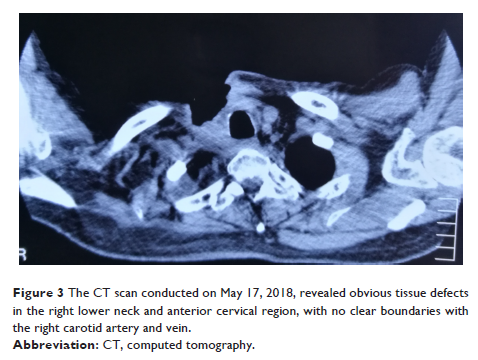
squamous carcinoma undergoing a third local relapse in the right region of the
neck and anterior cervical region. Oral apatinib was administered daily at a
dose of 250 mg. There was clear and rapid efficacy that led to complete
remission. However, giant, deep ulcers formed due to tumor necrosis. The
patient eventually died of massive bleeding resulting from the major cervical
vascular rupture caused by tumor necrosis and erosion. This case is novel and
instructional, highlighting that apatinib might be effective, with manageable
toxicity, for certain patients with refractory head and neck squamous cell carcinoma
(HNSCC). The advantages and disadvantages of apatinib should be carefully
evaluated, and close surveillance and quick intervention as required are
critical to reduce fatal cancer-associated complications. The role of apatinib
in recurrent or metastatic HNSCC needs to be clarified by multicenter trials in
the near future.
Keywords: apatinib,
head and neck squamous cell carcinoma, recurrent, lethal bleeding, VEGFR2, TKI