115195
论文已发表
注册即可获取德孚的最新动态
IF 收录期刊
- 3.6 Breast Cancer (Dove Med Press)
- 4.3 Clin Epidemiol
- 2.6 Cancer Manag Res
- 3.2 Infect Drug Resist
- 4.1 Clin Interv Aging
- 6.1 Drug Des Dev Ther
- 4.1 Int J Chronic Obstr
- 8.7 Int J Nanomed
- 2.5 Int J Women's Health
- 3.2 Neuropsych Dis Treat
- 2.4 OncoTargets Ther
- 2.6 Patient Prefer Adher
- 2.6 Ther Clin Risk Manag
- 3.1 J Pain Res
- 3.5 Diabet Metab Synd Ob
- 4.5 Psychol Res Behav Ma
- 3.4 Nat Sci Sleep
- 2.4 Pharmgenomics Pers Med
- 2.6 Risk Manag Healthc Policy
- 4.6 J Inflamm Res
- 2.3 Int J Gen Med
- 3.9 J Hepatocell Carcinoma
- 3.3 J Asthma Allergy
- 2.5 Clin Cosmet Investig Dermatol
- 3.0 J Multidiscip Healthc

TRIM37 通过调节胃癌中 SIP1 介导的上皮-间质转化来促进细胞侵袭和转移
Authors Chen D, You X, Pan Y, Liu Q, Cao G
Received 27 June 2018
Accepted for publication 10 October 2018
Published 10 December 2018 Volume 2018:11 Pages 8803—8813
DOI https://doi.org/10.2147/OTT.S178446
Checked for plagiarism Yes
Review by Single-blind
Peer reviewers approved by Dr Amy Norman
Peer reviewer comments 2
Editor who approved publication: Dr Yao Dai
Background: Tripartite
motif containing 37 (TRIM37) has been demonstrated to function importantly
during the progression of various cancers. However, the role of TRIM37 in
gastric cancer (GC) remains elusive.
Materials and methods: TRIM37
mRNA and protein expressions were determined by qRT-PCR, Western blot, and
immunohistochemical staining in GC specimens. The effects of TRIM37 on GC cells
behavior were evaluated by transwell assays in vitro and metastasis assay in
vivo, respectively. Besides, qRT-PCR, Western blot, and immunofluorescence
staining were employed to detect the expressions of TRIM37 and
epithelial–mesenchymal transition (EMT)-related markers.
Results: The
present study revealed that TRIM37 mRNA or protein expression was significantly
increased in GC tissues compared with that in paracancerous control tissues,
and its aberrant overexpression was closely associated with clinical metastasis
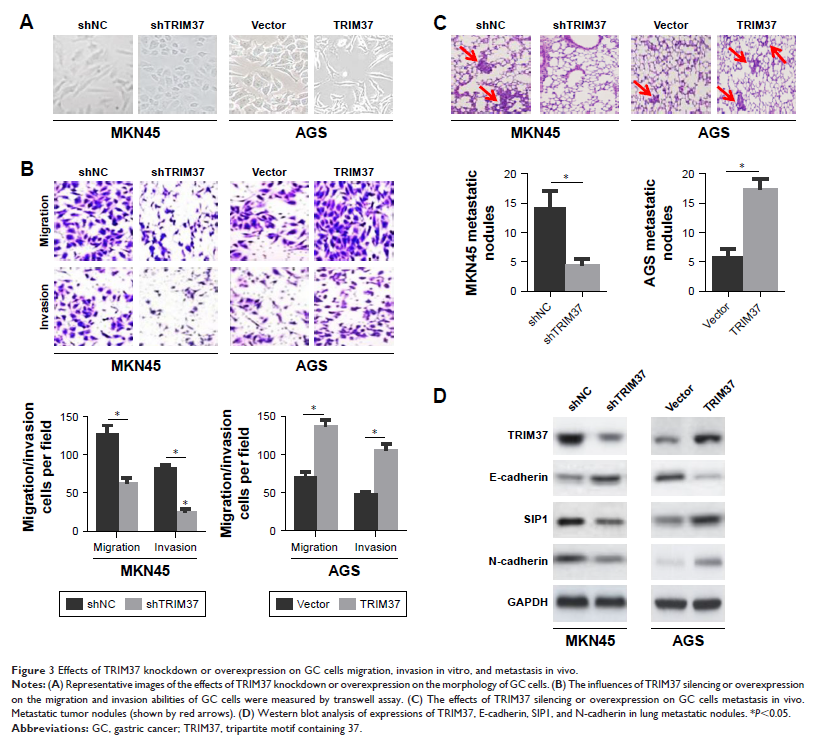
and poor prognosis in patients with GC. TRIM37 knockdown significantly
suppressed GC cells migration and invasion in vitro, as well as metastasis in
vivo. Inversely, TRIM37 overexpression exerted the opposite effects.
Mechanistic studies suggested that SIP1-mediated EMT might be responsible for
TRIM37-facilitated GC cells migration and invasion.
Conclusion: Our
findings revealed that high TRIM37 expression was associated with clinical
metastasis and poor survival in patients with GC. TRIM37 promoted GC cells
migration and invasion via EMT, mediated by the transcription factor SIP1, thus
providing a candidate target for GC treatment.
Keywords: tripartite
motif containing 37, gastric cancer, epithelial–mesenchymal transition