115195
论文已发表
注册即可获取德孚的最新动态
IF 收录期刊
- 3.6 Breast Cancer (Dove Med Press)
- 4.3 Clin Epidemiol
- 2.6 Cancer Manag Res
- 3.2 Infect Drug Resist
- 4.1 Clin Interv Aging
- 6.1 Drug Des Dev Ther
- 4.1 Int J Chronic Obstr
- 8.7 Int J Nanomed
- 2.5 Int J Women's Health
- 3.2 Neuropsych Dis Treat
- 2.4 OncoTargets Ther
- 2.6 Patient Prefer Adher
- 2.6 Ther Clin Risk Manag
- 3.1 J Pain Res
- 3.5 Diabet Metab Synd Ob
- 4.5 Psychol Res Behav Ma
- 3.4 Nat Sci Sleep
- 2.4 Pharmgenomics Pers Med
- 2.6 Risk Manag Healthc Policy
- 4.6 J Inflamm Res
- 2.3 Int J Gen Med
- 3.9 J Hepatocell Carcinoma
- 3.3 J Asthma Allergy
- 2.5 Clin Cosmet Investig Dermatol
- 3.0 J Multidiscip Healthc

白藜芦醇通过负调节 Erk/PKM2/Bcl-2 轴诱导人黑素瘤细胞凋亡
Authors Zhao H, Han L, Jian Y, Ma Y, Yan W, Chen X, Xu H, Li L
Received 11 September 2018
Accepted for publication 14 November 2018
Published 11 December 2018 Volume 2018:11 Pages 8995—9006
DOI https://doi.org/10.2147/OTT.S186247
Checked for plagiarism Yes
Review by Single-blind
Peer reviewers approved by Dr Amy Norman
Peer reviewer comments 3
Editor who approved publication: Dr Leo Jen-Liang Su
Background: Resveratrol is
known as a natural phytoalexin found in grapes and wine, which has significant
antitumor activity under in vitro and in vivo conditions. In recent
years, great progress has been made in understanding the underlying mechanisms
of resveratrol in inducing cellular apoptosis of melanoma cells. Our previous
study has shown that the apoptosis regulation of resveratrol in melanoma cells
was independent of activation of classical apoptosis-related protein p53.
Materials and methods: MTT assay
and 5-bromo-2'-deoxyuridine staining assay were used to analyze cell viability
and proliferation. Immunofluorescence analysis of γ-H2AX was employed to
clarify DNA damages. Annexin V–propidine iodide/fluorescein isothiocyanate
assay was performed to evaluate the cell apoptosis. The mechanisms underlying
the activation of M2-type pyruvate kinase (PKM2) by Erk1/2 to stabilize and
maintain Bcl-2 signaling was investigated by subcellular fractionation
analyses, immunofluorescence analysis, co-immunoprecipitation assay,
ubiquitination assay, and glutathione S-transferase pull-down assay.
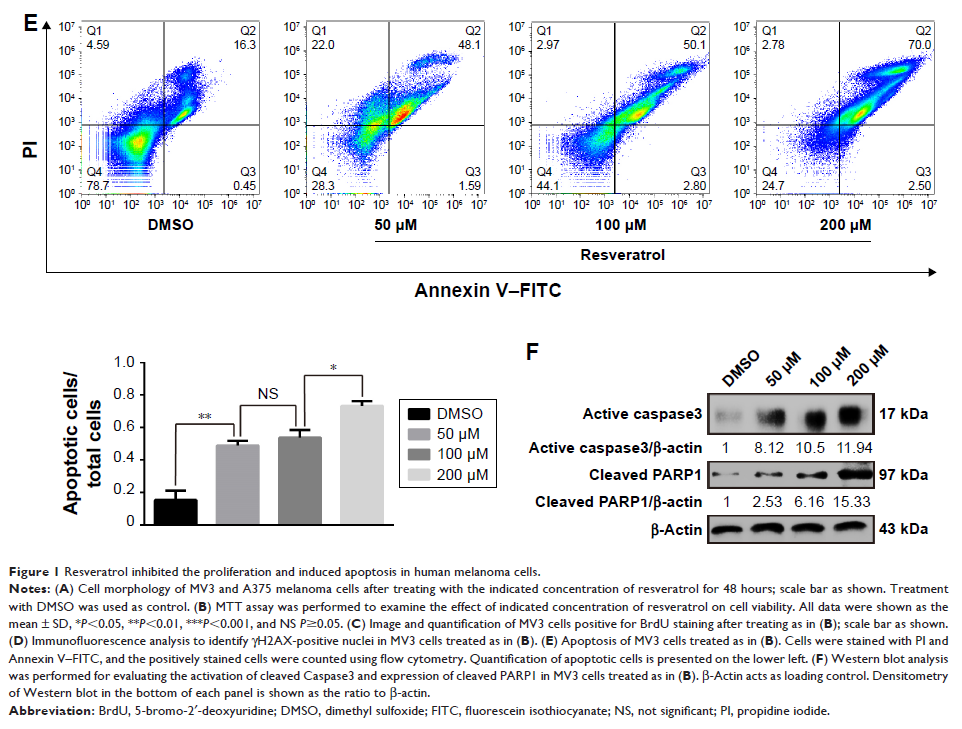
Results: In the
present study, we found that resveratrol dramatically inhibited melanoma cell
proliferation and induced cell apoptosis through upregulation of p53 in a
concentration-dependent manner. Conversely, p53 downregulation by short hairpin
RNA couldn’t rescue resveratrol-induced cell proliferation inhibition or
apoptosis enlargement. Additionally, we found that resveratrol downregulated
antiapoptotic protein Bcl-2 and activated Bax in the protein levels by
promoting Bcl-2 degradation and cytochrome c release. Moreover, we discovered
that PKM2, had a key role in cell apoptosis triggered by resveratrol through
interacting with Bcl-2. Based on these results, we overexpressed PKM2 in
melanoma cells and found that this prevented resveratrol-induced apoptosis by
stabilizing the protein level of Bcl-2.
Conclusion: Taken
together, our results provided a novel mechanism accounting for the apoptosis
induction of resveratrol in melanoma cells and suggested that downregulating
Erk/PKM2/Bcl-2 axis appears to be a new approach for the prevention or
treatment of melanoma.
Keywords: antitumor,
ubiquitination, cytochrome c, ER stress