115195
论文已发表
注册即可获取德孚的最新动态
IF 收录期刊
- 3.6 Breast Cancer (Dove Med Press)
- 4.3 Clin Epidemiol
- 2.6 Cancer Manag Res
- 3.2 Infect Drug Resist
- 4.1 Clin Interv Aging
- 6.1 Drug Des Dev Ther
- 4.1 Int J Chronic Obstr
- 8.7 Int J Nanomed
- 2.5 Int J Women's Health
- 3.2 Neuropsych Dis Treat
- 2.4 OncoTargets Ther
- 2.6 Patient Prefer Adher
- 2.6 Ther Clin Risk Manag
- 3.1 J Pain Res
- 3.5 Diabet Metab Synd Ob
- 4.5 Psychol Res Behav Ma
- 3.4 Nat Sci Sleep
- 2.4 Pharmgenomics Pers Med
- 2.6 Risk Manag Healthc Policy
- 4.6 J Inflamm Res
- 2.3 Int J Gen Med
- 3.9 J Hepatocell Carcinoma
- 3.3 J Asthma Allergy
- 2.5 Clin Cosmet Investig Dermatol
- 3.0 J Multidiscip Healthc

MIIP 在胃癌中下调,其强制表达可在体外和体内抑制胃癌细胞的增殖和侵袭
Authors Sun D, Wang Y, Jiang S, Wang G, Xin Y
Received 10 July 2018
Accepted for publication 10 November 2018
Published 11 December 2018 Volume 2018:11 Pages 8951—8964
DOI https://doi.org/10.2147/OTT.S173393
Checked for plagiarism Yes
Review by Single-blind
Peer reviewers approved by Dr Amy Norman
Peer reviewer comments 2
Editor who approved publication: Dr Tohru Yamada
Background: MIIP is
associated with cancer progression in various cancers. However, its expression
pattern, and associated molecular mechanisms in gastric cancer (GC) progression
are still mysterious. We aimed to explore the role of MIIP in proliferation and
invasion of GC.
Materials and methods: MIIP expression
was evaluated in human GC tissues and cell lines. Public clinical database of
GC patients was used to probe the correlation between MIIP expression and
prognosis of patients. The effects of forced MIIP expression on GC cells were
determined by MTT, cell cycle distribution, colony formation, wound-healing and
Transwell assays in vitro, as well as in vivo growth of subcutaneous tumor
xenografts and metastasis of xenografted tumors to the lungs in mice. The
expressions of GC progression-associated genes, including HOTAIR , MALAT1 , HDAC6,
AC-tubulin, and cyclin D1, were assessed by Western blotting or qRT-PCR.
Results: Both GC
tissues and GC cell lines had lower MIIP expression. Higher level of MIIP in GC
tissues predicts better survival in patients. Ectopic expression of MIIP in GC
cell lines BGC823 and HGC27 induced G0/G1 cell
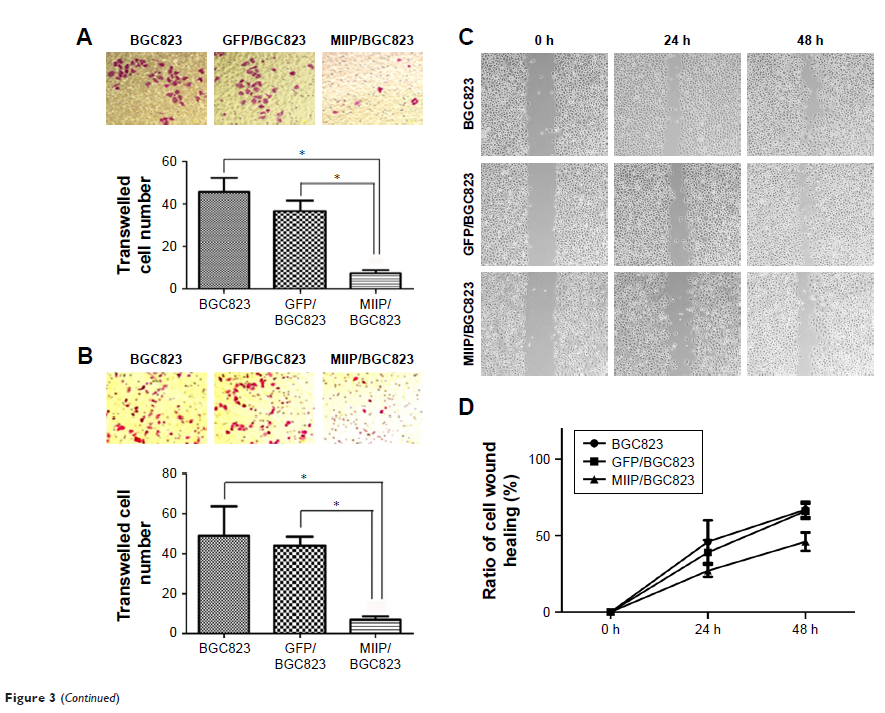
cycle arrest and inhibited cell proliferation, colony formation, migration and
invasion in vitro, as well as the growth of GC xenografts and metastasis of
tumors in vivo. Furthermore, overexpression of MIIP suppressed mRNA expressions
of HOTAIR and MALAT1, decreased protein expression of HDAC6 and cyclin D1, and
elevated AC-tubulin protein expression.
Conclusion: MIIP is a
suppressor for GC progression and is a potential therapeutic target for
treating GC.
Keywords: MIIP, gastric
cancer, proliferation, migration, invasion, metastasis