115195
论文已发表
注册即可获取德孚的最新动态
IF 收录期刊
- 3.6 Breast Cancer (Dove Med Press)
- 4.3 Clin Epidemiol
- 2.6 Cancer Manag Res
- 3.2 Infect Drug Resist
- 4.1 Clin Interv Aging
- 6.1 Drug Des Dev Ther
- 4.1 Int J Chronic Obstr
- 8.7 Int J Nanomed
- 2.5 Int J Women's Health
- 3.2 Neuropsych Dis Treat
- 2.4 OncoTargets Ther
- 2.6 Patient Prefer Adher
- 2.6 Ther Clin Risk Manag
- 3.1 J Pain Res
- 3.5 Diabet Metab Synd Ob
- 4.5 Psychol Res Behav Ma
- 3.4 Nat Sci Sleep
- 2.4 Pharmgenomics Pers Med
- 2.6 Risk Manag Healthc Policy
- 4.6 J Inflamm Res
- 2.3 Int J Gen Med
- 3.9 J Hepatocell Carcinoma
- 3.3 J Asthma Allergy
- 2.5 Clin Cosmet Investig Dermatol
- 3.0 J Multidiscip Healthc

miRNA-641 通过直接靶向 ZEB1 抑制宫颈癌细胞的增殖、迁移和侵袭并诱导其凋亡
Authors Yao R, Zheng H, Wu L, Cai P
Received 9 October 2018
Accepted for publication 27 October 2018
Published 11 December 2018 Volume 2018:11 Pages 8965—8976
DOI https://doi.org/10.2147/OTT.S190303
Checked for plagiarism Yes
Review by Single-blind
Peer reviewers approved by Dr Cristina Weinberg
Peer reviewer comments 2
Editor who approved publication: Dr Sanjay Singh
Background: miRNAs have
been found to be dysregulated in cervical cancer. The dysregulation of miRNA
has been implicated in cervical carcinogenesis and progression. Therefore,
further studies of the specific roles of deregulated miRNAs in cervical cancer
and underlying molecular mechanisms may facilitate the identification of novel therapeutic
techniques for patients with this disease. miRNA-641 (miR-641) was previously
reported to serve an important role in lung cancer. However, the expression
pattern and roles of miR-641 in cervical cancer remain unclear.
Method: In
this study, the expression level of miR-641 in cervical cancer tissues and cell
lines was detected using RT-qPCR. The influence of miR-641 upregulation in
cervical cancer cell proliferation, apoptosis, migration and invasion was
evaluated using CCK-8 assay, flow cytometry assay, migration and invasion
assays, respectively. In vivo tumor growth assay was utilized to determine the
effect of miR-641 overexpression in the tumor growth of cervical cancer cells
in vivo. The molecular mechanisms underlying the action of miR-641 in cervical
cancer cells were also explored.
Results: We
found that miR-641 expression was obviously decreased in cervical cancer
tissues and cell lines, which strongly correlated with the International
Federation of Gynecology and Obstetrics stage and lymph node metastasis.
Upregulation of miR-641 inhibited cell proliferation, induced apoptosis, and
reduced metastasis in cervical cancer. Additionally, bioinformatics analysis
predicted ZEB1 as
a novel target gene of miR-641. Notably, luciferase reporter assay, RT-qPCR,
and Western blot analysis revealed that miR-641 decreased ZEB1 expression
in cervical cancer cells by directly targeting its 3'-untranslated region.
Furthermore, ZEB1 was upregulated in cervical cancer tissues,
which was negatively correlated with miR-641 expression. Moreover,
recovered ZEB1 expression
attenuated the tumor suppressive action of miR-641 overexpression in the
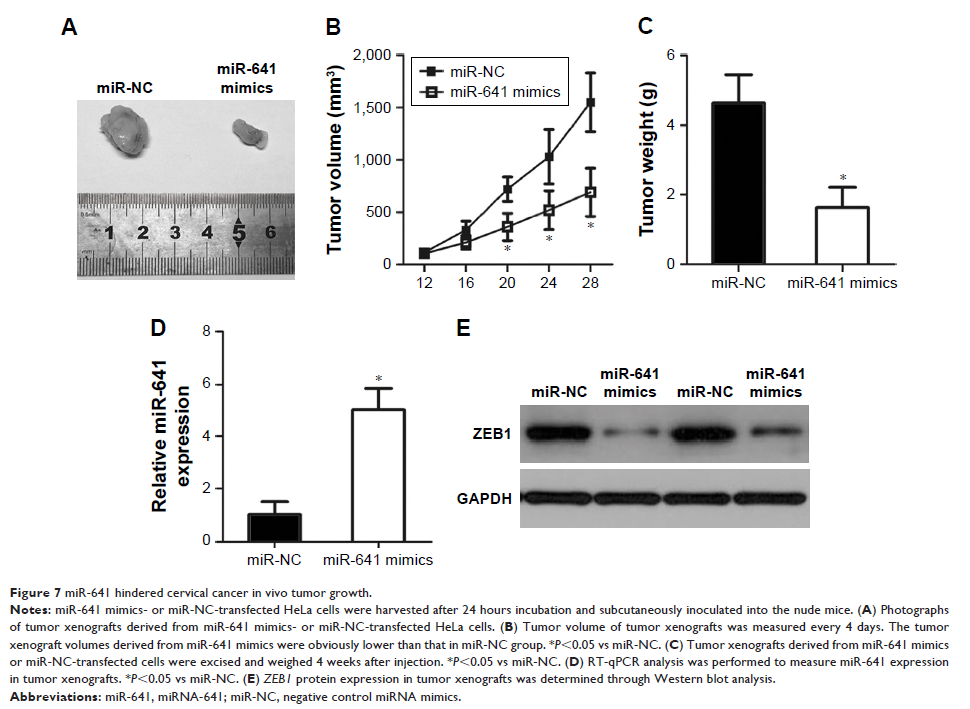
malignant phenotypes of cervical cancer cells. Besides, miR-641 could hinder
cervical cancer tumor growth in vivo by inhibiting ZEB1 .
Conclusion: These
results indicate that miR-641 has tumor suppressive roles in the development of
cervical cancer by directly targeting ZEB1 , suggesting that miR-641 is a novel, effective
therapeutic target for treating patients with this disease.
Keywords: microRNA-641,
target therapy, zinc finger E-Box binding homeobox 1, aggressive behaviors