115195
论文已发表
注册即可获取德孚的最新动态
IF 收录期刊
- 3.6 Breast Cancer (Dove Med Press)
- 4.3 Clin Epidemiol
- 2.6 Cancer Manag Res
- 3.2 Infect Drug Resist
- 4.1 Clin Interv Aging
- 6.1 Drug Des Dev Ther
- 4.1 Int J Chronic Obstr
- 8.7 Int J Nanomed
- 2.5 Int J Women's Health
- 3.2 Neuropsych Dis Treat
- 2.4 OncoTargets Ther
- 2.6 Patient Prefer Adher
- 2.6 Ther Clin Risk Manag
- 3.1 J Pain Res
- 3.5 Diabet Metab Synd Ob
- 4.5 Psychol Res Behav Ma
- 3.4 Nat Sci Sleep
- 2.4 Pharmgenomics Pers Med
- 2.6 Risk Manag Healthc Policy
- 4.6 J Inflamm Res
- 2.3 Int J Gen Med
- 3.9 J Hepatocell Carcinoma
- 3.3 J Asthma Allergy
- 2.5 Clin Cosmet Investig Dermatol
- 3.0 J Multidiscip Healthc

纳米粒子对生殖系统的潜在不利影响
Authors Wang R, Song B, Wu J, Zhang Y, Chen A, Shao LQ
Received 11 April 2018
Accepted for publication 27 September 2018
Published 11 December 2018 Volume 2018:13 Pages 8487—8506
DOI https://doi.org/10.2147/IJN.S170723
Checked for plagiarism Yes
Review by Single-blind
Peer reviewers approved by Dr Cristina Weinberg
Peer reviewer comments 3
Editor who approved publication: Dr Lei Yang
Abstract: With the
vigorous development of nanometer-sized materials, nanoproducts are becoming
widely used in all aspects of life. In medicine, nanoparticles (NPs) can be
used as nanoscopic drug carriers and for nanoimaging technologies. Thus,
substantial attention has been paid to the potential risks of NPs. Previous
studies have shown that numerous types of NPs are able to pass certain
biological barriers and exert toxic effects on crucial organs, such as the
brain, liver, and kidney. Only recently, attention has been directed toward the
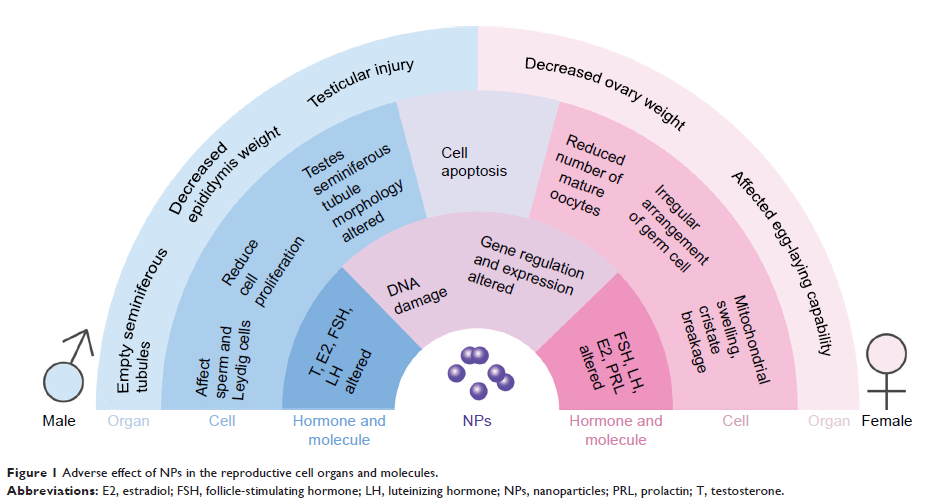
reproductive toxicity of nanomaterials. NPs can pass through the blood–testis
barrier, placental barrier, and epithelial barrier, which protect reproductive
tissues, and then accumulate in reproductive organs. NP accumulation damages
organs (testis, epididymis, ovary, and uterus) by destroying Sertoli cells,
Leydig cells, and germ cells, causing reproductive organ dysfunction that
adversely affects sperm quality, quantity, morphology, and motility or reduces
the number of mature oocytes and disrupts primary and secondary follicular
development. In addition, NPs can disrupt the levels of secreted hormones,
causing changes in sexual behavior. However, the current review primarily
examines toxicological phenomena. The molecular mechanisms involved in NP
toxicity to the reproductive system are not fully understood, but possible
mechanisms include oxidative stress, apoptosis, inflammation, and genotoxicity.
Previous studies have shown that NPs can increase inflammation, oxidative
stress, and apoptosis and induce ROS, causing damage at the molecular and genetic
levels which results in cytotoxicity. This review provides an understanding of
the applications and toxicological effects of NPs on the reproductive system.
Keywords: nanoparticles,
toxic, reproductive, sperm, ovary, ROS