115195
论文已发表
注册即可获取德孚的最新动态
IF 收录期刊
- 3.6 Breast Cancer (Dove Med Press)
- 4.3 Clin Epidemiol
- 2.6 Cancer Manag Res
- 3.2 Infect Drug Resist
- 4.1 Clin Interv Aging
- 6.1 Drug Des Dev Ther
- 4.1 Int J Chronic Obstr
- 8.7 Int J Nanomed
- 2.5 Int J Women's Health
- 3.2 Neuropsych Dis Treat
- 2.4 OncoTargets Ther
- 2.6 Patient Prefer Adher
- 2.6 Ther Clin Risk Manag
- 3.1 J Pain Res
- 3.5 Diabet Metab Synd Ob
- 4.5 Psychol Res Behav Ma
- 3.4 Nat Sci Sleep
- 2.4 Pharmgenomics Pers Med
- 2.6 Risk Manag Healthc Policy
- 4.6 J Inflamm Res
- 2.3 Int J Gen Med
- 3.9 J Hepatocell Carcinoma
- 3.3 J Asthma Allergy
- 2.5 Clin Cosmet Investig Dermatol
- 3.0 J Multidiscip Healthc

多光谱光声层析成像(MSOT)应用聚合物胶束成像显示肿瘤的粒径依赖性分布
Authors Cong ZQ, Yang FF, Cao L, Wen H, Fu TT, Ma SQ, Liu CY, Quan LH, Liao YH
Received 30 August 2018
Accepted for publication 27 November 2018
Published 12 December 2018 Volume 2018:13 Pages 8549—8560
DOI https://doi.org/10.2147/IJN.S185726
Checked for plagiarism Yes
Review by Single-blind
Peer reviewers approved by Dr Alexander Kharlamov
Peer reviewer comments 2
Editor who approved publication: Dr Linlin Sun
Purpose: This
study proposes the utilization of multispectral optoacoustic tomography (MSOT)
to investigate the intratumoral distribution of polymeric micelles and effect
of size on the biodistribution and antitumor efficacy (ATE).
Materials and methods: Docetaxel
and/or optoacoustic agent-loaded polymeric micelles (with diameters of 22, 48,
and 124 nm) were prepared using amphiphilic block copolymers poly (ethylene
glycol) methyl ether-block-poly (D,L lactide) (PEG2000–PDLLAx). Subcutaneous
4T1 tumor-bearing mice were monitored with MSOT imaging and IVIS® Spectrum
in vivo live imaging after tail vein injection of micelles. The in vivo results
and ex vivo confocal imaging results were then compared. Next, ATE of the three
micelles was found and compared.
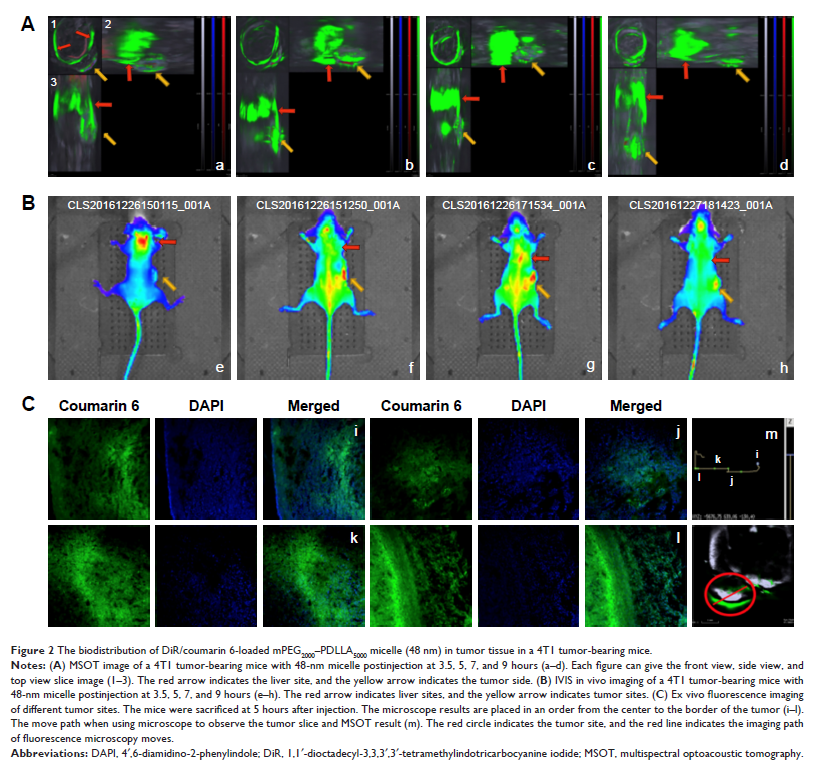
Results: We found that
MSOT imaging offers spatiotemporal and quantitative information on intratumoral
distribution of micelles in living animals. All the polymeric micelles rapidly
extravasated into tumor site after intravenous injection, but only the 22-nm
micelle preferred to distribute into the inner tumor tissues, leading to a
superior ATE than that of 48- and 124-nm micelles.
Conclusion: This study
demonstrated that MSOT is theranostically a powerful imaging modality, offering
quantitative information on size-dependent spatiotemporal distribution patterns
after the extravasation of nanomedicine from tumor blood vessels.
Keywords: multispectral
optoacoustic tomography, MSOT, polymeric micelle, in vivo imaging, intratumoral
distribution, particle size, tumor model